Hanamel
Who was Hanamel in the Bible?
The cousin of the prophet Jeremiah who sold him a field in Anathoth as a symbolic act of faith during the Babylonian siege of Jerusalem.
Hanamel was the son of Shallum and the cousin of the prophet Jeremiah, living during the final years of the Kingdom of Judah in the late 7th to early 6th century BC. He is primarily known for a single but highly significant legal transaction recorded in the Book of Jeremiah, which took place during the height of the Babylonian siege of Jerusalem. While the biblical record concerning Hanamel’s personal life is brief, his role as the seller of family property serves as the catalyst for one of the most powerful visual prophecies in the Old Testament.
As a resident of Anathoth, a city traditionally assigned to the priests in the territory of Benjamin, Hanamel approached Jeremiah with a request to exercise the right of redemption on a family field. This request was not merely a private business matter; it was a divinely orchestrated event intended to provide hope to a nation on the brink of exile. Hanamel’s presence in the biblical narrative illustrates the intersection of ancient Judean property law and prophetic revelation.
Background and Family
Hanamel appears in the biblical record during the tenth year of King Zedekiah’s reign (c. 588–587 BC), a period defined by the terminal decline of the Divided Monarchy. He is identified specifically as the son of Shallum, who was the uncle of the prophet Jeremiah (Jeremiah 32:7). This familial connection places Hanamel within the priestly lineage associated with the town of Anathoth in the land of Benjamin.
Although the text does not explicitly state Hanamel’s profession, his ownership of land in Anathoth—a Levitical city—suggests he was part of the priestly community. During this era, the Babylonian army under Nebuchadnezzar II had surrounded Jerusalem, making agricultural land outside the city walls practically worthless and legally volatile. It is within this atmosphere of geopolitical collapse that Hanamel enters the courtyard of the guard where Jeremiah was being held prisoner.
Major Life Events
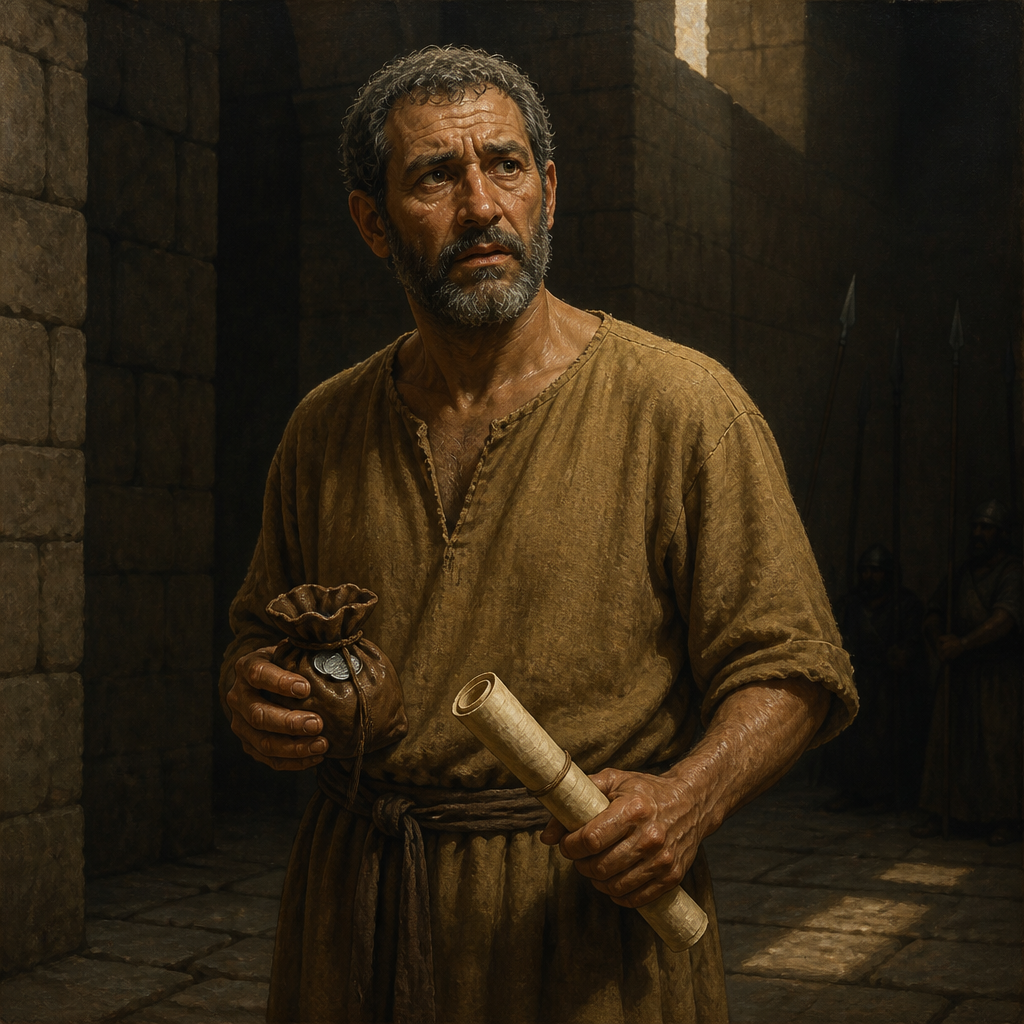
The defining event of Hanamel’s life was his visit to Jeremiah to sell a piece of ancestral property. According to the Mosaic Law (Leviticus 25:25–28), when a relative was forced to sell land due to poverty or impending loss, the nearest kinsman had the "right of redemption" to keep the property within the family. Hanamel approached Jeremiah, saying, “Please buy my field in Anathoth... for you own the right of inheritance and redemption” (Jeremiah 32:8).
Jeremiah, having already received a word from the Lord that Hanamel would come, recognized the request as a divine command. Despite the fact that the Babylonian army occupied the very land Hanamel was selling, Jeremiah performed a formal, public transaction. He weighed out seventeen shekels of silver for Hanamel, signed and sealed the deed of purchase, and summoned witnesses. Hanamel was present for the entire proceedings, watching as the money was paid and the legal documents were handed to Baruch son of Neriah for safekeeping in an earthenware jar.
Relationship to Other Biblical Figures
Hanamel’s primary relationship is with his cousin, Jeremiah. He also interacts indirectly with Baruch, Jeremiah’s scribe, who witnessed the transaction. While Hanamel’s motives are not explicitly critiqued in the text, some scholars suggest his desire to sell the land reflected the general despair of the Judean populace, who believed that land titles were becoming meaningless under Babylonian occupation. By approaching Jeremiah, Hanamel unknowingly facilitated a prophetic sign that would encourage the Jewish people for centuries.
Spiritual Significance
The transaction between Hanamel and Jeremiah serves as a "prophetic enacted parable." To the casual observer, Hanamel was simply offloading a liability to a relative. However, in the theological framework of the Book of Jeremiah, the purchase signified God’s promise that “houses, fields, and vineyards will again be bought in this land” (Jeremiah 32:15). Hanamel’s role was essential in demonstrating that even in the face of judgment and exile, the covenantal promise of the land remained valid. His request to Jeremiah proved that God’s word was active and precise, as the prophet had been forewarned of Hanamel's arrival.
Hanamel is significant because his request to sell family land provided the empirical evidence Jeremiah needed to demonstrate faith in Judah's future. The purchase of Hanamel's field stands as one of the most famous acts of 'hope against hope' in scripture, proving that God's plans for restoration outweighed the immediate reality of destruction. Hanamel himself represents the practical reality of the law of redemption, which later becomes a central theme in Christian soteriology (the concept of the kinsman-redeemer).
Frequently Asked Questions
Who was Hanamel's father?
Hanamel was the son of Shallum, who was the uncle of the prophet Jeremiah.
What town was Hanamel's field located in?
The field was located in Anathoth, which was in the territory of the tribe of Benjamin.
How much did Jeremiah pay Hanamel for the field?
Jeremiah weighed out seventeen shekels of silver for the purchase of the field.
Why did Hanamel want to sell his field?
While the Bible doesn't explicitly state his motive, the context suggests he was exercising the law of redemption during the Babylonian siege, likely because the land was currently occupied by enemy forces and he needed the funds or wanted to preserve the family line of ownership.
Where did the transaction between Hanamel and Jeremiah take place?
The transaction took place in the courtyard of the guard where Jeremiah was being confined by King Zedekiah.
Family & Relationships
Parents
 Shallum, Uncle of JeremiahFatherJeremiah 32:7
Inferred
Jeremiah 32:7 names Hanamel and Shallum in the same verse but does not state a father tie between them; the link rests on the surrounding narrative.Evidence: Jeremiah 32:7
 HanamelThis page
Connected Figures
Family
Father · Jeremiah 32:7
Shallum was the paternal uncle of the prophet Jeremiah and the father of Hanamel during the final years of the Divided Monarchy.
Categories
Mentions by Book
- Jeremiah4
Scripture References
All 4 indexed verses, in canonical order, from the Berean Standard Bible.
Jeremiah · 4
- Jeremiah 32:7
Behold! Hanamel, the son of your uncle Shallum, is coming to you to say, ‘Buy for yourself my field in Anathoth, for you have the right of redemption to buy it.’
- Jeremiah 32:8
Then, as the LORD had said, my cousin Hanamel came to me in the courtyard of the guard and urged me, ‘Please buy my field in Anathoth in the land of Benjamin, for you own the right of inheritance and redemption. Buy it for yourself.’” Then I knew that this was the word of the LORD.
- Jeremiah 32:9
So I bought the field in Anathoth from my cousin Hanamel, and I weighed out seventeen shekels of silver.
- Jeremiah 32:12
and I gave this deed to Baruch son of Neriah, the son of Mahseiah, in the sight of my cousin Hanamel and the witnesses who were signing the purchase agreement and all the Jews sitting in the courtyard of the guard.