Sheshan
Who was Sheshan in the Bible?
A descendant of Judah through the line of Hezron who, lacking male heirs, preserved his lineage by giving his daughter to his Egyptian servant Jarha.
Sheshan was a member of the tribe of Judah who lived during the era of the conquest and the judges. He is situated within the complex genealogies of the Chronicler, specifically identified as the son of Ishi and a descendant of the Jerahmeelite branch of Judah. His presence in the biblical record is relatively brief, appearing exclusively in the first book of Chronicles, yet his narrative represents a significant legal and genealogical case study regarding inheritance and the preservation of a family name.
Historically, Sheshan is defined by a lack of male biological heirs. During a time when the transmission of land and tribal identity was strictly patriarchal in the ancient Near East, Sheshan's circumstances presented a challenge to his family’s survival within the tribal allotments of Judah. The resolution to this dilemma—involving an Egyptian servant named Jarha—serves as a primary example of how genealogical continuity could be maintained through unconventional means within the Israelite community.
Background and Family
Sheshan’s lineage is recorded with precision in the genealogical records of 1 Chronicles 2. He was the son of Ishi, who was the son of Appaim, following the line of Jerahmeel, the firstborn of Hezron, who was in turn the grandson of Judah. The text establishes Sheshan as a legitimate heir within one of the most prominent tribal structures of Israel. The record in 1 Chronicles 2:31 lists the succession: "The son of Appaim: Ishi. The son of Ishi: Sheshan. The son of Sheshan: Ahlai."
While verse 31 mentions Ahlai, subsequent verses clarify the nature of this descent. The Chronicler provides a detailed explanation for the transition of the household, noting that Sheshan faced a crisis of patrilineal succession. The text explicitly states, "Sheshan had no sons, but only daughters" (1 Chronicles 2:34). In the sociocultural context of the era of the conquest and the judges, the absence of a son typically meant the end of a man's name and the potential loss of his ancestral land holdings.
Major Life Events
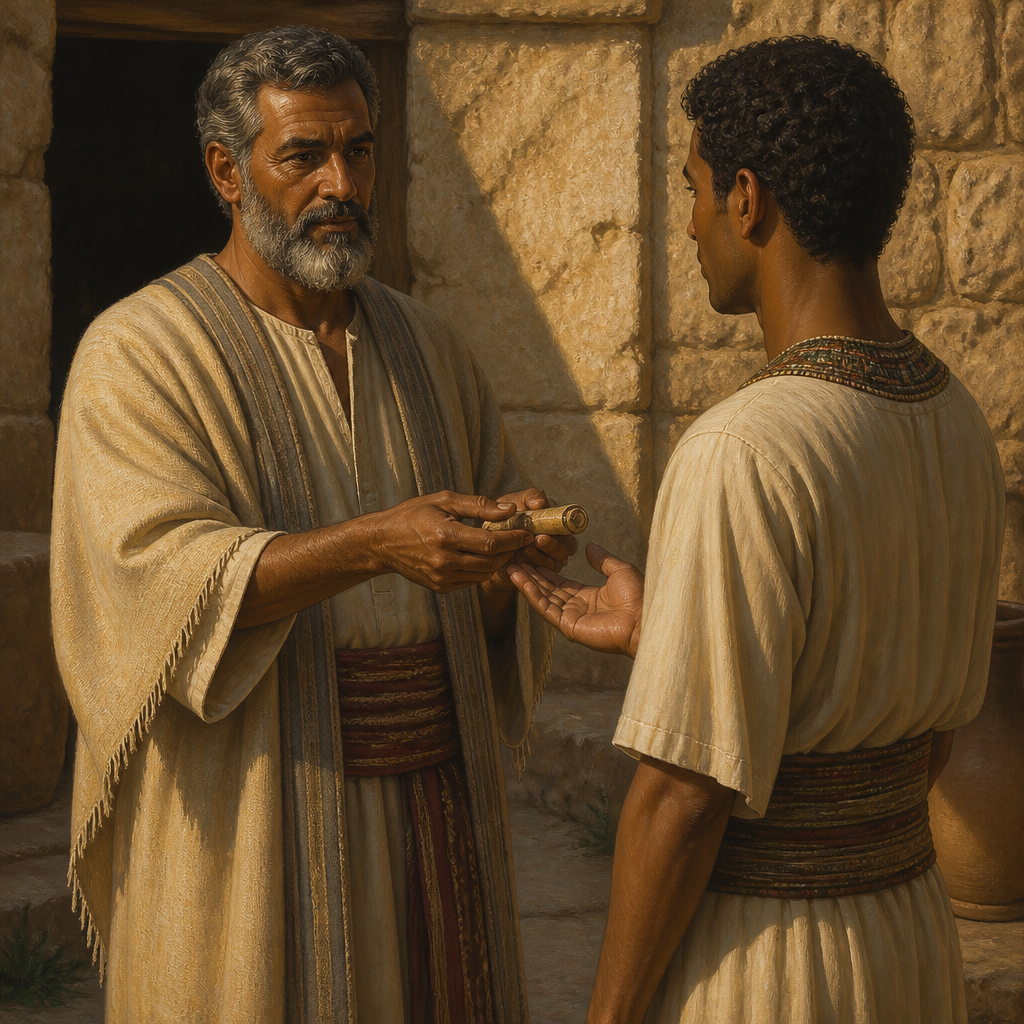
The defining event of Sheshan's life recorded in Scripture is his strategic decision to bypass the biological limitations of his lineage. According to 1 Chronicles 2:34-35, Sheshan possessed an Egyptian servant named Jarha. Rather than allowing his line to go extinct or his property to pass to a distant relative, Sheshan adopted a practice that, while rare, allowed for the incorporation of a servant into the family structure.
Sheshan gave one of his daughters (whose name is not explicitly mentioned, though some scholars associate the name Ahlai with this daughter or the resulting line) in marriage to Jarha. This union was not merely a domestic arrangement but a legal mechanism. By marrying his daughter to his servant, the offspring produced by the union would be counted as Sheshan's own descendants, thereby ensuring that his name and his portion within Judah remained intact. The text records that this union produced a son named Attai, through whom the genealogy continued for several generations.
Relationship to Other Biblical Figures
Sheshan’s relationship with Jarha is unique in the Old Testament. While the Mosaic Law provided for daughters to inherit if no sons existed (as seen in the case of the daughters of Zelophehad), Sheshan’s approach involved the elevation of a foreign servant. Jarha, as an Egyptian, was an outsider to the covenant community of Israel. However, through Sheshan’s intervention, Jarha became the progenitor of a line that would eventually include figures such as Zabad and other notable men listed in the subsequent verses of 1 Chronicles 2.
Spiritual Significance
Though Sheshan is a minor figure in terms of narrative volume, his actions reflect the broader biblical theme of inclusion and the preservation of the covenant promise. By incorporating an Egyptian into the tribe of Judah, Sheshan’s story foreshadows the eventual expansion of the people of God beyond ethnic boundaries. Sheshan represents the pragmatic and faithful effort to honor one’s heritage and ensure that the legacy of the tribe of Judah continued despite personal or biological setbacks.
Sheshan is significant for demonstrating the legal and social flexibility within ancient Israelite tribal structures regarding inheritance. His decision to marry his daughter to his Egyptian servant Jarha highlights how non-Israelites could be integrated into the tribal identity of Judah, ensuring the continuity of a family line that would otherwise have been extinguished. Proving that their place in Israel was divinely and legally sanctioned.
Frequently Asked Questions
Did Sheshan have any sons?
No, 1 Chronicles 2:34 explicitly states that 'Sheshan had no sons, but only daughters.'
Who was Jarha in relation to Sheshan?
Jarha was Sheshan’s Egyptian servant. Sheshan gave his daughter to Jarha in marriage to produce an heir for his household.
Which tribe did Sheshan belong to?
Sheshan belonged to the Tribe of Judah, specifically the Jerahmeelite branch.
Who was Sheshan's father?
Sheshan was the son of Ishi.
What happened to Sheshan's inheritance?
Because he married his daughter to Jarha, his grandson Attai became his heir, preserving his name and property within the tribe of Judah.
Family & Relationships
Parents
 Ishi, Son of AppaimFather1 Chronicles 2:31Stated
 SheshanThis page
Children
 Ahlai, Daughter of SheshanDaughter1 Chronicles 2:31Stated
Extended family
 Nathan, Son of AttaiGrandson1 Chronicles 2:31
Inferred
No verse names Sheshan and Nathan together; the grandson link is carried from the surrounding genealogy and is not stated in Scripture.Evidence: 1 Chronicles 2:31
 Elishama, Son of JekamiahDescendant1 Chronicles 2:31
Inferred
No verse names Sheshan and Elishama together; the descendant link is carried from the surrounding genealogy and is not stated in Scripture.Evidence: 1 Chronicles 2:31
 EphlalDescendant1 Chronicles 2:31
Inferred
No verse names Ephlal and Sheshan together; the ancestor link is carried from the surrounding genealogy and is not stated in Scripture.Evidence: 1 Chronicles 2:31
 Jehu, Son of ObedDescendant1 Chronicles 2:31
Inferred
No verse names Sheshan and Jehu together; the descendant link is carried from the surrounding genealogy and is not stated in Scripture.Evidence: 1 Chronicles 2:31
 Obed, Descendant of JarhaDescendant1 Chronicles 2:31
Inferred
No verse names Sheshan and Obed together; the descendant link is carried from the surrounding genealogy and is not stated in Scripture.Evidence: 1 Chronicles 2:31
 SismaiDescendant1 Chronicles 2:35
Inferred
No verse names Sismai and Sheshan together; the ancestor link is carried from the surrounding genealogy and is not stated in Scripture.Evidence: 1 Chronicles 2:35
Connected Figures
Family
Father · 1 Chronicles 2:31
A descendant of Judah through the line of Hezron and Jerahmeel, identified as the son of Appaim and the father of Sheshan.
Daughter · 1 Chronicles 2:31
A woman of the tribe of Judah whose lineage preserved her father Sheshan’s inheritance through her marriage to an Egyptian servant.
Grandson · 1 Chronicles 2:31
A member of the tribe of Judah mentioned in the genealogical records of 1 Chronicles during the United Monarchy.
Descendant · 1 Chronicles 2:31
A member of the tribe of Judah recorded in the post-exilic genealogies as the son of Jekamiah.
Descendant · 1 Chronicles 2:31
A member of the tribe of Judah and a descendant of Hezron, Ephlal is identified in the biblical genealogies as the son of Zabad and the father of Obed.
Descendant · 1 Chronicles 2:31
Jehu was a member of the Tribe of Judah and a descendant of Sheshan, appearing in the genealogical records of the Divided Monarchy.
Descendant · 1 Chronicles 2:31
A member of the tribe of Judah during the Divided Monarchy, Obed was the son of Ephlal and a link in the genealogical line of the Sheshanite clan.
Descendant · 1 Chronicles 2:35
A descendant of Judah through the line of Jerahmeel during the Divided Monarchy, recorded in the genealogies of the Chronicler.
Mentions by Book
- 1 Chronicles11
Scripture References
All 11 indexed verses, in canonical order, from the Berean Standard Bible.
1 Chronicles · 11
- 1 Chronicles 2:31Partial
The son of Appaim: Ishi. The son of Ishi: Sheshan. The son of Sheshan: Ahlai.
- 1 Chronicles 2:32Partial
The sons of Jada the brother of Shammai: Jether and Jonathan. Jether died without children.
Cited as evidence on a family card; added so References, Key Verses and Mentions by Book share one index.
- 1 Chronicles 2:33Partial
The sons of Jonathan: Peleth and Zaza. These were the descendants of Jerahmeel.
Cited as evidence on a family card; added so References, Key Verses and Mentions by Book share one index.
- 1 Chronicles 2:34Partial
Sheshan had no sons, but only daughters. He also had an Egyptian servant named Jarha.
- 1 Chronicles 2:35
Sheshan gave his daughter in marriage to his servant Jarha, and she bore to him Attai.
- 1 Chronicles 2:36Partial
Attai was the father of Nathan, Nathan was the father of Zabad,
Cited as evidence on a family card; added so References, Key Verses and Mentions by Book share one index.
- 1 Chronicles 2:37Partial
Zabad was the father of Ephlal, Ephlal was the father of Obed,
Cited as evidence on a family card; added so References, Key Verses and Mentions by Book share one index.
- 1 Chronicles 2:38Partial
Obed was the father of Jehu, Jehu was the father of Azariah,
Cited as evidence on a family card; added so References, Key Verses and Mentions by Book share one index.
- 1 Chronicles 2:39Partial
Azariah was the father of Helez, Helez was the father of Elasah,
Cited as evidence on a family card; added so References, Key Verses and Mentions by Book share one index.
- 1 Chronicles 2:40Partial
Elasah was the father of Sismai, Sismai was the father of Shallum,
Cited as evidence on a family card; added so References, Key Verses and Mentions by Book share one index.
- 1 Chronicles 2:41Partial
Shallum was the father of Jekamiah, and Jekamiah was the father of Elishama.
Cited as evidence on a family card; added so References, Key Verses and Mentions by Book share one index.