Ehud, Son of Gera
Who was Ehud, Son of Gera, in the Bible?
A left-handed Benjamite judge and patriarch who delivered Israel from eighteen years of Moabite oppression by assassinating King Eglon.
This is one of 2 people named Ehud in the Bible. See all 2 →
Ehud, the son of Gera, stands as one of the most distinctive figures in the Period of the Judges. A member of the tribe of Benjamin, his narrative is defined by his unique physical characteristic—being left-handed—and his tactical brilliance in single-handedly ending the Moabite hegemony over Israel. At a time when the Israelites had fallen into apostasy and were subjected to Eglon, the King of Moab, for eighteen years, Ehud was raised by God as a deliverer in response to the people's cries for help.
His story, recorded primarily in the third chapter of the Book of Judges, is characterized by its visceral detail and military precision. Unlike the sweeping battlefield victories of other judges, Ehud’s success hinged on a clandestine mission and the exploitation of his opponent's expectations. Beyond his role as a military savior, the genealogical records in 1 Chronicles identify him as a patriarchal head of Benjamite families, underscoring his lasting legacy within the tribal structure of Israel.
Background and Family
Ehud was the son of Gera, belonging to the tribe of Benjamin. The tribal affiliation is significant, as the name 'Benjamin' literally translates to 'son of the right hand,' yet Ehud is explicitly identified in Judges 3:15 as being ish itter yad-yemino—a man restricted in his right hand, or left-handed. Scholars often debate whether this indicated a physical disability or a specialized military training common among Benjamites, who were noted for their ambidextrous or left-handed slingers (cf. Judges 20:16).
In the broader genealogical context of the Old Testament, Ehud is listed as a significant patriarchal figure within his tribe. According to 1 Chronicles 8:6, he was the head of the ancestral houses of the inhabitants of Geba. His descendants were later exiled to Manahath, and the text names several of his children, including Ahihud, Ahijah, Naaman, Gera, and Uzza. This highlights that while his military exploit is his most famous contribution, he was also a foundational figure in the demographic and social organization of the tribe of Benjamin during the pre-monarchic era.
Major Life Events
The Oppression of Eglon
After the death of the judge Othniel, the Israelites 'again did evil in the sight of the Lord.' As a consequence, God strengthened Eglon, the King of Moab, to defeat Israel. Eglon, allied with the Ammonites and Amalekites, captured the City of Palms (Jericho) and subjected Israel to tribute for eighteen years. In their distress, the Israelites petitioned God for a deliverer, and Ehud was chosen for the task.
The Assassination of the King
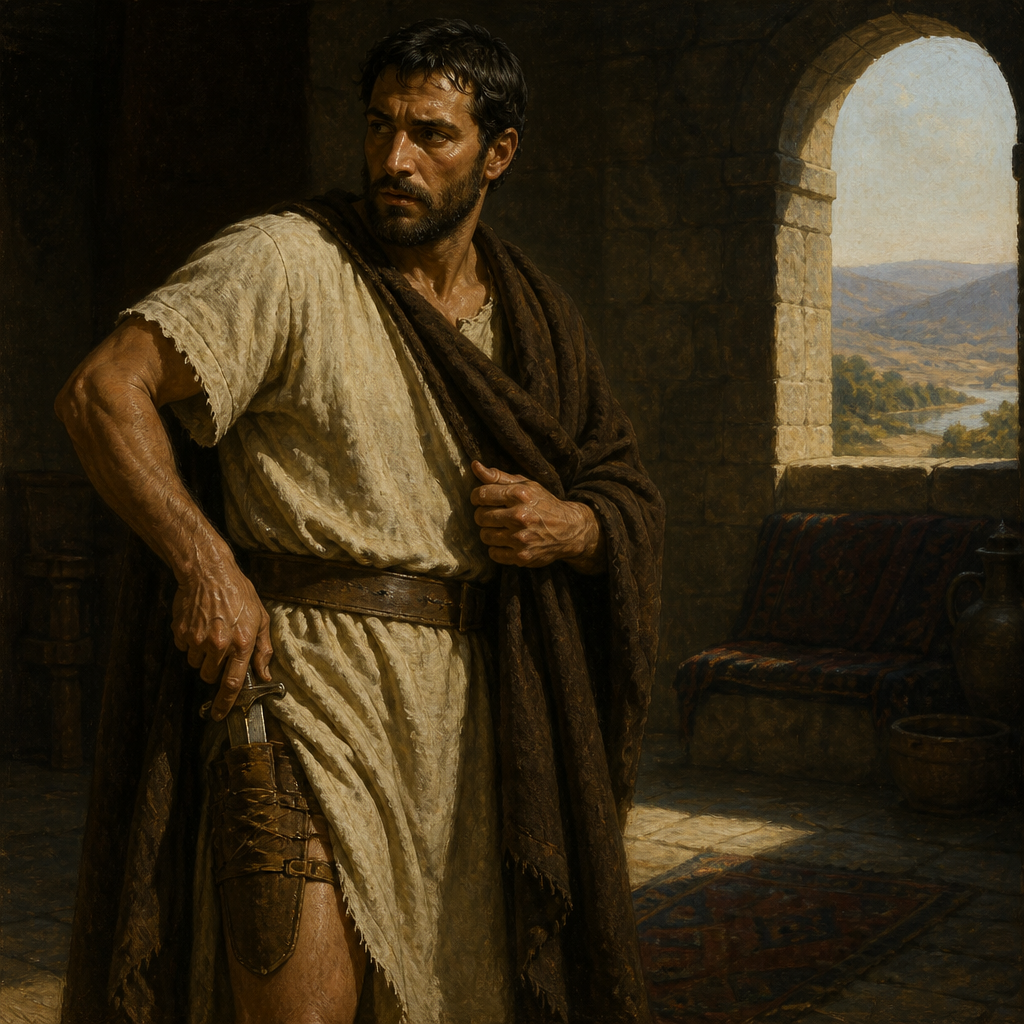
Ehud was selected to carry the tribute to King Eglon. Preparation for this mission involved Ehud fashioning a bespoke weapon: a double-edged sword (a cubit in length). He strategically strapped this blade to his right thigh, hidden under his garments. Because traditional warriors wore their swords on the left hip for a right-handed draw, a search by Eglon’s guards likely missed the weapon concealed for a left-handed draw.
After presenting the tribute, Ehud dismissed his companions and returned to Eglon’s palace, claiming to have a 'secret message' for the king. Eglon, seeking privacy, dismissed his attendants in his cool roof chamber. Ehud approached him, stating, 'I have a word from God for you.' As the king rose, Ehud used his left hand to draw the sword and plunged it into Eglon’s abdomen. The biblical text provides the graphic detail that the king's obesity caused the fat to close over the blade, preventing Ehud from withdrawing it.
The Escape and Victory
Ehud exhibited remarkable composure following the act. He locked the doors of the upper chamber from the inside and exited through the porch. The king’s servants, finding the doors locked, assumed the king was relieving himself and hesitated to interrupt. This delay allowed Ehud to escape past the 'idols' (or stone quarries) near Gilgal to the hill country of Ephraim. There, he sounded the ram’s horn, rallying the Israelites. Under his leadership, they seized the fords of the Jordan, cutting off the Moabite retreat and killing approximately 10,000 Moabite men of valor. This victory secured eighty years of peace for the land.
Relationship to Other Biblical Figures
Ehud is the second judge mentioned in the Book of Judges, following Othniel and preceding Shamgar. His lineage connects him directly to the patriarchal line of Benjamin, as he is the son of Gera (a name that appears frequently in Benjamite genealogies). His role as a deliverer established a pattern of 'charismatic leadership' where God empowered specific individuals to meet specific national crises. The silence of the text regarding his interactions with other major figures suggests his primary role was that of a solitary strategic operative and later a national military commander.
Spiritual Significance
Theologically, the story of Ehud emphasizes that God utilizes the unconventional to achieve His purposes. In a culture that favored the 'right hand' as a symbol of strength and favor, God used a 'restricted' or left-handed man to topple a powerful oppressor. His declaration, 'I have a word from God for you,' serves as a double entendre; while the king expected a verbal prophecy, the 'word' was the physical execution of divine judgment.
Ehud’s life also illustrates the cycle of the Judges: sin, oppression, supplication, and deliverance. His long period of rest—eighty years—is the longest recorded in the book, signifying the thoroughness of the deliverance God provided through him. However, the narrative ends on a somber note in Judges 4:1, stating that after Ehud died, the people returned to evil, showing that while a judge could provide temporary physical peace, they could not permanently rectify the heart of the nation.
Ehud serves as a primary example of the 'Deliverer' archetype in the Old Testament, demonstrating how God responds to the repentance of His people. His narrative is significant for its emphasis on divine providence through human ingenuity; he did not wait for a miracle but acted with strategic planning and personal courage. The detail of his left-handedness serves a literary and theological function, showcasing how God employs the 'weak' or 'different' to shame the strong.
Furthermore, Ehud’s mention in 1 Chronicles 8 affirms his status as a historical patriarch. He is not merely a folk hero of a single battle but a founding father whose descendants helped shape the Benjamite identity. His story reinforces the theme that Israel's security was entirely dependent on their covenantal faithfulness to God and the quality of the leaders God provided in response to their needs.
Frequently Asked Questions
Why is it important that Ehud was left-handed?
Being left-handed allowed Ehud to hide his sword on his right thigh, a place where guards would not typically expect to find a weapon. This physical trait was the key to his successful infiltration and assassination of King Eglon.
What happened to King Eglon's guards during the assassination?
Ehud asked for a private audience, so the guards were dismissed by Eglon himself. After Ehud locked the doors and left, the guards waited outside, assuming the king was using the bathroom, which gave Ehud time to escape.
How long did Israel have peace after Ehud's victory?
The Bible records that after Ehud defeated the Moabites, the land had rest for eighty years (Judges 3:30), the longest period of peace mentioned in the Book of Judges.
Who were the children of Ehud?
According to 1 Chronicles 8:6-7, Ehud was the father of Ahihud, Ahijah, Naaman, Gera, and Uzza, and he was a head of the families in Geba.
Where did Ehud go to rally the Israelites?
After escaping to Seirah, Ehud went to the hill country of Ephraim and blew a trumpet (ram's horn) to summon the Israelites to battle.
Family & Relationships
Parents
 Gera, Son of BenjaminFatherJudges 3:15Stated
 Ehud, Son of GeraThis page
Children
 Ahijah, Son of EhudSon1 Chronicles 8:6–7Stated
 Gera, Son of EhudSon1 Chronicles 8:6–7Stated
 Naaman, Son of EhudSon1 Chronicles 8:6–7Stated
Connected Figures
Family
Father · Judges 3:15
Gera was a son of the patriarch Benjamin and a foundational member of the tribe of Benjamin during the migration to Egypt.
Son · 1 Chronicles 8:6–7
Ahijah was a member of the tribe of Benjamin and a descendant of Ehud, listed among those who were carried into exile.
Son · 1 Chronicles 8:6–7
A Benjamite leader and son of Ehud who participated in the relocation of his family to Manahath.
Son · 1 Chronicles 8:6–7
A Benjamite descendant of Ehud who is recorded in the genealogical records of the tribe of Benjamin as having been carried into exile.
Categories
Mentions by Book
- Judges8
- 1 Chronicles2
Scripture References
All 10 indexed verses, in canonical order, from the Berean Standard Bible.
Judges · 8
- Judges 3:15
And again they cried out to the LORD, and He raised up Ehud son of Gera, a left-handed Benjamite, as their deliverer. So they sent him with tribute to Eglon king of Moab.
- Judges 3:16
Now Ehud had made for himself a double-edged sword a cubit long. He strapped it to his right thigh under his cloak
- Judges 3:20Partial
Then Ehud approached him while he was sitting alone in the coolness of his upper room. “I have a word from God for you,” Ehud said, and the king rose from his seat.
- Judges 3:21
And Ehud reached with his left hand, pulled the sword from his right thigh, and plunged it into Eglon’s belly.
- Judges 3:23
Then Ehud went out through the porch, closing and locking the doors of the upper room behind him.
- Judges 3:26
Ehud, however, had escaped while the servants waited. He passed by the idols and escaped to Seirah.
- Judges 3:30Partial
So Moab was subdued under the hand of Israel that day, and the land had rest for eighty years.
Cited as a key verse; added so References, Key Verses and Mentions by Book share one index.
- Judges 4:1
After Ehud died, the Israelites again did evil in the sight of the LORD.
1 Chronicles · 2
- 1 Chronicles 8:6
These were the descendants of Ehud who were the heads of the families living in Geba and were exiled to Manahath:
- 1 Chronicles 8:7Partial
Naaman, Ahijah, and Gera, who carried them into exile and who was the father of Uzza and Ahihud.
Cited as evidence on a family card; added so References, Key Verses and Mentions by Book share one index.
Others Named Ehud
Compare all 2 bearers →Ehud, Son of Bilhan1 Chronicles 7:10
A Benjamite descendant and son of Bilhan who is listed within the tribal genealogies of 1 Chronicles during the Egypt and Wilderness era.