Shamgar
Who was Shamgar in the Bible?
A judge of Israel who delivered the nation by slaying six hundred Philistines with an oxgoad during a period of severe oppression.
Shamgar is one of the most enigmatic figures in the Book of Judges. Though his biblical record is extremely brief—appearing in only two verses—he is explicitly credited with the salvation of Israel. He succeeded Ehud in the chronological sequence of leaders during the period of the Judges, a time characterized by tribal fragmentation and external threats.
His identification as the 'son of Anath' and his use of a non-traditional weapon, the oxgoad, have sparked significant scholarly debate regarding his background and status within the Israelite community. Despite the lack of biographical detail, the biblical text places him firmly within the tradition of the military deliverers raised by God to counter foreign aggression, specifically the rising power of the Philistines.
Background and Family
The biblical record provides no information regarding Shamgar’s tribe or birthplace. He is identified exclusively as the 'son of Anath' (Judges 3:31; 5:6). This patronymic has led to several scholarly interpretations. Some suggest 'Anath' refers to his father, while others note that Anath was the name of a Canaanite goddess of war, potentially suggesting Shamgar had a non-Israelite or Canaanite background, or that he came from a town named Beth-anath. However, the text does not confirm these theories, leaving his precise lineage unknown.
Major Life Events
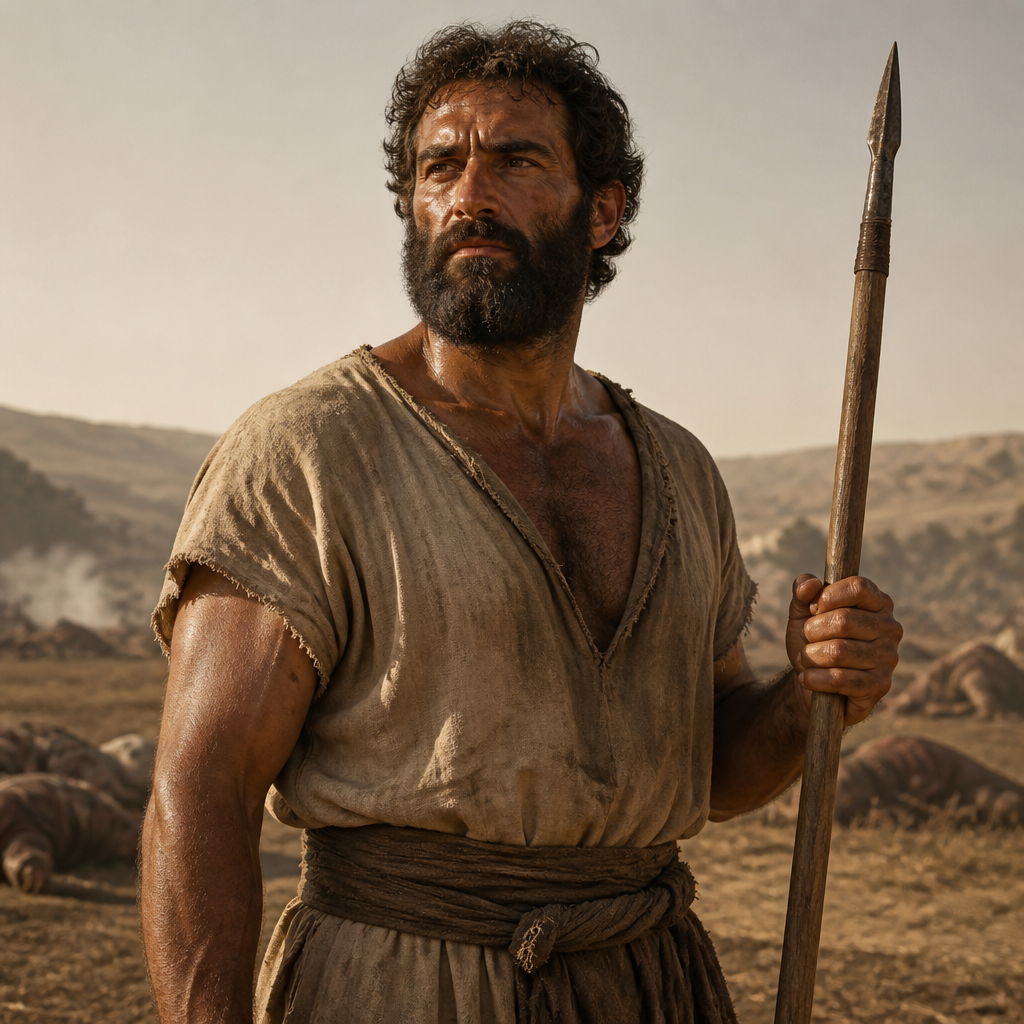
Shamgar’s primary contribution to the history of Israel was a singular, decisive military action. According to Judges 3:31, he struck down six hundred Philistines using only an oxgoad—a long wooden pole tipped with a metal point used for driving cattle. This feat suggests a moment of sudden, perhaps desperate, intervention against a Philistine incursion. The text explicitly states that through this act, Shamgar 'too saved Israel.'
The state of the land during his era is further described in the Song of Deborah. Judges 5:6 notes that 'in the days of Shamgar,' the highways were so dangerous that they were 'deserted,' and travelers were forced to take 'byways' or winding paths to avoid detection. This implies a period of lawlessness and heavy oppression where the central authorities were unable to protect the common populace.
Relationship to Other Biblical Figures
Chronologically, Shamgar followed the judge Ehud. His mention in the Song of Deborah links his era to that of Jael, the woman who killed the Canaanite general Sisera. While the text does not record a direct meeting between Shamgar and other judges, he is positioned as a transitional figure between the deliverance from the Moabites (under Ehud) and the later struggle against the Canaanites led by Deborah and Barak.
Spiritual Significance
Shamgar represents the biblical theme of God utilizing unlikely individuals and unconventional means to achieve national deliverance. Like Samson after him, Shamgar fought the Philistines with a common tool rather than standardized weaponry. His inclusion in the list of judges, despite the brevity of his mention, underscores the theological point that the 'saving' of Israel was an act of divine providence rather than a result of Israel's military sophistication or stable political structure.
Shamgar serves as a critical link in the narrative of the Judges, demonstrating that God’s deliverance is not limited by the social status or the equipment of the deliverer. His use of an oxgoad highlights the dire straits of the Israelites, who often lacked conventional iron weapons during the early Iron Age transition.
Theologically, Shamgar's brief mention alongside major figures like Deborah serves to validate his role as a legitimate agent of God. He is remembered as one who stood in the gap during a time when the nation's infrastructure had collapsed, and travel was unsafe, providing a temporary reprieve from Philistine pressure.
Frequently Asked Questions
What is an oxgoad?
An oxgoad was a farm tool, typically a wooden pole about eight feet long, with a sharp metal point at one end for prodding oxen and a flat scraper at the other for cleaning a plow.
Was Shamgar an Israelite?
The Bible does not specify his tribe. His name and his father's name (Anath) have led some scholars to wonder if he was of Hurrian or Canaanite descent, but the text treats him as a savior of Israel.
How many Philistines did Shamgar kill?
According to Judges 3:31, Shamgar killed six hundred Philistines.
In which book of the Bible is Shamgar mentioned?
Shamgar is mentioned only in the Book of Judges, specifically in chapters 3 and 5.
Family & Relationships
Parents
 AnathParentJudges 3:31Stated
 ShamgarThis page
Connected Figures
Family
Parent · Judges 3:31
Anath was a figure from the era of the Judges, identified in the biblical text exclusively as the parent of Shamgar, a judge who delivered Israel from the Philistines.
Conquest and JudgesFirst: Judges 3:312 versesParent of a Judge
Categories
Mentions by Book
- Judges2
Scripture References
All 2 indexed verses, in canonical order, from the Berean Standard Bible.
Judges · 2
- Judges 3:31
After Ehud came Shamgar son of Anath. And he too saved Israel, striking down six hundred Philistines with an oxgoad.
- Judges 5:6
In the days of Shamgar son of Anath, in the days of Jael, the highways were deserted and the travelers took the byways.