Philip the Tetrarch
Who was Philip the Tetrarch in the Bible?
Philip the Tetrarch was a son of Herod the Great who ruled the northern territories of Roman Palestine for 37 years with a reputation for justice and moderation.
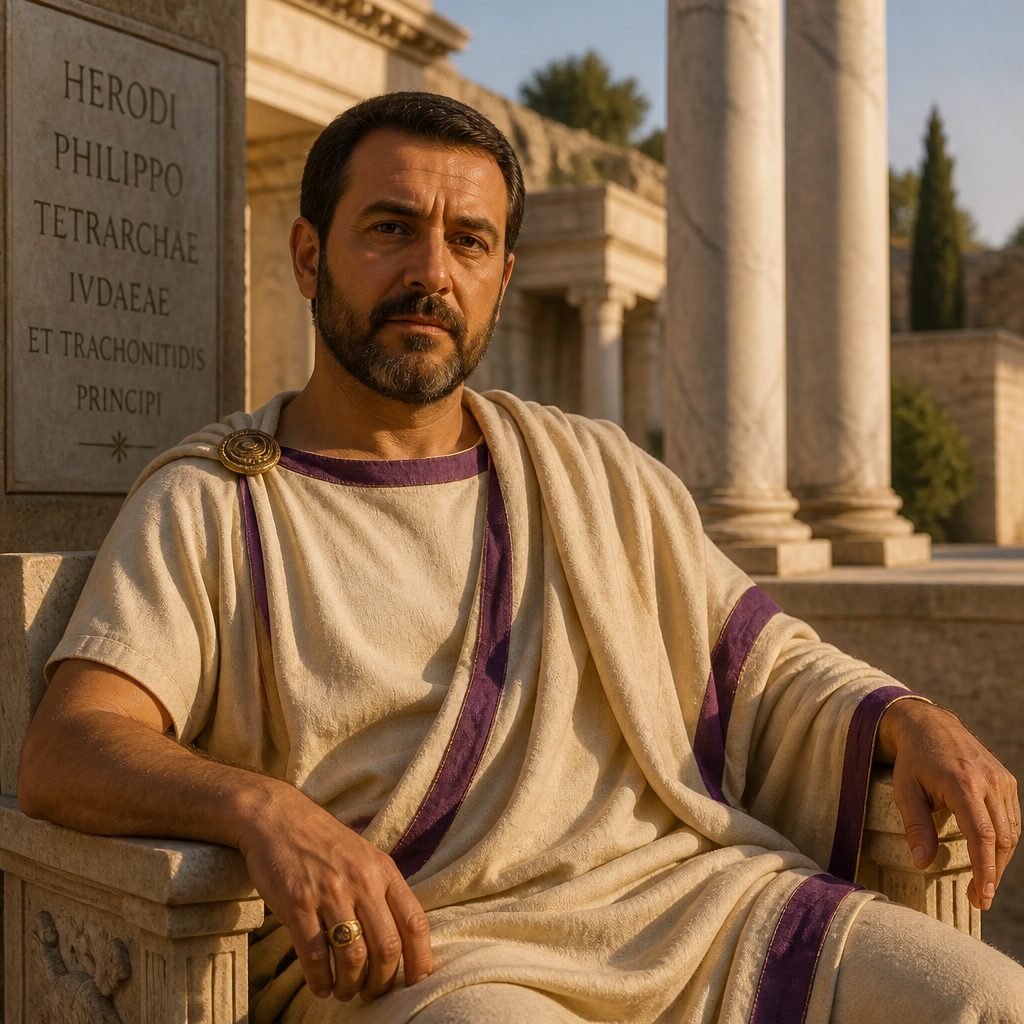
Philip the Tetrarch, also known as Herod Philip II, was a significant political figure in the Levant during the life of Jesus Christ. Born to Herod the Great and Cleopatra of Jerusalem, he inherited a portion of his father's fragmented kingdom following Herod's death in 4 BC. Unlike his more infamous brothers, Archelaus and Herod Antipas, Philip is generally characterized by historians of the period as a fair and peaceful ruler who avoided the dynastic scandals that plagued the rest of the Herodian line.
His primary biblical significance lies in his role as a territorial marker in the New Testament. The Gospel of Luke uses his reign to anchor the chronological beginning of the ministry of John the Baptist. Furthermore, the territories he governed, particularly the region of Caesarea Philippi, served as the backdrop for one of the most pivotal moments in the life of Jesus: the Petrine Confession of Christ's divinity.
Background and Family
Philip was one of the many sons of Herod the Great, the Roman-appointed King of the Jews. His mother was Cleopatra of Jerusalem, a woman of high standing whom Herod married during his long and tumultuous reign. Philip was raised and educated in Rome, a common practice for the offspring of client kings to ensure their loyalty to the Empire and their familiarity with Roman administration.
Upon the death of Herod the Great in 4 BC, his kingdom was divided among three of his sons by the Roman Emperor Augustus, despite the chaotic disputes regarding Herod’s final will. While Archelaus received Judea and Samaria, and Antipas received Galilee and Perea, Philip was granted the northern and northeastern territories. This region included Iturea, Trachonitis, Batanea, Aurantis, and Gaulanitis. These lands were largely populated by a mix of Greeks, Syrians, and Jews, making for a complex, multicultural administrative environment.
Major Life Events
Philip’s reign was remarkably long, lasting approximately 37 years (4 BC – AD 34). Historically, he is noted for his civil development projects. His most famous endeavor was the rebuilding and expansion of the ancient town of Paneas at the foot of Mount Hermon, which he renamed Caesarea Philippi in honor of Augustus Caesar and himself (to distinguish it from the coastal Caesarea Maritima). He also elevated the village of Bethsaida, located on the northern shore of the Sea of Galilee, to the status of a city, renaming it Julias in honor of the daughter of Augustus.
Unlike his brothers, who were frequently embroiled in accusations of cruelty or political intrigue, the historian Flavius Josephus describes Philip as a man of "moderation and quietness." Josephus records that Philip spent much of his time traveling through his districts with a small retinue, carrying his portable throne so that he could hear the legal cases of his subjects the moment they approached him. He died in AD 34, and because he left no heirs, his territories were briefly annexed to the province of Syria before being granted to his nephew, Herod Agrippa I.
Relationship to Other Biblical Figures
Philip's primary connection to the biblical narrative is geographic and chronological. Luke 3:1 establishes the historical context of Jesus' ministry by listing the concurrent rulers, naming Philip as the tetrarch of Iturea and Trachonitis.
In the Gospels of Matthew and Mark, the region under his control is the setting for the "Confession of Peter." It was in the "region of Caesarea Philippi" that Jesus asked His disciples, "Who do people say that the Son of Man is?" (Matthew 16:13). The choice of this location is significant; the city was a center of pagan worship, specifically dedicated to the Greek god Pan and the cult of the Emperor. It was against this backdrop of worldly power and mythological deity that Peter declared Jesus to be "the Christ, the Son of the living God."
It is important for students of the Bible to distinguish Philip the Tetrarch from two other men: Philip the Apostle (one of the Twelve) and Philip the Evangelist (one of the seven deacons in Acts). Furthermore, a common source of confusion arises regarding Herodias. While the Synoptic Gospels state that Herodias had been married to "Philip" (Matthew 14:3; Mark 6:17) before joining Herod Antipas, many historians believe this refers to a different half-brother, sometimes called Herod Philip I, who lived as a private citizen in Rome, rather than the Tetrarch Philip described here.
Spiritual Significance
Philip the Tetrarch provides an essential chronological anchor for the New Testament, appearing in the formal dating of the ministries of John the Baptist and Jesus. His reign over the northern territories established the socio-political landscape of areas like Caesarea Philippi and Bethsaida, which were central to Christ's late Galilean ministry.
His character, noted for justice and stability, contrasts with the volatile nature of other Herodian rulers mentioned in the gospels. The stability of his districts allowed for the safe transit of Jesus and His disciples during periods of intense persecution, making his administrative success an unwitting facilitator for key moments in redemptive history.
While Philip the Tetrarch is not portrayed as a personal follower of Jesus, his presence in the biblical text serves as a witness to the fulfillment of Jewish prophecy in a Roman context. His stable rule provided a relatively peaceful environment in the northern regions where Jesus occasionally sought retreat from the crowds and the rising hostility of the Judean authorities.
Spiritually, the territory of Philip serves as a theological bridge. By leading His disciples into the borders of Philip’s realm, Jesus demonstrated that His mission extended beyond the traditional heartland of Judea into the regions inhabited by Gentiles and the "lost sheep" of the northern tribes. The transformation of Caesarea Philippi from a site of paganism to the site of Christ's self-revelation signifies the dawning of a new kingdom that would eventually supersede the temporary political structures of the Herodian tetrarchs.
Josephus makes him a son of Herod the Great by Cleopatra of Jerusalem and the husband of Herodias' daughter; Scripture says only that he was tetrarch of Iturea and the brother of Herod the tetrarch (Luke 3:1).
Frequently Asked Questions
Was Philip the Tetrarch the same man who married Herodias?
This is a point of scholarly debate. Mark 6:17 identifies Herodias's first husband as Philip. However, most historians, including Josephus, indicate Herodias was married to a different half-brother of the tetrarch, often called Herod Philip I, who lived as a private citizen. It is possible the two shared the name or the Gospel writers used a common family name.
What is a 'Tetrarch'?
A tetrarch is a Greek term meaning 'ruler of a fourth part.' Following the death of Herod the Great, the Romans divided his kingdom into four parts (though technically three sons and a city-state shared it) to prevent any one descendant from becoming too powerful.
Is Philip the Tetrarch mentioned in the book of Acts?
No. By the time the events of the middle and late Book of Acts take place, Philip had died (AD 34), and his territories had eventually passed to his nephew, Herod Agrippa I.
Did Philip the Tetrarch ever meet Jesus?
There is no biblical or historical record of a meeting between Philip and Jesus. However, Jesus performed significant ministry within Philip's jurisdiction, specifically near Caesarea Philippi and Bethsaida.
What happened to his land after he died?
Since Philip died without an heir, Emperor Tiberius initially annexed his tetrarchy to the Roman province of Syria. Later, Emperor Caligula granted these lands to Philip's nephew, Agrippa I, in AD 37.
Family & Relationships
 Philip the TetrarchThis page
 Herod AntipasBrotherLuke 3:1Stated
Connected Figures
Family
Brother · Luke 3:1
The regional ruler of Galilee and Perea who beheaded John the Baptist and participated in the trial of Jesus Christ.
The GospelsFirst: Matthew 14:125 versesTetrarch of Galilee and Perea
Categories
Mentions by Book
- Matthew3
- Mark1
- Luke1
Scripture References
All 5 indexed verses, in canonical order, from the Berean Standard Bible.
Matthew · 3
- Matthew 2:22Partial
But when he learned that Archelaus was reigning in Judea in place of his father Herod, he was afraid to go there. And having been warned in a dream, he withdrew to the district of Galilee,
Cited as evidence on a family card; added so References, Key Verses and Mentions by Book share one index.
- Matthew 14:3Partial
Now Herod had arrested John and bound him and put him in prison on account of Herodias, his brother Philip’s wife,
Cited as evidence on a family card; added so References, Key Verses and Mentions by Book share one index.
- Matthew 16:13Partial
When Jesus came to the region of Caesarea Philippi, He questioned His disciples: “Who do people say the Son of Man is?”
Cited as a key verse; added so References, Key Verses and Mentions by Book share one index.
Mark · 1
- Mark 15:40Partial
And there were also women watching from a distance. Among them were Mary Magdalene, Mary the mother of James the younger and of Joses, and Salome.
Cited as evidence on a family card; added so References, Key Verses and Mentions by Book share one index.
Luke · 1
- Luke 3:1
In the fifteenth year of the reign of Tiberius Caesar, while Pontius Pilate was governor of Judea, Herod tetrarch of Galilee, his brother Philip tetrarch of Ituraea and Trachonitis, and Lysanias tetrarch of Abilene,