Mary, Mother of James and Joses
A dedicated follower of Jesus who witnessed His crucifixion, prepared for His burial, and was among the first to witness the empty tomb.
Mary, identified primarily by her relationship to her sons James and Joses, was one of the faithful women who accompanied Jesus during His ministry in Galilee and followed Him to Jerusalem. Though the biblical record provides limited details regarding her background, her presence at the most critical moments of the Gospel narrative—the crucifixion and the resurrection—underscores her significance within the early community of disciples. In the Synoptic Gospels, she is often mentioned alongside Mary Magdalene and other women who provided for Jesus out of their resources.
Historically, this Mary is distinguished by her maternal titles, being called the 'mother of James and Joses' or 'the mother of James the younger.' In the Gospel of John, she is frequently identified as the 'wife of Clopas,' assuming the identification holds that she is the same Mary standing near the cross. Her life is characterized by silent but steadfast devotion, remaining with Christ when many of His closest male disciples had fled.
Background and Family
The identity of Mary is defined in the New Testament through her familial connections. She is most frequently identified as the mother of James and Joseph (or Joses). In Mark 15:40, her son James is described as 'James the younger,' likely to distinguish him from James the son of Zebedee. This identification has led many biblical scholars to conclude that her husband was Alphaeus, as the Apostle James is elsewhere listed as the 'son of Alphaeus' (Matthew 10:3).
In John 19:25, a woman named 'Mary the wife of Clopas' is listed as standing near the cross. Scholars often debate whether 'Clopas' is a Greek variant of the Aramaic 'Alphaeus' or a different individual entirely. If they are the same, this Mary was the wife of Clopas/Alphaeus and the mother of at least two sons, James and Joses, both of whom were known within the early Christian community. The text does not specify her tribe or city of origin, though her presence with Jesus in Galilee suggests she may have been from that region.
Major Life Events
The Crucifixion of Jesus
Mary was present during the final hours of Jesus' life. As recorded in Matthew 27:55-56 and Mark 15:40, she was among the women 'watching from a distance' as Jesus hung on the cross. While the male disciples—with the notable exception of the 'beloved disciple'—are largely absent from the scene, Mary remained a witness to the fulfillment of Christ's sacrificial mission. Her presence at Golgotha highlights her courage and her enduring loyalty to Jesus despite the immediate danger posed by the Roman authorities and the hostile crowds.
The Burial and the Sabbath
Following the death of Jesus, Mary continued her vigil. Matthew 27:61 notes that she and Mary Magdalene were 'sitting there opposite the tomb' as Joseph of Arimathea placed the body of Jesus in the sepulcher. Mark 15:47 corroborates this, stating that she 'saw where He was laid.' Because the Sabbath was approaching, the women could not immediately perform the full burial rites. However, their observation of the tomb's location was crucial, as it ensured they could return to finish the work of anointing the body as soon as the holy day had passed.
The Resurrection Morning
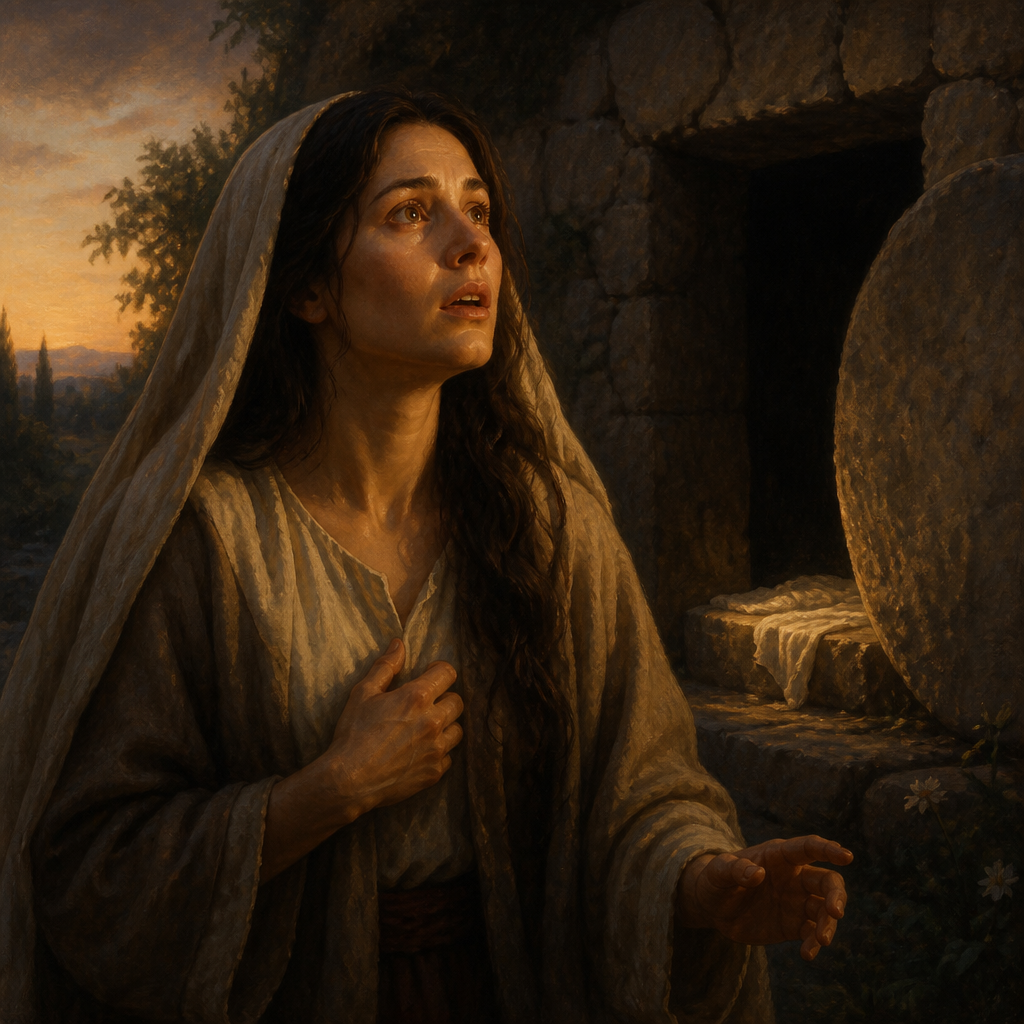
Mary plays a pivotal role in the resurrection narratives. At dawn on the first day of the week, she returned to the tomb with Mary Magdalene and Salome (Matthew 28:1, Mark 16:1). They brought spices they had purchased to anoint the body. Upon arrival, they found the stone rolled away and encountered angelic messengers who informed them that Jesus had risen. According to Luke 24:10, she was one of the specific women who went to the eleven Apostles to report these events. Although the Apostles initially met their report with skepticism, Mary stands as one of the primary historical witnesses to the empty tomb.
Relationship to Other Biblical Figures
Mary’s primary relationships are defined by her motherhood. Her son, James the Younger, was one of the Twelve Apostles, indicating that her entire household was deeply integrated into the ministry of Jesus. She worked in close partnership with other women, specifically Mary Magdalene and Salome, forming a core group of female supporters who 'followed Him and ministered to Him' during His time in Galilee. In the Johannine account, she is seen standing in solidarity with the mother of Jesus and the sister of Jesus' mother, showing a close-knit support system among the followers of Christ during His execution.
Spiritual Significance
Theologically, Mary represents the 'faithful remnant' of disciples who do not abandon Christ in his hour of greatest suffering. Her role as a witness is her most significant contribution to the biblical canon. In the legal context of the first century, the testimony of women was often marginalized; however, the Gospel writers emphasize that God chose Mary and her companions to be the first heralds of the Resurrection. Her life serves as an example of practical service—providing for Jesus’ needs—and steadfast presence, proving that devotion to Christ often manifests in the quiet act of staying near Him when all others have departed.
Spiritual Significance
Mary’s significance lies in her role as a primary witness to the death, burial, and resurrection of Jesus Christ. By appearing in all four Gospel accounts in the context of the Passion, she provides a continuous thread of testimony that verifies the reality of Jesus' physical death and the subsequent emptiness of His tomb. Her presence ensures the historical continuity of the narrative between the Friday of the crucifixion and the Sunday of the resurrection.
Furthermore, she exemplifies the vital role of women in the early ministry of Jesus. Unlike the Apostles, who are often portrayed struggling with the concepts of Christ's suffering, Mary and her companions are depicted as having a resolute commitment that carries them to the foot of the cross and the mouth of the grave. She is a foundational figure in the transition from the ministry of Jesus to the birth of the early Church.
Frequently Asked Questions
Was Mary the mother of James an Apostle?
While she was not an Apostle herself, her son, James the Younger (or James son of Alphaeus), was one of the Twelve Apostles chosen by Jesus.
Is Mary the mother of James the same person as Mary the wife of Clopas?
Most biblical scholars believe they are the same person, based on the parallel lists of women at the cross in the Synoptic Gospels and the Gospel of John, where 'Mary the wife of Clopas' occupies the position assigned to the 'mother of James' in other accounts.
What did Mary do after the resurrection?
The Bible does not record Mary's life after she reported the empty tomb to the Apostles. It is generally assumed she remained part of the early Christian community in Jerusalem.
Which of Mary's sons are mentioned in the Bible?
The Gospels specifically name two of her sons: James (the Younger) and Joses (or Joseph).
Why is she called 'the other Mary' in Matthew's Gospel?
Matthew uses this term to distinguish her from Mary Magdalene, who is the most prominent Mary mentioned in the resurrection narrative.
Connected Figures
James the Younger
Son
Joses
Son
Alphaeus
Partner/Husband (Disputed)
Clopas
Partner/Husband (Disputed)
Mary Magdalene
Companion and fellow witness
Categories
Mentions by Book
- Matthew3
- Mark2
- John1
- Luke1
Family & Relationships
Child
James son of Alphaeus, ApostleDisputed
Matthew 27:56
Child
Matthew 27:56
Child
Matthew 27:56
Spouse / partner
Matthew 27:56
Spouse / partner
AlphaeusDisputed
Matthew 10:3
Others Named Mary
Mary, Mother of John MarkActs 12:12
A prominent woman in the early Jerusalem church whose home served as a primary meeting and prayer location for the apostles.
Mary, Sister of Martha and LazarusLuke 10:39
A devoted follower of Jesus from Bethany known for her contemplative posture at Christ's feet and her sacrificial act of anointing Him with expensive perfume.
Mary, Hard Worker of RomeRomans 16:6
A prominent woman in the first-century Roman church commended by the Apostle Paul for her exceptional labor and dedication to the Christian community.