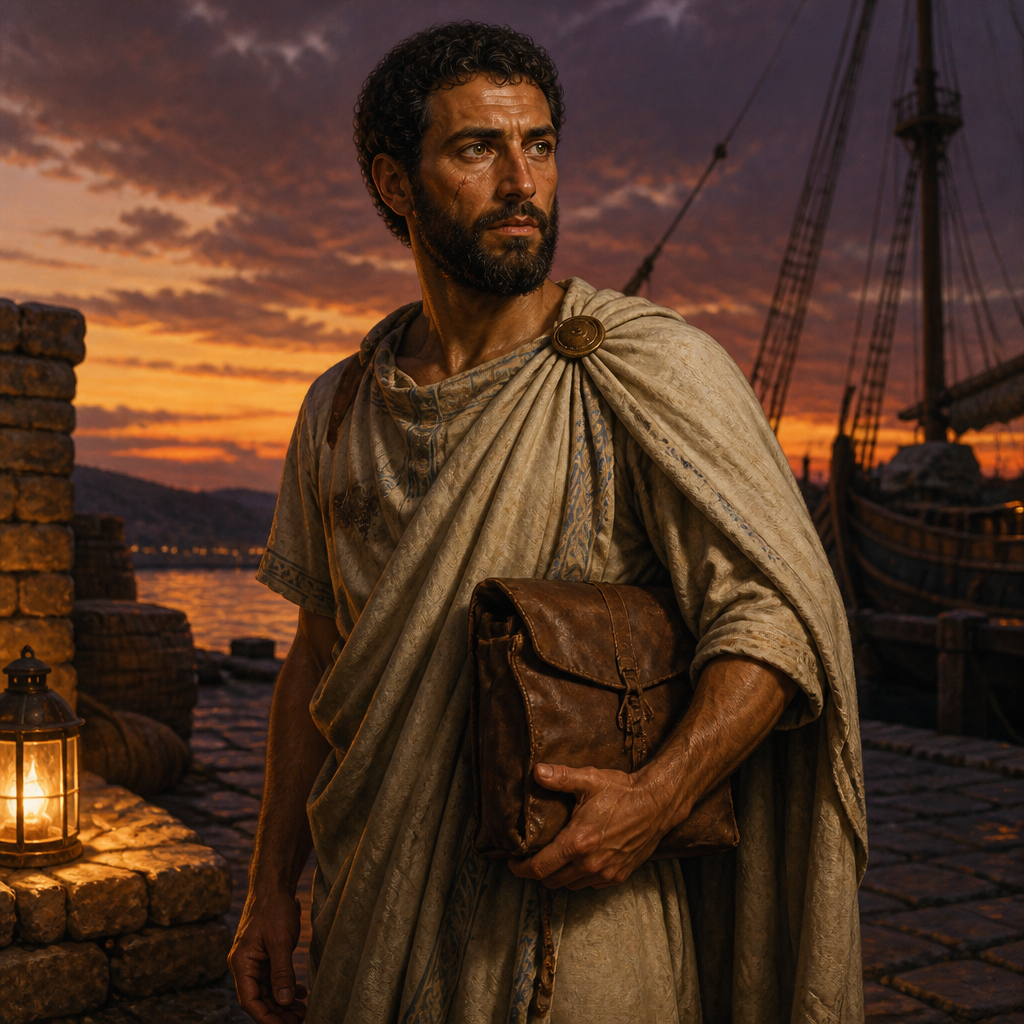
Pyrrhus
A man from the Macedonian city of Berea and the father of Sopater, a traveling companion of the Apostle Paul.
Pyrrhus is a figure from the New Testament known exclusively as the father of Sopater, a Christian from the Macedonian city of Berea. His name appears in the context of the Apostle Paul’s third missionary journey, specifically during the stage where Paul was returning to Jerusalem through Macedonia and Asia Minor.
While Pyrrhus himself is not described as a traveler with Paul, his inclusion in the text serves to distinguish his son, Sopater, from other individuals in the early church. His name, which means 'fiery' or 'flame-colored' in Greek, suggests a background within the Hellenistic culture of Macedonia during the middle of the 1st century AD.
Background and Family
Pyrrhus was a resident of Berea, a prominent city in Macedonia. The biblical record identifies him solely through his patronymic relationship with Sopater. In Acts 20:4, the author Luke provides a detailed list of those who accompanied the Apostle Paul as he prepared to sail from Macedonia to Asia. Among these men is "Sopater son of Pyrrhus from Berea."
Historical and textual evidence suggests that the inclusion of Pyrrhus's name is significant. In many ancient manuscripts, the father’s name is omitted, but the most reliable Greek texts (including the Nestle-Aland and United Bible Societies editions) include the phrase Sopatros Pyrrou Beroiaios (Sopater of Pyrrhus, the Berean). This specific identification likely served to highlight Sopater's pedigree or to distinguish him from other men named Sopater in the early Christian community.
Major Life Events
There are no recorded major life events for Pyrrhus within the biblical canon. His life is glimpsed only through the lens of his son’s ministry. Because Sopater was chosen to accompany Paul—likely as a representative of the Berean church to deliver a collection for the impoverished saints in Jerusalem—it is inferred that Pyrrhus was part of a family that had embraced the Christian faith during Paul’s earlier visit to Berea (Acts 17:10–14). The Bereans were famously described as being of "more noble character" than those in Thessalonica because they received the word with great eagerness and examined the Scriptures every day.
Relationship to Other Biblical Figures
Pyrrhus’s primary relationship is to his son, Sopater. Through his son, he is indirectly linked to the inner circle of the Apostle Paul’s missionary team, which included Aristarchus, Secundus, Gaius, Timothy, Tychicus, and Trophimus. While Pyrrhus is not mentioned as a disciple or traveler himself, his presence in the text as a named father indicates he was likely a known entity to the early readers of the Book of Acts.
Spiritual Significance
The spiritual significance of Pyrrhus lies in the legacy of his household. The inclusion of his name in the sacred record immortalizes him as a father of a faithful servant of the early church. In the context of the 1st century AD, a son representing a city’s church on a dangerous and important mission for an Apostle reflects favorably on the household and the father who raised him. Pyrrhus stands as a representative of the many named and unnamed families in Macedonia who supported the spread of the Gospel during the apostolic era.
Spiritual Significance
Pyrrhus is significant as a marker of historical precision in the Lucan narrative. By identifying Sopater by his father's name, the author provides a specific genealogical anchor that characterizes the 'noble' Berean community. It highlights the familial nature of the early church and the way in which the Gospel took root in specific households in Macedonia.
Frequently Asked Questions
Who was Pyrrhus in the Bible?
Pyrrhus was a man from Berea and the father of Sopater, one of the men who accompanied the Apostle Paul on his third missionary journey.
What does the name Pyrrhus mean?
The name is Greek (Pyrros) and means 'fiery' or 'red-haired.'
Did Pyrrhus travel with the Apostle Paul?
No, the Bible does not record Pyrrhus traveling with Paul; only his son Sopater is listed as a traveling companion in Acts 20:4.
Where did Pyrrhus live?
He lived in the city of Berea, located in the Roman province of Macedonia.
Why is Pyrrhus mentioned only once?
He is mentioned to uniquely identify his son Sopater, helping to distinguish him and provide historical weight to the list of Paul's companions.