Potiphera
Who was Potiphera in the Bible?
An Egyptian priest of the city of On and the father of Asenath, who became the wife of the patriarch Joseph.
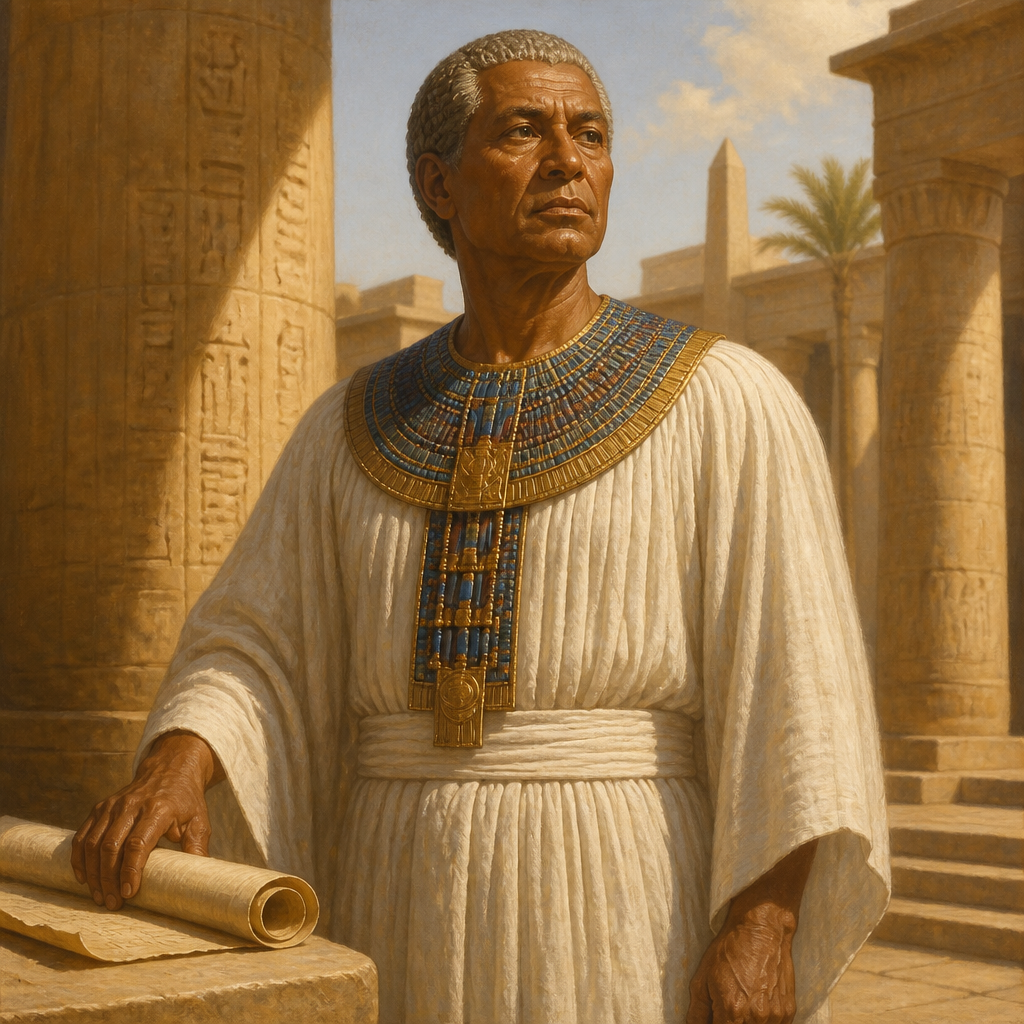
Potiphera (also spelled Poti-Pherah) was an Egyptian official of high religious standing during the Patriarchal Period. He is primarily identified in the Book of Genesis as the 'priest of On,' a city historically associated with the worship of the sun god Ra. His significance in the biblical narrative is derived entirely from his family connection to Joseph, the son of Jacob, who rose to prominence in the Egyptian court.
While Potiphera does not engage in direct dialogue or action within the text, his presence underscores the administrative and social elevation of Joseph. By marriage to Potiphera's daughter, Joseph was integrated into the highest echelons of Egyptian society. Potiphera serves as the paternal link for two of the most significant figures in the later history of Israel: Manasseh and Ephraim, the founders of two of the twelve tribes.
Background and Family
Potiphera is introduced in the biblical record during the transition of Joseph from a Hebrew prisoner to the grand vizier of Egypt. His name, of Egyptian origin, is generally understood by scholars to mean 'He whom Ra has given,' fitting for his role as a priest of On. The city of On, later known by the Greeks as Heliopolis, was the center of Egyptian solar worship. As a priest in this city, Potiphera would have belonged to a privileged and influential class, likely possessing significant land and political influence.
The only family member of Potiphera mentioned in Scripture is his daughter, Asenath. According to Genesis 41:45, Pharaoh himself arranged the marriage between Asenath and Joseph. This arrangement was likely intended to solidify Joseph’s new status; as a foreigner and former slave, marrying into the family of a respected priest like Potiphera provided Joseph with immediate domestic legitimacy and social standing among the Egyptian elite.
Major Life Events
The biblical text does not record the personal life events of Potiphera, focusing instead on his role as a fixed point in the genealogy of Joseph’s descendants. His name appears three times in the Book of Genesis, each time specifically to identify his daughter Asenath.
Pharaoh gave Joseph the name Zaphenath-paneah, and he gave him Asenath daughter of Potiphera, priest of On, to be his wife. (Genesis 41:45)
Potiphera is mentioned again in Genesis 41:50 and Genesis 46:20. These references serve to document the birth of Joseph's sons, Manasseh and Ephraim, during the years of plenty before the great famine. In these genealogies, Potiphera’s title—'priest of On'—is consistently included, emphasizing the priestly lineage of the mother of the two tribal patriarchs.
Relationship to Other Biblical Figures
Potiphera’s primary relationship is that of father to Asenath and father-in-law to Joseph. Through this union, he became the maternal grandfather of Manasseh and Ephraim. This connection is vital because it establishes that two of the primary tribes of Israel had an Egyptian grandfather who held a high religious office in a pagan system. Despite this, the biblical narrative portrays the adoption of Manasseh and Ephraim into the covenant family of Jacob without conflict regarding their maternal ancestry.
Spiritual Significance
Potiphera’s significance is largely contextual rather than personal. His presence in the text illustrates the providence of God in placing Joseph in a position where he could save both Egypt and his own family from famine. The fact that Joseph, a devout follower of the LORD, was wed to the daughter of a priest of On has been a point of interest for commentators. It highlights the complexities of the Patriarchal Period, where the chosen family of God interacted with, and sometimes married into, the surrounding cultures and religious systems. Potiphera remains a silent but essential figure in the lineage that produced the northern tribes of Israel.
Potiphera is significant as the link between the Egyptian religious establishment and the lineage of the tribes of Israel. His status as the 'priest of On' provides historical weight to Joseph's high standing in Egypt, confirming that Joseph was given a wife from the highest social order. Furthermore, his mention in the genealogical records of Genesis 46 ensures that the maternal ancestry of Ephraim and Manasseh is preserved, showing how God incorporated diverse elements into the formation of the nation of Israel.
Frequently Asked Questions
What does the name Potiphera mean?
The name is of Egyptian origin and is widely understood to mean 'He whom Ra (the sun god) has given.'
What was the city of On?
On was an ancient Egyptian city, also known as Heliopolis, which served as the center for the worship of the sun god, Ra.
Who was Potiphera's daughter?
His daughter was Asenath, who was given in marriage to Joseph by Pharaoh.
Did Potiphera have any grandchildren?
Yes, through his daughter Asenath, he was the grandfather of Manasseh and Ephraim, the heads of two of the tribes of Israel.
Was Potiphera the same person as Potiphar?
While the names are linguistically similar, the biblical text treats them as distinct individuals; Potiphar was an officer of Pharaoh and captain of the guard, while Potiphera was the priest of On.
Family & Relationships
 PotipheraThis page
Children
 AsenathDaughterGenesis 41:45Stated
Extended family
 EphraimGrandsonGenesis 41:45
Inferred
Genesis 46:20 names Ephraim and Potiphera in the same verse but does not state a grandfather tie between them; the link rests on the surrounding narrative.Evidence: Genesis 41:45; Genesis 41:50; Genesis 46:20
Connected Figures
Family
Daughter · Genesis 41:45
An Egyptian noblewoman and the wife of the patriarch Joseph, who bore him the two tribal ancestors, Manasseh and Ephraim.
PatriarchsFirst: Genesis 41:453 versesNoblewoman
Grandson · Genesis 41:45
The second son of Joseph and Asenath, Ephraim was adopted by his grandfather Jacob and received the primary blessing of the firstborn, becoming the progenitor of a dominant tribe in Israel.
PatriarchsFirst: Genesis 41:5216 versesPatriarchEphraim
Categories
Mentions by Book
- Genesis3
Scripture References
All 3 indexed verses, in canonical order, from the Berean Standard Bible.
Genesis · 3
- Genesis 41:45
Pharaoh gave Joseph the name Zaphenath-paneah, and he gave him Asenath daughter of Potiphera, priest of On, to be his wife. And Joseph took charge of all the land of Egypt.
- Genesis 41:50
Before the years of famine arrived, two sons were born to Joseph by Asenath daughter of Potiphera, priest of On.
- Genesis 46:20
Manasseh and Ephraim were born to Joseph in the land of Egypt by Asenath daughter of Potiphera, priest of On.