Shelumiel
Who was Shelumiel in the Bible?
Shelumiel was the prince and tribal leader of the Simeonites during the Exodus from Egypt and the subsequent wilderness wanderings.
Shelumiel, the son of Zurishaddai, was a prominent tribal leader (nasi) of the tribe of Simeon during the pivotal era of the Exodus and the Israelite journey through the wilderness. His leadership is established early in the book of Numbers, where he is identified as the representative for Simeon during the first census conducted by Moses at Mount Sinai. As a tribal head, he held significant administrative and religious responsibilities, representing one of the twelve core divisions of the Israelite camp.
His role extended beyond mere demographics; he was a primary participant in the dedication of the Tabernacle and served as the military commander over the Simeonite division during the march. While the biblical text focuses on his official capacities rather than personal narratives, Shelumiel’s presence in the narrative signifies the structured, organized nature of the Israelite community as they transitioned from Egyptian bondage toward the Promised Land.
Background and Family
Shelumiel was the son of Zurishaddai, a man belonging to the tribe of Simeon. His name, often interpreted from Hebrew roots to mean "Friend of God" or "God is my Peace," reflects the theocratic orientation of his family and culture. The tribe of Simeon, descended from the second son of Jacob and Leah, was one of the larger tribes during the initial census at Sinai, numbering 59,300 men (Numbers 1:23). As the son of Zurishaddai, Shelumiel inherited or was appointed to the position of "prince" or "leader" (nasi) of his tribe, placing him among the elite administrative circle of the Israelite nation under the supreme leadership of Moses and Aaron.
Major Life Events
Shelumiel’s recorded actions occur exclusively within the first ten chapters of the book of Numbers, during the second year after the Exodus from Egypt (c. 1445 BC).
The First Census
In Numbers 1, Shelumiel is summoned by name to assist Moses and Aaron in the registration of the men of Israel. He was responsible for overseeing the count of the tribe of Simeon, ensuring that every male twenty years old and upward who was able to go to war was recorded. This census served both a military purpose and a genealogical one, establishing the legal standing of each family within the camp.
Tribal Arrangement and Order of March
When the Lord commanded the arrangement of the camp in Numbers 2, Shelumiel and the tribe of Simeon were assigned to the south side of the Tabernacle. They were grouped under the standard of the camp of Reuben, positioned specifically between the tribes of Reuben and Gad. As the leader, Shelumiel was responsible for the order and discipline of his tribe, both when camping and when breaking camp to follow the Pillar of Cloud.
The Dedication of the Altar
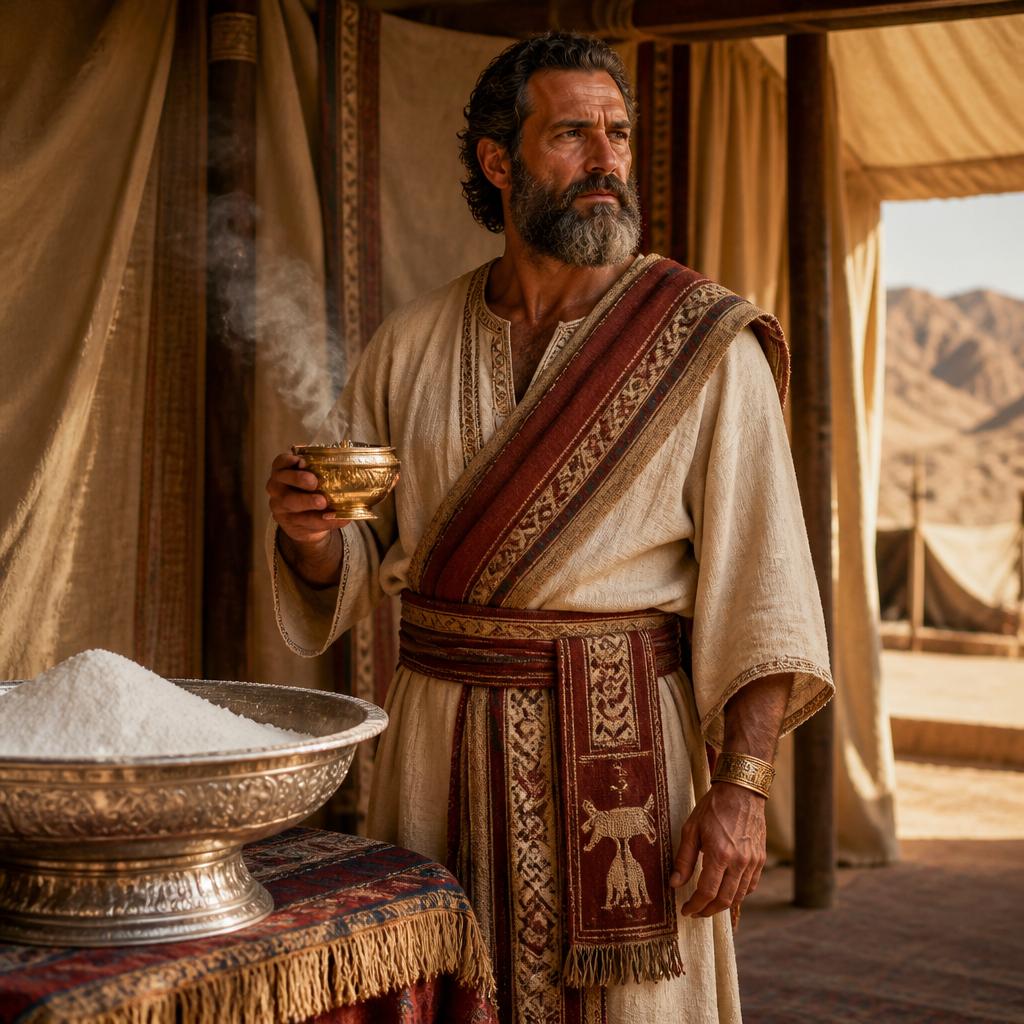
One of the most significant liturgical moments for Shelumiel occurred during the twelve-day dedication of the Tabernacle's altar (Numbers 7). On the fifth day, Shelumiel presented the offering for the tribe of Simeon. His contribution was substantial and identical to the other princes, consisting of silver vessels filled with fine flour and oil, a gold dish of incense, and various animals for burnt offerings, sin offerings, and peace offerings. This act demonstrated the tribe's commitment to the sacrificial system and the centralized worship of the LORD.
The Departure from Sinai
In Numbers 10, when the Israelites moved for the first time from the Wilderness of Sinai, Shelumiel is mentioned as being "over the division of the tribe of Simeon." He led his people as they followed the ark, maintaining the specific marching order ordained by God.
Relationship to Other Biblical Figures
Shelumiel operated as a contemporary and subordinate to Moses. He worked alongside other tribal leaders like Elizur of Reuben and Eliasaph of Gad. His relationship with his father, Zurishaddai, is the only familial tie explicitly mentioned, though as a tribal prince, he would have been the patriarchal head of numerous clans within the Simeonite lineage.
Spiritual Significance
Shelumiel represents the principle of orderly service within the biblical narrative. In a period characterized by both divine revelation and human murmuring, Shelumiel is recorded only in the context of obedience—counting the people, offering sacrifices, and leading his tribe according to divine command. His life illustrates the transition of Israel from a loosely organized group of former slaves into a structured, liturgical, and military community ready to inherit a land, even though the generation he led would eventually fall in the wilderness due to the lack of faith following the report of the twelve spies.
Shelumiel serves as a key representative of the tribal structure of Israel during the Tabernacle’s inaugural year. His participation in the census and the dedication of the altar highlights the importance of individual tribal identity within the unity of the twelve tribes. He signifies the 'prince' archetype—leaders who were responsible for the physical and spiritual mobilization of their people.
Theologically, Shelumiel’s involvement in the offerings of Numbers 7 underscores the equality of the tribes before God; each leader brought the same weight of silver and gold and the same number of sacrifices, showing that the tribe of Simeon, despite later historical declines, was an equal partner in the initial covenantal life of Israel.
Frequently Asked Questions
What tribe did Shelumiel belong to?
Shelumiel was the leader of the tribe of Simeon.
Who was Shelumiel's father?
His father was Zurishaddai.
What was Shelumiel's role during the Exodus?
He was a tribal prince (nasi) responsible for census-taking, presenting offerings at the Tabernacle, and commanding the Simeonite division during the wilderness march.
When did Shelumiel present his offering at the Tabernacle?
He presented his offering on the fifth day of the dedication of the altar.
How many times is Shelumiel mentioned in the Bible?
Shelumiel is mentioned five times, all within the book of Numbers.
Family & Relationships
Parents
 ZurishaddaiFatherNumbers 1:6Stated
 ShelumielThis page
Connected Figures
Family
Father · Numbers 1:6
Zurishaddai was a patriarch of the tribe of Simeon during the Exodus and the father of the tribal prince Shelumiel.
Egypt and WildernessFirst: Numbers 1:65 versesPatriarchal head of a householdSimeon
Categories
Mentions by Book
- Numbers5
Scripture References
All 5 indexed verses, in canonical order, from the Berean Standard Bible.
Numbers · 5
- Numbers 1:6
from Simeon, Shelumiel son of Zurishaddai;
- Numbers 2:12
The tribe of Simeon will camp next to it. The leader of the Simeonites is Shelumiel son of Zurishaddai,
- Numbers 7:36
On the fifth day Shelumiel son of Zurishaddai, the leader of the Simeonites, drew near.
- Numbers 7:41
and a peace offering of two oxen, five rams, five male goats, and five male lambs a year old. This was the offering of Shelumiel son of Zurishaddai.
- Numbers 10:19
Shelumiel son of Zurishaddai was over the division of the tribe of Simeon,