Oholiab
Who was Oholiab in the Bible?
A skilled artisan from the tribe of Dan appointed by God to help construct the Tabernacle and its sacred furnishings during the Exodus.
Oholiab, son of Ahisamach, was a prominent craftsman and artist selected by God to play a pivotal role in the construction of the Tabernacle during the Israelites' wilderness journey. A member of the tribe of Dan, Oholiab served as the primary assistant to Bezalel, the lead architect. While the biblical record concerning his personal life is sparse, his appointment is marked by a specific divine endowment of skill, intelligence, and the ability to teach others the sacred crafts required for the dwelling place of God.
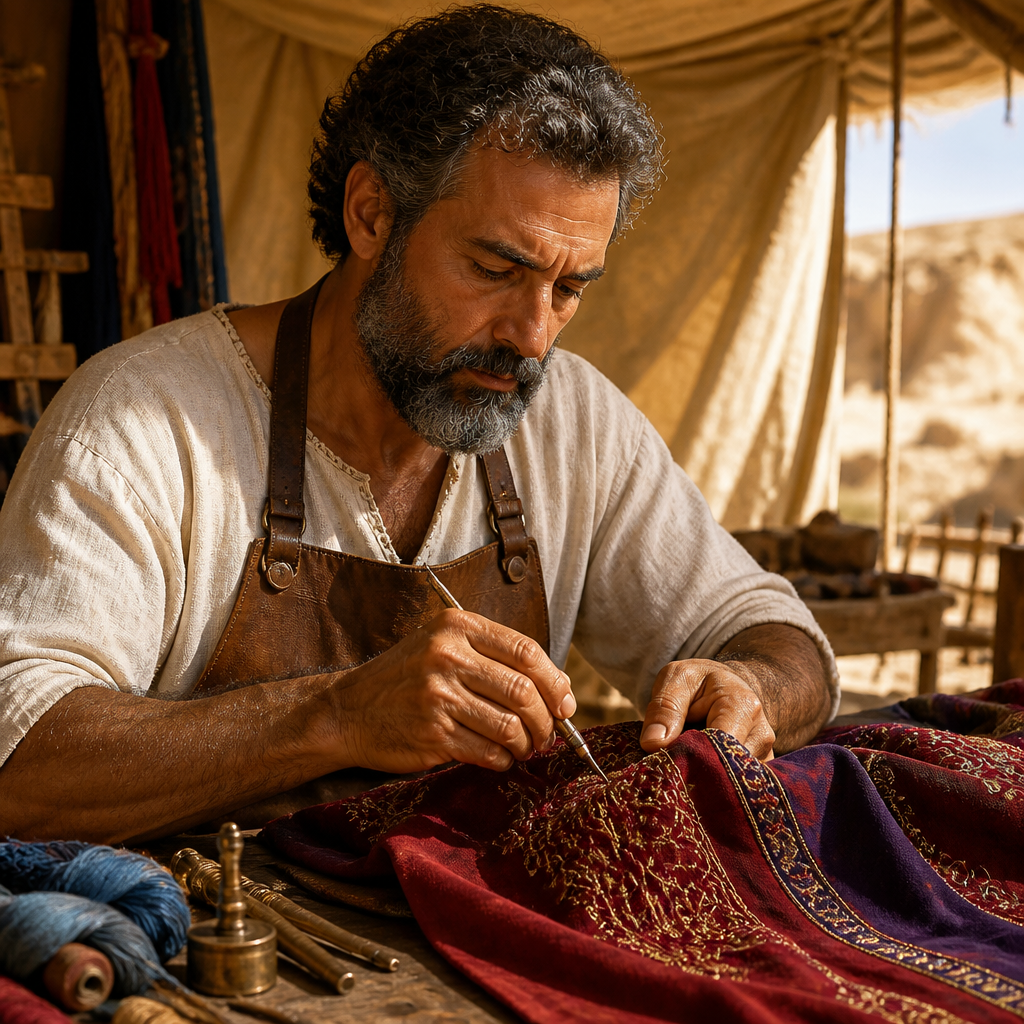
His work was not merely manual labor but a divinely commissioned artistic endeavor. Oholiab was specifically noted for his expertise as an engraver, a designer, and an embroiderer. Working with fine linen and expensive yarns of blue, purple, and scarlet, he was responsible for the aesthetic and structural textile elements that defined the sanctuary's interior and the vestments of the priesthood. His contribution represents the biblical intersection of human talent and divine inspiration.
Background and Family
Oholiab was the son of Ahisamach and belonged to the tribe of Dan. His name, Oholiab, is often translated from Hebrew to mean "Father’s Tent" or "The Father is my Tent," a name perhaps reflecting the nomadic or dwelling-focused context of his era. The tribe of Dan, while later known for its challenges in securing territory, provided in Oholiab one of the most significant contributors to Israel's liturgical life. The biblical text does not provide details regarding Oholiab’s age, marital status, or his life in Egypt prior to the Exodus, focusing exclusively on his calling at Mount Sinai.
Major Life Events
The primary events of Oholiab’s life are centered on the construction of the Tabernacle as recorded in the Book of Exodus. Following the delivery of the Law at Sinai, Moses received instructions for a portable sanctuary. In Exodus 31:6, God explicitly named Oholiab as the assistant to Bezalel. This appointment was not based on nepotism or social standing but on a divine impartation of "skill and ability" (Exodus 36:1).
Oholiab’s specific technical portfolio included engraving, designing, and needlework. He worked extensively with fine linen and yarns dyed in symbolic colors: blue, purple, and scarlet. As a master craftsman, he was tasked with translating the heavenly pattern shown to Moses into physical reality. Furthermore, Exodus 35:34 notes that God gave Oholiab the "ability to teach others," indicating that he functioned as a foreman or instructor, overseeing a guild of artisans who labored to complete the sanctuary’s intricate components.
Relationship to Other Biblical Figures
Oholiab is inextricably linked with Bezalel, the son of Uri from the tribe of Judah. The two men represent a partnership between the tribes of Judah and Dan. While Bezalel was the primary lead—filled with the Spirit of God to oversee the entire project—Oholiab is consistently presented as his chief collaborator. He also stood in a direct subservient relationship to Moses, who acted as the visionary mediator between God’s commands and the artisans' execution. Oholiab’s obedience is highlighted in Exodus 36:2, where he is among those whose "heart stirred him to come and do the work."
Spiritual Significance
Oholiab’s significance in the biblical narrative lies in the theology of work and spiritual gifts. He serves as an early scriptural example of how the Holy Spirit empowers individuals for tasks beyond traditional prophecy or leadership. By sanctifying his craftsmanship, the text elevates artistic labor to a form of worship. Oholiab’s role also emphasizes the communal nature of God's work; despite Bezalel's primary leadership, the Tabernacle could not be completed without the specific, specialized skills of Oholiab. His ability to teach others suggests that his legacy was not merely the objects he created, but the transmission of sacred skill to the broader community of Israel.
Oholiab is significant as one of the first individuals in the Bible explicitly described as being divinely gifted for artistic and manual labor. His role demonstrates that God values aesthetic beauty and craftsmanship in the context of worship. Furthermore, his partnership with Bezalel highlights the necessity of collaboration and the distribution of various gifts within the community of faith to achieve a common goal.
Theologically, Oholiab represents the 'called' artisan. His work on the Tabernacle—the physical dwelling place of God on earth—points to the importance of excellence in service. His specific skills in embroidery and engraving were essential for creating the visual boundaries between the common and the holy, a central theme in the Pentateuch's liturgical requirements.
Frequently Asked Questions
What tribe did Oholiab belong to?
Oholiab was a member of the tribe of Dan.
Who was Oholiab's father?
His father was Ahisamach.
What were Oholiab's specific artistic skills?
He was an engraver, a designer, and an embroiderer who worked with fine linen and blue, purple, and scarlet yarn.
Who was Oholiab's primary partner in building the Tabernacle?
He was the chief assistant to Bezalel son of Uri, from the tribe of Judah.
Did Oholiab work alone on the Tabernacle?
No, he was given the ability to teach others, and he worked alongside a larger group of skilled people whose hearts were stirred by God.
Family & Relationships
Parents
 AhisamachFatherExodus 31:6Stated
 OholiabThis page
Connected Figures
Family
Father · Exodus 31:6
Ahisamach was a member of the tribe of Dan and the father of Oholiab, a chief artisan chosen by God to construct the Tabernacle.
Egypt and WildernessFirst: Exodus 31:63 versesPatriarch within the tribe of DanDan
Categories
Mentions by Book
- Exodus5
Scripture References
All 5 indexed verses, in canonical order, from the Berean Standard Bible.
Exodus · 5
- Exodus 31:6
Moreover, I have selected Oholiab son of Ahisamach, of the tribe of Dan, as his assistant. I have also given skill to all the craftsmen, that they may fashion all that I have commanded you:
- Exodus 35:34
And the LORD has given both him and Oholiab son of Ahisamach, of the tribe of Dan, the ability to teach others.
- Exodus 36:1
“So Bezalel, Oholiab, and every skilled person are to carry out everything commanded by the LORD, who has given them skill and ability to know how to perform all the work of constructing the sanctuary.”
- Exodus 36:2
Then Moses summoned Bezalel, Oholiab, and every skilled person whom the LORD had gifted—everyone whose heart stirred him to come and do the work.
- Exodus 38:23
With him was Oholiab son of Ahisamach, of the tribe of Dan, an engraver, designer, and embroiderer in blue, purple, and scarlet yarn and fine linen.