Jonah
Who was Jonah in the Bible?
A prophet from the northern kingdom of Israel who was commissioned by God to preach repentance to the Assyrian city of Nineveh.
Jonah, the son of Amittai, was a Hebrew prophet active during the Divided Monarchy, specifically during the reign of King Jeroboam II of Israel. He is unique among the writing prophets for his narrative-driven book, which focuses less on the content of his oracles and more on his personal resistance to the divine commission. Jonah's story is characterized by his attempt to flee from the presence of the LORD, his harrowing experience inside a great fish, and his eventual, albeit reluctant, delivery of a warning to the city of Nineveh.
Historically, Jonah is identified as a prophet from Gath-hepher, a town in the region of Galilee. His ministry occurred at a time when Israel was expanding its borders and facing the rising threat of the Assyrian Empire. While the Book of Jonah chronicles his mission to a foreign power, his appearance in the historical record of 2 Kings 14:25 establishes him as a recognized servant of God whose words influenced the geopolitical landscape of the northern kingdom.
Background and Family
Jonah is identified as the son of Amittai. He was a native of Gath-hepher, a village located within the territory of the tribe of Zebulun in northern Israel. His prophetic career is firmly anchored in the historical era of the Divided Monarchy. According to 2 Kings 14:25, Jonah served during the reign of Jeroboam II (c. 786–746 BC). During this period, Jonah prophesied that the borders of Israel would be restored from Lebo-hamath to the Sea of the Arabah, a prediction that saw fulfillment as Jeroboam II expanded the kingdom's influence. This specific historical mention suggests that Jonah was a well-established and respected figure in the royal court of Samaria prior to his mission to Nineveh.
Major Life Events
The Flight to Tarshish
The narrative of Jonah begins with a direct command from God to go to Nineveh, the capital of the Assyrian Empire, to cry out against its wickedness. Rather than obeying, Jonah attempted to flee "away from the presence of the LORD." He traveled south to the port of Joppa and boarded a ship bound for Tarshish, a location in the opposite direction of Nineveh.
During the voyage, a violent storm threatened the vessel. The pagan sailors, desperate to identify the cause of the calamity, cast lots, and the lot fell on Jonah. After Jonah confessed he was fleeing from the God who made the sea and the dry land, the sailors reluctantly cast him overboard at his own suggestion. The sea immediately became calm, leading the sailors to offer sacrifices to the LORD.
The Great Fish and Deliverance
As Jonah sank into the depths, the LORD "appointed a great fish to swallow Jonah." He remained in the belly of the fish for three days and three nights. From this dark interior, Jonah offered a prayer of thanksgiving and distress, acknowledging that "salvation is from the LORD." Upon God's command, the fish vomited Jonah onto dry land, effectively resetting his mission.
The Preaching at Nineveh
God issued the command a second time, and this time Jonah obeyed. He traveled to Nineveh, a city described as "exceedingly great," and delivered a sparse five-word message in Hebrew: "Forty more days and Nineveh will be overturned!" Unexpectedly, the entire population—from the king to the livestock—responded with fasting and sackcloth. Seeing their repentance, God relented from the disaster He had threatened.
The Prophet’s Anger
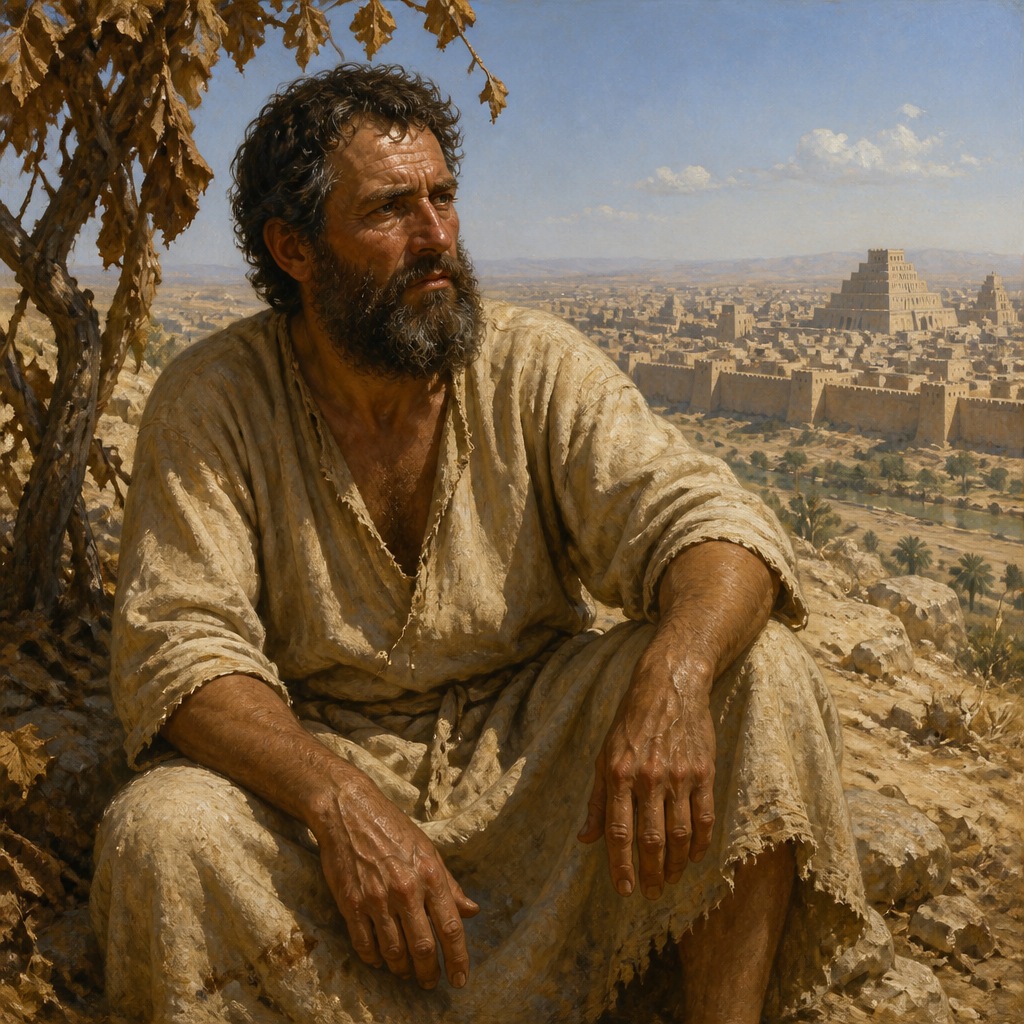
The city’s salvation resulted in deep resentment from Jonah. He confessed that his initial flight to Tarshish was motivated by the knowledge that God is "gracious and compassionate, slow to anger and abounding in love." Jonah withdrew from the city and built a shelter, waiting to see if destruction might still fall. God used a rapidly growing vine to provide Jonah shade, then sent a worm to kill the vine and a scorching east wind to distress him. When Jonah expressed anger over the vine's death, God used the object lesson to rebuke him: if Jonah could pity a plant he did not labor for, should not God have compassion on a city of 120,000 people who "do not know their right hand from their left"?
Relationship to Other Biblical Figures
Jonah’s primary documented relationship is with his father, Amittai. Historically, he is linked to Jeroboam II, the King of Israel, for whom he served as a messenger of national restoration. In the New Testament, Jesus Christ references Jonah more than any other minor prophet. Jesus identifies Jonah as a "sign," drawing a parallel between Jonah's three days in the fish and His own three days in the heart of the earth. Furthermore, Jesus contrasts the repentance of the Ninevites under Jonah’s preaching with the lack of repentance among His own contemporaries.
Spiritual Significance
Jonah stands as a complex figure who represents the tension between nationalistic loyalty and the universal scope of God's mercy. His story challenges the notion that God’s concern is limited to a single nation. Theologically, Jonah serves as a foil to the typical prophetic archetype; where others speak at length, Jonah is brief; where others seek to save their people, Jonah seeks the destruction of his enemies.
His experience in the fish became a foundational type of death and resurrection in Christian theology. The book ends with a rhetorical question from God, leaving Jonah's final response unrecorded, which serves to force the reader to examine their own attitudes toward divine grace and the inclusion of outsiders in God's plan.
Jonah is significant for demonstrating the reach of God's sovereignty over both nature and foreign nations. He serves as the only Old Testament prophet sent specifically to a Gentile powerhouse to preach repentance, highlighting that the 'God of Israel' is also the Judge and Savior of the whole world. His life provides a narrative template for the 'Sign of Jonah,' which Jesus utilized to validate His own messianic mission and impending resurrection.
Furthermore, Jonah's story provides a stark exploration of human resistance to the divine will. It illustrates that even a valid, divinely appointed prophet can be out of step with God's heart. By recording his failures, the biblical text emphasizes that God’s purposes are not thwarted by human frailty or prejudice, and that repentance is available to even the most notorious of sinners.
Frequently Asked Questions
Where was Jonah from?
Jonah was from Gath-hepher, a town in the territory of Zebulun in the northern kingdom of Israel.
During which king's reign did Jonah live?
Jonah lived and prophesied during the reign of King Jeroboam II of Israel, who ruled during the Divided Monarchy period.
Why did Jonah flee to Tarshish?
Jonah fled because he did not want to go to Nineveh. He knew God was merciful and feared that if the Ninevites repented, God would forgive them instead of destroying them.
What is the 'Sign of Jonah' mentioned in the New Testament?
Jesus referred to the 'Sign of Jonah' as a parallel to His death and resurrection; just as Jonah was in the fish for three days and nights, the Son of Man would be in the earth for three days and nights.
Did the city of Nineveh actually repent?
According to the Book of Jonah, the entire city, including the king, fasted and put on sackcloth in response to Jonah's warning, leading God to spare the city.
Family & Relationships
Parents
 AmittaiFather2 Kings 14:25Stated
 JonahThis page
Connected Figures
Family
Father · 2 Kings 14:25
Amittai was the father of the prophet Jonah and a resident of Gath-hepher during the era of the Divided Monarchy.
Categories
Mentions by Book
- 2 Kings1
- Jonah17
- Matthew4
- Luke3
Scripture References
All 25 indexed verses, in canonical order, from the Berean Standard Bible.
- 2 Kings 14:25
This Jeroboam restored the boundary of Israel from Lebo-hamath to the Sea of the Arabah, according to the word that the LORD, the God of Israel, had spoken through His servant Jonah son of Amittai, the prophet from Gath-hepher.
- Jonah 1:1
Now the word of the LORD came to Jonah son of Amittai, saying,
- Jonah 1:3
Jonah, however, got up to flee to Tarshish, away from the presence of the LORD. He went down to Joppa and found a ship bound for Tarshish. So he paid the fare and went aboard to sail for Tarshish, away from the presence of the LORD.
- Jonah 1:5
The sailors were afraid, and each cried out to his own god. And they threw the ship’s cargo into the sea to lighten the load. But Jonah had gone down to the lowest part of the vessel, where he lay down and fell into a deep sleep.
- Jonah 1:7
“Come!” said the sailors to one another. “Let us cast lots to find out who is responsible for this calamity that is upon us.” So they cast lots, and the lot fell on Jonah.
- Jonah 1:15
Then they picked up Jonah and cast him into the sea, and the raging sea grew calm.
- Jonah 1:17Partial
Now the LORD had appointed a great fish to swallow Jonah, and Jonah spent three days and three nights in the belly of the fish.
- Jonah 2:1
From inside the fish, Jonah prayed to the LORD his God,
- Jonah 2:10
And the LORD commanded the fish, and it vomited Jonah onto dry land.
- Jonah 3:1
Then the word of the LORD came to Jonah a second time:
- Jonah 3:3
This time Jonah got up and went to Nineveh, in accordance with the word of the LORD. Now Nineveh was an exceedingly great city, requiring a three-day journey.
- Jonah 3:4
On the first day of his journey, Jonah set out into the city and proclaimed, “Forty more days and Nineveh will be overturned!”
- Jonah 4:1
Jonah, however, was greatly displeased, and he became angry.
- Jonah 4:2Partial
So he prayed to the LORD, saying, “O LORD, is this not what I said while I was still in my own country? This is why I was so quick to flee toward Tarshish. I knew that You are a gracious and compassionate God, slow to anger, abounding in loving devotion—One who relents from sending disaster.
Cited as a key verse; added so References, Key Verses and Mentions by Book share one index.
- Jonah 4:5
Then Jonah left the city and sat down east of it, where he made himself a shelter and sat in its shade to see what would happen to the city.
- Jonah 4:6Partial
So the LORD God appointed a vine, and it grew up to provide shade over Jonah’s head to ease his discomfort, and Jonah was greatly pleased with the plant.
- Jonah 4:8
As the sun was rising, God appointed a scorching east wind, and the sun beat down on Jonah’s head so that he grew faint and wished to die, saying, “It is better for me to die than to live.”
- Jonah 4:9
Then God asked Jonah, “Have you any right to be angry about the plant?” “I do,” he replied. “I am angry enough to die!”
- Matthew 12:39
Jesus replied, “A wicked and adulterous generation demands a sign, but none will be given it except the sign of the prophet Jonah.
- Matthew 12:40
For as Jonah was three days and three nights in the belly of the great fish, so the Son of Man will be three days and three nights in the heart of the earth.
- Matthew 12:41Partial
The men of Nineveh will stand at the judgment with this generation and condemn it; for they repented at the preaching of Jonah, and now One greater than Jonah is here.
- Matthew 16:4
A wicked and adulterous generation demands a sign, but none will be given it except the sign of Jonah.” Then He left them and went away.
- Luke 11:29
As the crowds were increasing, Jesus said, “This is a wicked generation. It demands a sign, but none will be given it except the sign of Jonah.
- Luke 11:30
For as Jonah was a sign to the Ninevites, so the Son of Man will be a sign to this generation.
- Luke 11:32Partial
The men of Nineveh will stand at the judgment with this generation and condemn it; for they repented at the preaching of Jonah, and now One greater than Jonah is here.