Achan
Who was Achan in the Bible?
A member of the Tribe of Judah whose violation of the ban on spoils at Jericho brought divine judgment and military defeat upon the nation of Israel.
Achan, the son of Carmi and a descendant of Zerah from the tribe of Judah, is a figure primarily known for his role in the Israelite conquest of Canaan. During the transition from the leadership of Moses to Joshua, Israel crossed the Jordan River and achieved a miraculous victory at Jericho. However, Achan’s actions during this battle fundamentally altered the trajectory of the initial conquest, leading to the first recorded military defeat of the Israelites in the promised land at the city of Ai.
His story serves as a cautionary narrative within the Old Testament regarding the concepts of individual sin and corporate responsibility. Achan’s decision to secretly take items that were "devoted to destruction" resulted in his execution and the destruction of his household. The biblical record presents his life as a stark contrast to the obedience required for the conquest, illustrating that the holiness of the camp was a prerequisite for divine favor in battle.
Background and Family
Achan was a man of significant lineage within the tribe of Judah. The biblical record in Joshua 7:1 and 1 Chronicles 2:7 meticulously traces his genealogy to establish his identity and tribal standing: he was the son of Carmi, the son of Zabdi, the son of Zerah. As a descendant of Zerah, Achan belonged to one of the primary clans of Judah. This genealogical detail underscores that Achan was not an outsider or a recent convert to the faith of Israel, but a full member of the covenant community, enjoying the status and protections of one of the leading tribes during the Patriarchal Period and the subsequent era of conquest.
Major Life Events
The primary events of Achan’s life are centered on the siege of Jericho and its immediate aftermath. Before the battle, Joshua had issued a strict command that all silver, gold, and vessels of bronze and iron were to be consecrated to the treasury of the LORD, while everything else was to be destroyed. The Israelites were warned that taking any of the "devoted things" (Hebrew: herem) would bring a curse upon the camp (Joshua 6:17-19).
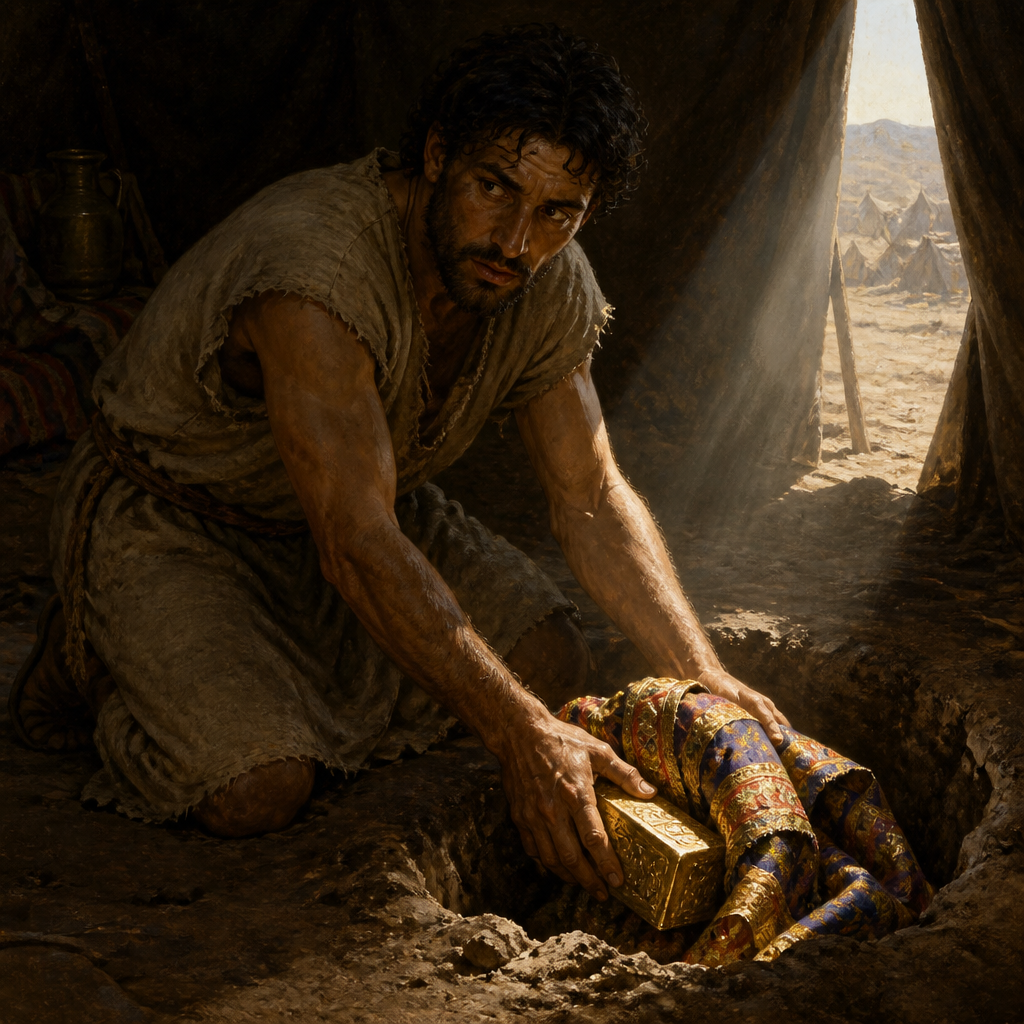
Achan disregarded this command. According to his own confession in Joshua 7:20-21, he saw among the spoils a beautiful Babylonian robe, two hundred shekels of silver, and a bar of gold weighing fifty shekels. Overcome by covetousness, he took these items and hid them in the ground beneath his tent.
The Defeat at Ai and the Investigation
The consequence of Achan's theft was immediate but hidden. When Joshua sent a small force of three thousand men to attack the city of Ai, the Israelites were unexpectedly routed, resulting in the deaths of thirty-six men. This defeat caused the hearts of the people to "melt and become like water." Joshua, in distress, sought the LORD, who revealed that the nation had sinned by violating the ban on the devoted things.
To identify the culprit, a process of elimination by lots was conducted. The tribe of Judah was selected, then the clan of the Zarhites, then the family of Zabdi, and finally, Achan himself was singled out. Joshua urged Achan to "give glory to the LORD" by confessing his sin. Achan admitted his guilt, describing the specific items he had stolen and where they were hidden.
Judgment in the Valley of Achor
Messengers were sent to Achan’s tent to retrieve the stolen goods, which were then spread out before the LORD. The judgment was severe and communal. Joshua and all Israel took Achan, the silver, the robe, the gold, and remarkably, his sons, daughters, livestock, and tent to the Valley of Achor. There, Achan and his household were stoned to death and their remains burned. A large pile of stones was raised over the site as a permanent memorial of the event. The valley was named "Achor," meaning "trouble," a name that is reflected in the 1 Chronicles 2:7 reference where Achan is called "Achar" (the bringer of trouble).
Relationship to Other Biblical Figures
Achan’s primary relationship in the text is with Joshua, the successor of Moses. Joshua acts as the judge and mediator between the sinning individual and the offended Deity. While Achan is a member of the tribe of Judah, the text does not record his interactions with tribal leaders, focusing instead on his relationship to the whole congregation of Israel. The later reference in Joshua 22:20 highlights how his single act of unfaithfulness brought "wrath upon the whole congregation," illustrating the interconnectedness of the community during this era.
Spiritual Significance
The narrative of Achan is often cited by scholars as a primary example of "corporate personality" or collective responsibility in the Hebrew Bible. The sin of one man resulted in the defeat of the entire army and the death of thirty-six innocent soldiers. The text emphasizes that the presence of the "devoted things" within the camp made the entire nation "devoted to destruction" until the sin was purged. Achan's confession acknowledges that his sin was ultimately "against the LORD, the God of Israel," highlighting the theological principle that secret sin is visible to God and has public consequences.
Theologically, Achan represents the danger of covetousness and the internal threat to the covenant community. While the Israelites feared the walls of Jericho and the warriors of Canaan, the biblical narrative suggests that the greater threat was the moral failure of one of their own. Achan's story serves to validate the holiness laws regarding 'herem' (things set apart for God) and demonstrates that the success of the conquest was contingent upon spiritual purity rather than military might.
Furthermore, the severity of his punishment and the inclusion of his family in the judgment reflect the ancient Near Eastern understanding of familial solidarity. The memory of Achan (or Achar) remained a stark warning in Israelite history, mentioned centuries later in the genealogical records of 1 Chronicles to define the character of the tribe of Judah as one capable of both great leadership and great 'trouble.'
Frequently Asked Questions
Why was Achan's family also punished?
The biblical text in Joshua 7 does not explicitly state the level of the family's involvement, but the burial of the items under the family tent suggests they may have been complicit. In the context of ancient Israelite law and corporate responsibility, the household was often treated as a single legal entity in cases of extreme violation of the covenant.
What items did Achan steal?
Achan confessed to stealing a beautiful Babylonian robe, two hundred shekels of silver, and a gold bar weighing fifty shekels.
What does the name 'Achor' mean?
The name 'Achor' means 'trouble' or 'disturbance.' The Valley of Achor was named this because Achan brought trouble upon Israel, and 1 Chronicles 2:7 even refers to him as 'Achar' to emphasize this connection.
How was Achan identified as the sinner?
Achan was identified through a process of elimination, likely using lots, overseen by Joshua. The process moved from the tribe level down to the individual: Tribe of Judah, Clan of Zerah, Family of Zabdi, and finally Achan.
What tribe did Achan belong to?
Achan was a member of the Tribe of Judah, specifically from the lineage of Zerah.
Family & Relationships
Parents
 Carmi, Father of AchanFatherJoshua 7:1Stated
 AchanThis page
Extended family
 Zerah, Son of TamarGreat-Great-GrandfatherJoshua 7:1Stated
 Zabdi, Grandson of ZerahGrandfatherJoshua 7:1Stated
Connected Figures
Family
Father · Joshua 7:1
A member of the tribe of Judah and the father of Achan, noted in the biblical record as a link in the genealogy leading to the crisis at Jericho.
Great-Great-Grandfather · Joshua 7:1
The twin son of Judah and Tamar, Zerah is known for the scarlet thread tied to his hand during a competitive birth and for founding a prominent clan within the Tribe of Judah.
PatriarchsFirst: Genesis 38:3013 versesPatriarchJudah
Grandfather · Joshua 7:1
A patriarch within the tribe of Judah, Zabdi was the grandson of Zerah and the grandfather of Achan, figuring prominently in the genealogical records of the conquest of Canaan.
Conquest and JudgesFirst: Joshua 7:14 versesPatriarchal Clan HeadJudah
Categories
Mentions by Book
- Joshua7
- 1 Chronicles1
Scripture References
All 8 indexed verses, in canonical order, from the Berean Standard Bible.
Joshua · 7
- Joshua 7:1
The Israelites, however, acted unfaithfully regarding the things devoted to destruction. Achan son of Carmi, the son of Zabdi, the son of Zerah, of the tribe of Judah, took some of what was set apart. So the anger of the LORD burned against the Israelites.
- Joshua 7:18
And he had the family of Zabdi come forward man by man, and Achan son of Carmi, the son of Zabdi, the son of Zerah, of the tribe of Judah, was selected.
- Joshua 7:19
So Joshua said to Achan, “My son, give glory to the LORD, the God of Israel, and make a confession to Him. I urge you to tell me what you have done; do not hide it from me.”
- Joshua 7:20
“It is true,” Achan replied, “I have sinned against the LORD, the God of Israel. This is what I did:
- Joshua 7:24
Then Joshua, together with all Israel, took Achan son of Zerah, the silver, the cloak, the bar of gold, his sons and daughters, his oxen and donkeys and sheep, his tent, and everything else he owned, and brought them to the Valley of Achor.
- Joshua 7:25Partial
“Why have you brought this trouble upon us?” said Joshua. “Today the LORD will bring trouble upon you!” And all Israel stoned him to death. Then they stoned the others and burned their bodies.
Cited as a key verse; added so References, Key Verses and Mentions by Book share one index.
- Joshua 22:20
Was not Achan son of Zerah unfaithful regarding what was set apart for destruction, bringing wrath upon the whole congregation of Israel? Yet it was not only Achan who perished because of his sin!’”
1 Chronicles · 1
- 1 Chronicles 2:7Partial
The son of Carmi: Achar, who brought trouble upon Israel by violating the ban on devoted things.
Cited as a key verse; added so References, Key Verses and Mentions by Book share one index.