The Two Spies at Jericho
Two unnamed Israelite agents sent by Joshua to scout the city of Jericho, who were sheltered by Rahab and participated in her rescue during the city's conquest.
The Two Spies at Jericho were agents commissioned by Joshua son of Nun to conduct a clandestine reconnaissance of the fortified city of Jericho. Their mission took place during the early stages of the Israelite Conquest, shortly after the crossing of the Jordan River. Tasked with inspecting the land and the specific defenses of the city, these men entered Jericho and sought lodging in the house of Rahab, a local prostitute. Their presence was quickly detected by the city's authorities, leading to a high-stakes pursuit that tested their resourcefulness and reliance on local assistance.
Background and Mission
Following the death of Moses, Joshua assumed leadership of the Israelites and prepared to lead the nation into the Promised Land. The first major obstacle was the walled city of Jericho. According to Joshua 2:1, Joshua "secretly sent two spies from Shittim," instructing them to "Go, inspect the land, especially Jericho." The biblical record does not preserve the names, ages, or tribal affiliations of these men, though their mission implies they were individuals of significant physical stamina and tactical discretion. By entering the house of Rahab, the spies chose a location that afforded them access to information and a degree of anonymity, as Rahab’s home was built directly into the city wall.
Major Life Events
The Pursuit and Rahab's Protection
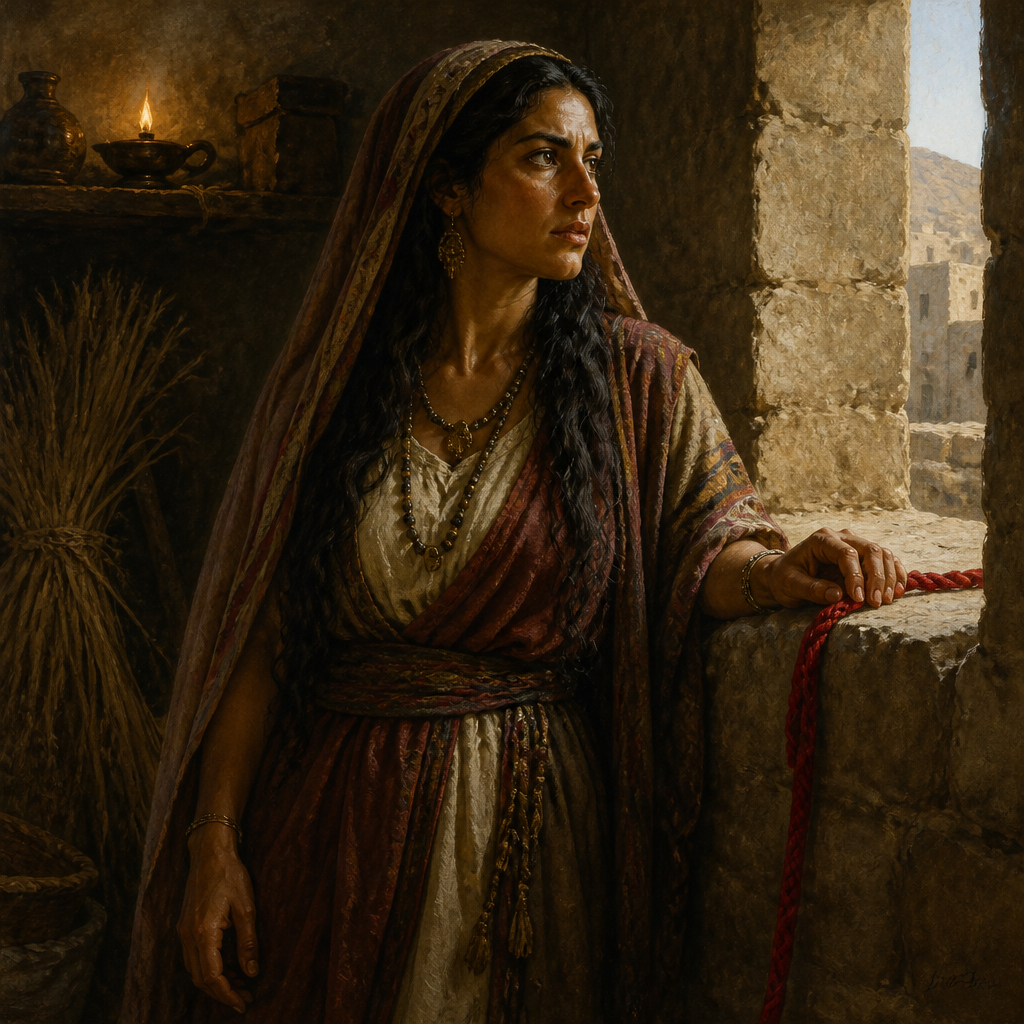
The spies' arrival did not go unnoticed. The King of Jericho received word that "some men of Israel have come here tonight to spy out the land" (Joshua 2:2). When the king’s messengers arrived at Rahab’s house demanding the men be turned over, Rahab risked her life to protect them. She hid the spies on her roof beneath stalks of flax she had laid out to dry. To mislead the king's men, she claimed the visitors had already left the city at dusk before the gates were shut, urging the pursuers to chase after them toward the fords of the Jordan (Joshua 2:4-7).
The Covenant with Rahab
Before the spies departed, Rahab approached them on the roof and confessed her faith in the God of Israel. She recounted how the residents of Jericho were "melting in fear" because of the reports of the Red Sea crossing and the defeat of the Amorite kings Sihon and Og. Recognizing the inevitability of an Israelite victory, she requested a "sure sign" that her family would be spared during the coming invasion.
In response, the two spies entered into a solemn oath with her. They established three conditions for her protection: first, she must tie a scarlet cord in the window through which she lowered them; second, she must gather her entire family inside her house; and third, she must maintain the secrecy of their mission. They declared, "Our lives for your lives!"—a vow that bound the safety of the Israelite scouts to the safety of Rahab’s household (Joshua 2:14-20).
The Escape and Report
Following Rahab's tactical advice, the spies fled into the hill country rather than returning immediately to the Israelite camp. They remained hidden for three days until the king’s search parties abandoned their pursuit. After crossing the Jordan, they returned to Joshua and delivered a report that contrasted sharply with the report of the ten spies a generation earlier: "The LORD has surely delivered the entire land into our hands... all who dwell in the land are melting in fear of us" (Joshua 2:24).
The Rescue of Rahab
During the subsequent fall of Jericho, the two spies fulfilled their promise. After the walls of the city collapsed, Joshua specifically commanded the "two men who had spied out the land" to enter Rahab’s house and bring out the woman and her family (Joshua 6:22). They escorted Rahab, her parents, and her siblings to a place of safety outside the camp of Israel, ensuring their survival while the rest of the city was devoted to destruction.
Relationship to Other Biblical Figures
The primary relationship documented for these men is with Joshua, who served as their commander and authorized their mission. Their interaction with Rahab is the central focus of their narrative; through this encounter, the spies acted as the intermediaries through whom Rahab and her lineage were incorporated into the community of Israel. While later Jewish traditions and commentators have attempted to identify these men (often suggesting Phinehas and Caleb), the biblical text itself maintains their anonymity, emphasizing their role as representatives of the Israelite military and the divine will rather than their individual identities.
Spiritual Significance
The mission of the two spies serves as a narrative bridge between the wandering in the wilderness and the occupation of Canaan. Their report signifies a shift in Israel's collective psyche from fear to faith. Theologically, their encounter with Rahab demonstrates the grace of God toward those outside the covenant who acknowledge His sovereignty. The spies’ strict adherence to their oath, even in the midst of a total war, underscores the importance of integrity and the keeping of vows within the biblical tradition. Their role in the scarlet cord narrative has also been viewed in Christian typology as an early foreshadowing of the protection offered by the blood of the Lamb.
Spiritual Significance
The two spies represent the successful application of faith and military strategy in the Conquest of Canaan. Unlike the earlier scouting mission in Numbers 13, which resulted in a report of fear and 40 years of wandering, these two men returned with a report of confidence that galvanized the Israelite forces. Their mission highlights the psychological state of the Canaanite populations and establishes the legal and moral precedent for Rahab’s inclusion in the genealogy of Israel.
Their story is integral to the fall of Jericho, serving as a catalyst for Rahab's confession of faith. The scouts' willingness to trust a local informant and their discipline in following her escape plan illustrate the human element of divine providence. Their actions ensured that the destruction of Jericho was not absolute, preserving a remnant through the covenant of the scarlet cord.
Frequently Asked Questions
What were the names of the two spies who went to Jericho?
The Bible does not provide the names of the two spies. They are referred to simply as 'two men' or 'the spies' throughout the Book of Joshua.
How did the spies escape from Jericho?
Rahab let them down by a rope through a window in her house, which was built into the city wall. They then hid in the mountains for three days to evade the king's search parties.
What was the 'scarlet cord' mentioned in their story?
The scarlet cord was a sign agreed upon by the spies and Rahab. She was to tie it in her window so the Israelite army would know which house to spare during the attack on Jericho.
Why did the spies go to Rahab's house?
The text states they 'stayed there,' likely because a house of lodging (associated with a prostitute) was a place where strangers could arrive without attracting immediate suspicion and where they could gather intelligence on the city's morale.
Did the two spies participate in the battle of Jericho?
The Bible does not detail their combat actions, but it does record that after the walls fell, Joshua sent them specifically to rescue Rahab and her family before the city was burned.
Connected Figures
Joshua
Commander who sent them on the mission
Rahab
Ally who hid them and made a covenant with them
Categories
Mentions by Book
- Joshua28