Jephthah's Daughter
The only child of the judge Jephthah, she became the subject of her father's tragic vow after he led Israel to victory over the Ammonites during the era of the Conquest.
Jephthah's daughter is a central figure in one of the most sobering accounts in the Book of Judges. As the only child of Jephthah the Gileadite, she appears in the biblical narrative at the moment of her father’s greatest triumph and deepest personal crisis. Following a successful military campaign against the Ammonites, she is the first to greet her father upon his return to Mizpah, inadvertently becoming the object of a rash vow Jephthah had made to the LORD.
Her story is characterized by a remarkable display of submission and devotion to both her father and her God. Despite the tragic implications of her father's promise, she encourages him to fulfill his word, requesting only a two-month period to mourn her fate with her companions. Her life and the manner of its conclusion left such an impression on the nation that it inspired a lasting tradition among the young women of Israel, who would commemorate her annually.
Background and Family
The account of Jephthah’s daughter is set during the late period of the Conquest, specifically the era of the Judges, when Israel faced recurring oppression from neighboring nations. Her father, Jephthah, was a Gileadite—a man of valor who had been marginalized by his family due to his mother's background but was later recalled by the elders of Gilead to lead the defense against the Ammonite invasion. The biblical text in Judges 11:34 explicitly states that she was Jephthah’s only child; the author emphasizes that "besides her he had neither son nor daughter," highlighting the magnitude of the loss to Jephthah’s lineage and household.
While her mother’s name and specific tribal lineage are not provided, her identity is entirely defined by her relationship to her father and her status as a young woman of Israel. She lived in Mizpah, where her father had established his residence and where the tragic reunion between parent and child occurred following the cessation of hostilities.
Major Life Events
The Rash Vow and Victory
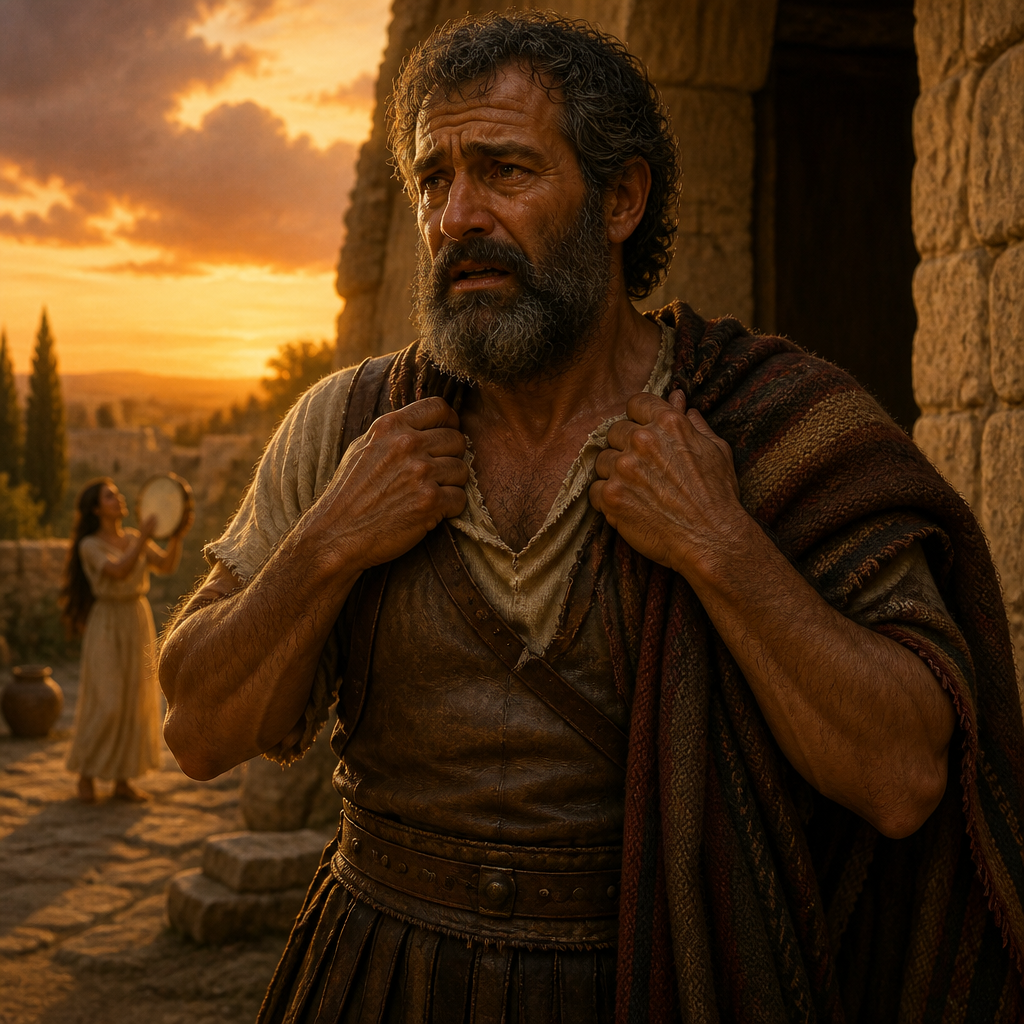
Before engaging the Ammonites in battle, Jephthah made a vow to the LORD, stating: "Whatever comes out from the doors of my house to meet me when I return in peace from the Ammonites shall be the LORD's, and I will offer it up for a burnt offering" (Judges 11:30-31). Following a decisive victory granted by God, Jephthah returned home to Mizpah. The first to emerge from his house was his daughter, leading a celebration with tambourines and dancing (Judges 11:34).
The Tragic Confrontation
Upon seeing her, Jephthah tore his clothes in a traditional gesture of mourning and despair. He confessed his vow, telling her, "You have brought me to my knees! You have brought great misery upon me, for I have given my word to the LORD and cannot take it back" (Judges 11:35). The response of Jephthah’s daughter is noted by scholars for its courage; she accepted the necessity of the vow, noting that since the LORD had avenged Israel of their enemies, her father must do as he had spoken (Judges 11:36).
The Two-Month Lamentation
She made a single request to her father: to be allowed two months to wander through the mountains with her friends to mourn her virginity (Judges 11:37). Jephthah granted this request. This period allowed her to process the fact that she would never marry or carry on her father's name—a significant social and personal tragedy in the context of ancient Israelite culture.
The Fulfillment of the Vow
After the two months concluded, she returned to her father. The text states that "he did to her as he had vowed" (Judges 11:39). The verse immediately follows by noting that she had never had relations with a man. This event led to a lasting custom where the young women of Israel would go out for four days each year to lament her (Judges 11:40).
Relationship to Other Biblical Figures
Her primary and only recorded relationship is with her father, Jephthah. The interaction between them is one of mutual respect and tragic irony. While Jephthah is the active leader and judge, his daughter serves as the moral anchor in their final dialogue. She does not contest his authority or the sanctity of his word, despite being the victim of his impulsive speech. Her friends, though unnamed, appear as a collective support system, accompanying her during her final days in the mountains.
Spiritual Significance
The story of Jephthah’s daughter is often viewed as a cautionary tale regarding the danger of rash vows and the spiritual state of Israel during the period of the Judges. Unlike the intended sacrifice of Isaac, where God provided a ram and forbade the act, there is no divine intervention recorded here. The text remains neutral in its reporting, neither explicitly condemning nor praising Jephthah’s act, though it highlights the daughter's piety and submission. She represents a figure of tragic virtue—one who honors a covenant even when it costs her life and future, reflecting the serious nature of oaths taken in the name of the LORD during the Conquest era.
Spiritual Significance
Jephthah's daughter serves as a poignant example of sacrificial obedience and the gravity of the spoken word in the Old Testament. Her willingness to accept the consequences of her father's vow—despite its personal cost—highlights a level of character that stands in stark contrast to the often chaotic and unfaithful behavior of Israel during the time of the Judges. Her story underscores the cultural and spiritual weight of vows (Numbers 30:2) and the tragedy that ensues when human rashness intersects with divine devotion.
Theologically, she is often cited in discussions regarding the nature of Jephthah's vow—whether it resulted in a literal human sacrifice (which was strictly forbidden by Mosaic Law) or a lifetime of dedicated service and celibacy at the Tabernacle. Regardless of the interpretation, the biblical emphasis remains on her perpetual virginity and the communal mourning of the women of Israel, marking her as a figure of national lament and a symbol of the innocent suffering the consequences of the errors of their leaders.
Frequently Asked Questions
What was the name of Jephthah's daughter?
The Bible does not provide a name for her; she is referred to only as 'the daughter of Jephthah' or his 'only child.'
Why did Jephthah's daughter have to be sacrificed?
Her father had made a vow to God that he would sacrifice the first thing that came out of his house to meet him if he were victorious over the Ammonites. She was the first to greet him.
Did Jephthah's daughter actually die?
The text says Jephthah 'did to her as he had vowed.' Scholars debate whether this means she was offered as a burnt sacrifice or dedicated to a life of perpetual virginity and service to God, though the literal reading of the vow suggests the former.
How long did she mourn in the mountains?
She requested and was granted two months to mourn her virginity in the mountains with her friends.
What custom did her life inspire in Israel?
The young women of Israel established a tradition of going out for four days every year to lament or commemorate her.
Connected Figures
Categories
Mentions by Book
- Judges7