Abidan
Who was Abidan in the Bible?
Abidan, son of Gideoni, was the tribal leader and military commander of the tribe of Benjamin during the Israelite wandering in the wilderness.
Abidan, the son of Gideoni, appears in the biblical record as a prominent leader of the tribe of Benjamin during the pivotal period following the Exodus from Egypt. His role is defined by administrative and military leadership, serving as the official representative of his tribe during the organization of the Israelite camp in the wilderness of Sinai. As the 'prince' or 'leader' (nasi) of the Benjamites, Abidan functioned as a primary intermediary between his tribesmen and the central leadership of Moses and Aaron.
While the scriptural record concerning Abidan is concentrated within the first ten chapters of the Book of Numbers, these references establish his status as a man of significant standing and responsibility. He was responsible for the census of his tribe, the presentation of ceremonial offerings at the dedication of the Tabernacle, and the strategic positioning of his people during the march toward the Promised Land. His service coincides with the formalization of Israel’s religious and social structures in the 15th century BC.
Background and Family
Abidan was the son of a man named Gideoni. He belonged to the tribe of Benjamin, the youngest of the twelve sons of Jacob. By the time of the Exodus, the tribe of Benjamin had grown into a significant military and social unit within the nation of Israel. Abidan emerged as the nasi—a term often translated as "prince," "leader," or "chief"—of the Benjamites. This title indicates that he was likely the head of a major ancestral house and possessed the authority to speak for the entire tribe in matters of national importance.
Major Life Events
Abidan’s recorded activities begin in the second year after the Israelites left Egypt. In Numbers 1:11, he is specifically named as the individual chosen to assist Moses and Aaron in conducting a census of the men of fighting age. This task required Abidan to verify the genealogical records of the Benjamites and oversee the counting of 35,400 men qualified for military service.
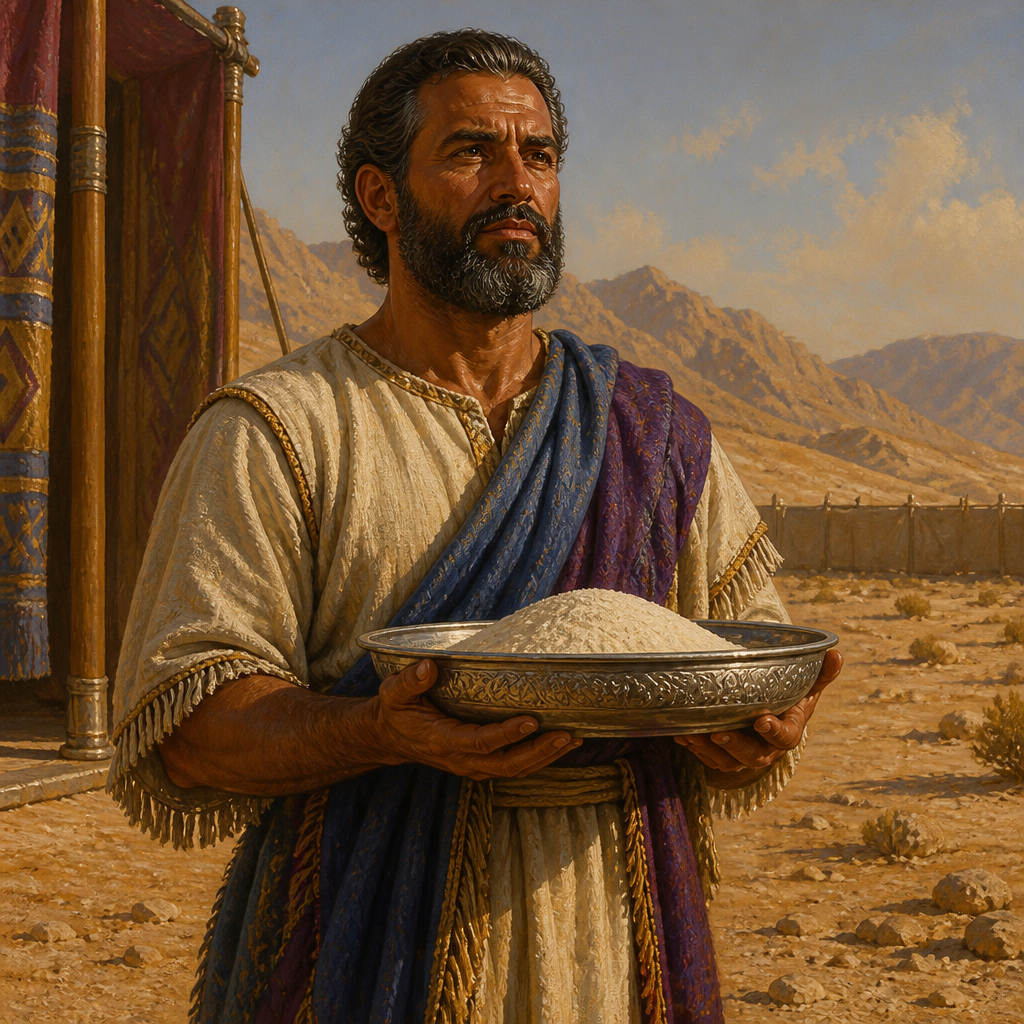
Following the completion of the Tabernacle, Abidan played a central role in the dedication ceremonies described in Numbers 7. On the ninth day of the dedication, he presented the offering for the tribe of Benjamin. The text records his contribution with meticulous detail:
"His offering was one silver platter weighing a hundred and thirty shekels, one silver sprinkling bowl weighing seventy shekels, both according to the sanctuary shekel, each filled with fine flour mixed with oil for a grain offering; one gold dish weighing ten shekels, filled with incense; one young bull, one ram, and one male lamb a year old, for a burnt offering; one male goat for a sin offering; and for a sacrifice of peace offerings, two oxen, five rams, five male goats, and five male lambs a year old." (Numbers 7:60–65)
Finally, Abidan is noted for his military command. In the organized camp of Israel, the tribe of Benjamin was stationed on the west side of the Tabernacle, under the standard of the camp of Ephraim. When the cloud lifted and the nation moved, Abidan was responsible for leading his division in the prescribed order of march (Numbers 10:24).
Relationship to Other Biblical Figures
Abidan operated under the direct authority of Moses and Aaron, the supreme leaders of the Exodus. As the leader of Benjamin, he was a peer to other tribal princes, such as Nahshon of Judah and Elisama of Ephraim. His relationship with Gideoni, his father, is the only familial tie explicitly mentioned, serving to anchor his legitimacy within the Benjamite genealogy.
Spiritual Significance
Abidan represents the order and obedience required of the covenant people during the wilderness period. His participation in the census and the dedication of the Tabernacle underscores the biblical theme that every individual tribe, including the smaller tribe of Benjamin, had a specific and essential place in God’s redemptive plan for Israel. His generous and systematic offerings reflect a heart of worship and a commitment to the communal maintenance of the sanctuary.
Abidan’s primary significance lies in his role as a foundational leader during the birth of Israel as a structured nation. By overseeing the census and presenting the dedication offerings, he validated the inclusion of the tribe of Benjamin in the national identity and the sacrificial system. His leadership demonstrates the transition from a collection of escaped slaves to a disciplined, organized people governed by divine law.
Furthermore, Abidan serves as an example of the 'princes of Israel' who provided the necessary logistical and spiritual support for the work of Moses. Though his individual words are not recorded, his actions in the Tabernacle dedication signify the collective devotion of the Benjamites to the God of their fathers.
Frequently Asked Questions
What does the name Abidan mean in Hebrew?
The name Abidan (אֲבִידָן) is generally understood to mean 'My father is judge' or 'Father of judgment.'
Which tribe did Abidan lead?
Abidan was the leader of the tribe of Benjamin during the wilderness wanderings.
What was Abidan's role during the census?
He was appointed to assist Moses and Aaron in counting the men of Benjamin who were twenty years old or older and able to go to war.
On which day did Abidan present his offering for the Tabernacle?
He presented his offering on the ninth day of the dedication ceremony.
Where was Abidan's tribe positioned in the camp?
The tribe of Benjamin, under Abidan's leadership, was positioned on the west side of the Tabernacle.
Family & Relationships
Parents
 GideoniFatherNumbers 1:11Stated
 AbidanThis page
Connected Figures
Family
Father · Numbers 1:11
A prominent member of the tribe of Benjamin during the Exodus, recognized as the father of Abidan, the tribal leader who assisted Moses.
Categories
Mentions by Book
- Numbers5
Scripture References
All 5 indexed verses, in canonical order, from the Berean Standard Bible.
Numbers · 5
- Numbers 1:11
from Benjamin, Abidan son of Gideoni;
- Numbers 2:22
Next will be the tribe of Benjamin. The leader of the Benjamites is Abidan son of Gideoni,
- Numbers 7:60
On the ninth day Abidan son of Gideoni, the leader of the Benjamites, drew near.
- Numbers 7:65
and a peace offering of two oxen, five rams, five male goats, and five male lambs a year old. This was the offering of Abidan son of Gideoni.
- Numbers 10:24
and Abidan son of Gideoni was over the division of the tribe of Benjamin.