Hophni
Who was Hophni in the Bible?
A priest of Israel at Shiloh and son of Eli whose corrupt behavior and eventual death in battle signaled the end of his family’s priestly dominance.
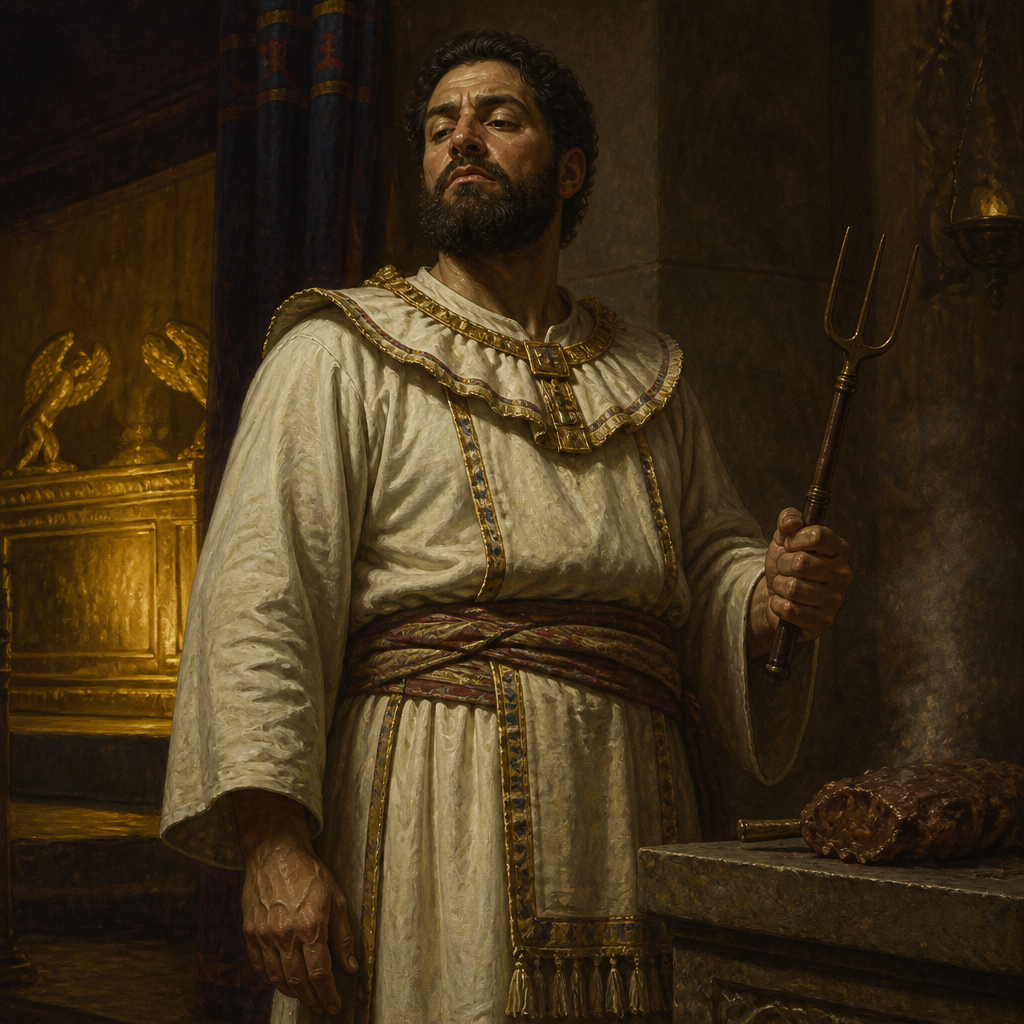
Hophni was a priest of Israel serving at the tabernacle in Shiloh during the transitional period of the era of the conquest and the judges. As one of the two sons of Eli, the High Priest and Judge, Hophni held a position of significant religious and political authority. However, the biblical narrative depicts his tenure as one defined by systemic corruption and a disregard for the sanctity of the sacrificial system.
His life is inextricably linked with that of his brother, Phinehas, as the two are almost always mentioned together in the scriptural record. Their actions represented a spiritual crisis for Israel, leading to a divine prophetic indictment against the house of Eli. Hophni’s biography concludes with the catastrophic defeat of Israel by the Philistines, resulting in his death and the loss of the Ark of the Covenant.
Background and Family
Hophni was a member of the Tribe of Levi, specifically descending from the line of priests tasked with maintaining the worship of Yahweh at Shiloh. He was the son of Eli, who served as both priest and judge over Israel for forty years. According to 1 Samuel 1:3, Hophni and his brother Phinehas were actively serving as "priests to the LORD" at the central sanctuary in Shiloh during the time when Elkanah and his family, including the future prophet Samuel, traveled there for annual sacrifices.
While the biblical text focuses heavily on his professional failures, Hophni’s domestic life is not detailed beyond his immediate family ties. He functioned within a hereditary priesthood where the expectations for holiness were paramount, yet he and his brother are described as failing to meet even the basic requirements of their office.
Major Life Events
The primary events of Hophni’s life center on his service at Shiloh and the subsequent judgment upon his house. The narrative in 1 Samuel 2 portrays Hophni and Phinehas as men who "did not know the LORD," treating the offerings of the people with contempt. While the specific details of their ritual abuses—such as taking the meat of the sacrifice by force before the fat was burned—are attributed to Eli's sons generally, Hophni is named as a primary participant in this systemic corruption.
A significant turning point occurred when a "man of God" came to Eli to deliver a prophecy of doom. As a specific sign of the coming judgment, the prophet declared that both Hophni and Phinehas would die on the same day (1 Samuel 2:34). This prophecy set the stage for the final act of Hophni’s life.
During a period of intense conflict with the Philistines, the elders of Israel decided to bring the Ark of the Covenant from Shiloh to the battlefield at Aphek, hoping it would ensure victory. Hophni and Phinehas accompanied the Ark to the front lines. The presence of the Ark failed to secure a win; instead, the Philistines slaughtered thirty thousand Israelites. During this engagement, Hophni was killed alongside his brother, and the Ark was captured.
Relationship to Other Biblical Figures
Hophni’s most significant relationship was with his father, Eli. The text highlights a dynamic of failed discipline; while Eli rebuked his sons for their behavior, he failed to restrain them or remove them from office. This failure to honor God above his sons resulted in the divine rejection of the family line.
Hophni also served as a foil to the young Samuel. While Hophni represented the decaying and corrupt old order of the priesthood, Samuel was depicted as growing in favor with both God and men, eventually replacing the house of Eli as the spiritual leader of the nation.
Spiritual Significance
Hophni serves as a cautionary figure regarding the misuse of sacred office. His life illustrates the biblical principle that proximity to the holy does not equate to personal righteousness. The death of Hophni is presented not as a random casualty of war, but as a specific fulfillment of divine prophecy and a judgment on a leadership that exploited its subjects. His legacy is one of institutional failure, marking the end of the Shiloh priesthood and the transition toward the era of the monarchy and the rise of the prophetic office.
Theologically, Hophni represents the 'worthless' leader who uses religious ritual for personal gain. His life and death underscore the necessity of integrity within the priesthood and the reality of divine accountability for those in positions of spiritual authority. His story serves as the catalyst for the rise of Samuel and the eventual shift in Israel's leadership structure.
Frequently Asked Questions
How did Hophni die?
Hophni died in battle against the Philistines at Aphek. His death occurred on the same day as his brother Phinehas, fulfilling a prophecy given to their father Eli.
What was Hophni’s role in Israel?
Hophni was a priest of the Tribe of Levi serving at the tabernacle in Shiloh under his father, Eli.
What sins were Hophni and his brother accused of?
They were accused of treating the Lord's offerings with contempt, forcibly taking portions of sacrifices for themselves, and failing to acknowledge the authority of God.
What happened to the Ark of the Covenant when Hophni died?
Hophni was accompanying the Ark on the battlefield when he was killed; the Philistines subsequently captured the Ark and took it back to their territory.
Who was Hophni's brother?
His brother was Phinehas, who served alongside him as a priest and died with him in battle.
Family & Relationships
Parents
 EliFather1 Samuel 4:4Stated
 HophniThis page
 Phinehas, Son of EliBrother1 Samuel 4:4Stated
Connected Figures
Family
Father · 1 Samuel 4:4
Eli was a high priest of Israel at Shiloh and a judge during the era of the conquest and the judges, known for mentoring the prophet Samuel.
Conquest and JudgesFirst: 1 Samuel 1:332 versesHigh Priest and JudgeLevi
Brother · 1 Samuel 4:4
Phinehas was a priest at Shiloh during the United Monarchy whose death coincided with the Philistine capture of the Ark of the Covenant.
Mentions by Book
- 1 Samuel5
Scripture References
All 5 indexed verses, in canonical order, from the Berean Standard Bible.
1 Samuel · 5
- 1 Samuel 1:3
Year after year Elkanah would go up from his city to worship and sacrifice to the LORD of Hosts at Shiloh, where Eli’s two sons, Hophni and Phinehas, were priests to the LORD.
- 1 Samuel 2:34
And this sign shall come to you concerning your two sons Hophni and Phinehas: They will both die on the same day.
- 1 Samuel 4:4
So the people sent men to Shiloh, and they brought back the ark of the covenant of the LORD of Hosts, who sits enthroned between the cherubim. And the two sons of Eli, Hophni and Phinehas, were there with the ark of the covenant of God.
- 1 Samuel 4:11
The ark of God was captured, and Eli’s two sons, Hophni and Phinehas, died.
- 1 Samuel 4:17
The messenger answered, “Israel has fled before the Philistines, and there has been a great slaughter among the people. Your two sons, Hophni and Phinehas, are both dead, and the ark of God has been captured.”