Hannah
Who was Hannah in the Bible?
The devout wife of Elkanah and mother of the prophet Samuel, known for her persistent prayer and dedicating her firstborn to the LORD at Shiloh.
Hannah is a prominent figure in the Old Testament, specifically at the dawn of the United Monarchy in Israel. As the preferred but barren wife of Elkanah, an Ephraimite, her narrative serves as the transition from the chaotic Period of the Judges to the establishment of the monarchy. Her story is defined by intense personal suffering, fervent prayer, and the fulfillment of a solemn vow to God.
Hannah is primarily characterized by her piety and her role as the mother of Samuel, who would become one of Israel’s most influential prophets and the one who anointed its first two kings. Her poetic song of praise in 1 Samuel 2 is considered a masterpiece of biblical liturgy, reflecting her deep theological understanding of God’s sovereignty over the humble and the proud.
Background and Family
Hannah lived during a pivotal transition in Israel’s history, residing in Ramah (specifically Ramathaim-zophim) in the hill country of Ephraim. She was one of two wives of Elkanah; the other wife was Peninnah. The biblical record in 1 Samuel 1:2 notes a sharp contrast between the two women: Peninnah had children, but Hannah had none. Despite her infertility, which was a source of great social and personal distress in the ancient Near Eastern context, Elkanah demonstrated a deep affection for Hannah, giving her a "double portion" of the sacrificial meat during their annual pilgrimages to the tabernacle at Shiloh.
The family dynamic was marked by domestic friction. Peninnah reportedly provoked Hannah severely to irritate her because the LORD had closed her womb. This distress was so profound that Hannah often wept and could not eat, even when Elkanah attempted to comfort her by asserting that his love should be worth more to her than ten sons (1 Samuel 1:8).
Major Life Events
The Vow at Shiloh
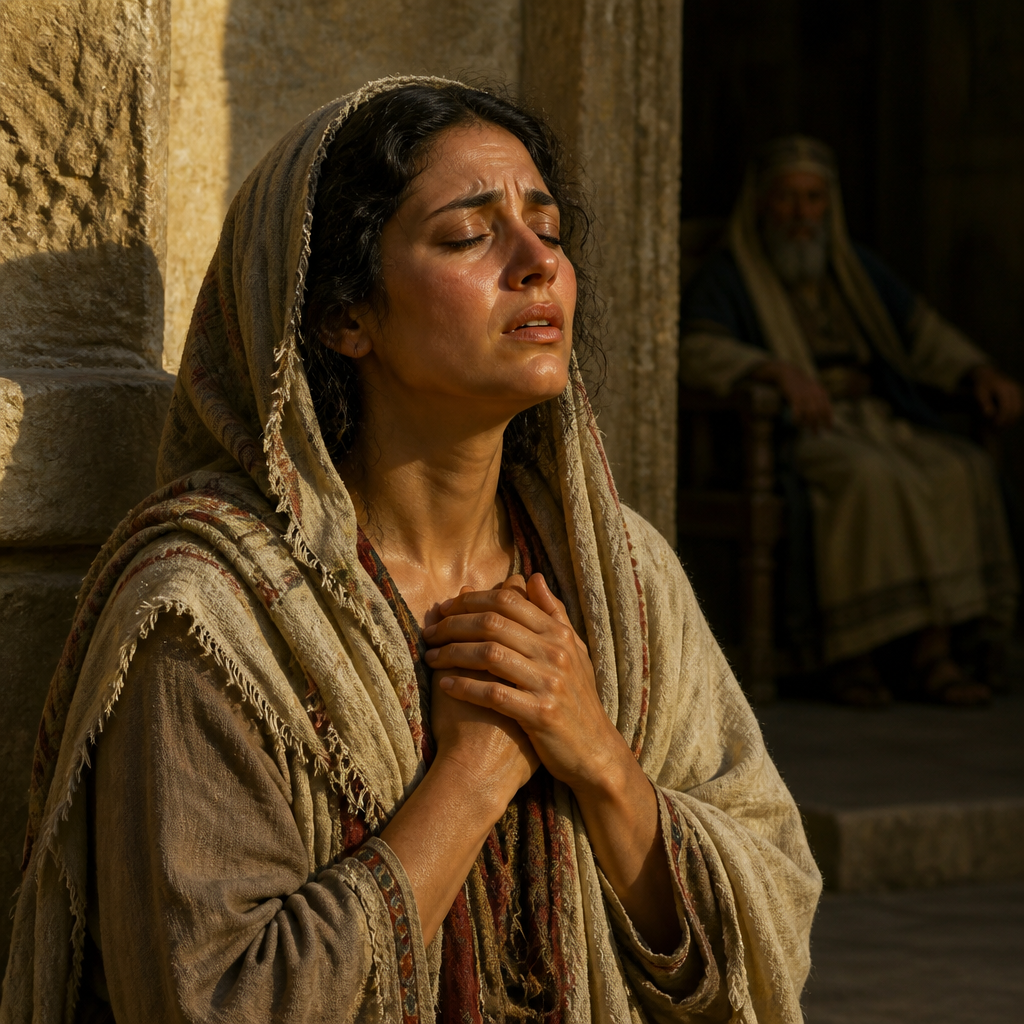
During one of the family’s annual visits to Shiloh, Hannah’s grief reached a breaking point. Standing near the doorpost of the temple of the LORD, she prayed with such intensity that her lips moved without sound. In her petition, she made a specific vow: if God would give her a son, she would give him back to the LORD for all the days of his life, and no razor would ever touch his head (a Nazirite-like dedication).
Eli the priest, observing her silent labor in prayer, initially accused her of being drunk. Hannah’s dignified response—describing herself as a "woman oppressed in spirit" who was "pouring out her soul"—moved Eli to offer a blessing, praying that the God of Israel would grant her petition. Following this encounter, Hannah’s demeanor shifted; she ate and was no longer sad.
The Birth and Dedication of Samuel
In due time, Hannah conceived and gave birth to a son, whom she named Samuel (Shemuel), citing that she had asked for him from the LORD. True to her word, she did not return to the annual sacrifice until the child was weaned. Once weaned, she brought the young Samuel to Shiloh, along with a three-year-old bull, an ephah of flour, and a skin of wine.
She presented the child to Eli, reminding him of her previous prayer. The text records that she left the child there to serve the LORD permanently. This act of sacrificial devotion was followed by her famous prayer of thanksgiving, often referred to as the Song of Hannah.
Relationship to Other Biblical Figures
Hannah’s primary relationship is with her son, Samuel. Although she left him at the tabernacle, the biblical record indicates a continued maternal care; she would make him a little robe each year and bring it when she came with her husband for the yearly sacrifice. Her relationship with Elkanah is portrayed as one of mutual respect and love, as he supported her vow and her decision to remain home until Samuel was weaned. Through Eli’s subsequent blessings, the LORD attended to Hannah further, and she eventually gave birth to three more sons and two daughters (1 Samuel 2:21).
Spiritual Significance
Hannah is a model of "petitionary prayer" and the "prayer of the heart." Her narrative emphasizes that God hears the cries of the marginalized and the distressed. Historically, her son Samuel serves as the bridge between the judges and the kings, making Hannah’s faithfulness the catalyst for a new era in Israel's governance. Her song in 1 Samuel 2:1-10 is theologically rich, emphasizing that God "brings low" and "lifts up," a theme that echoes throughout the Psalms and anticipates the Magnificat in the New Testament. She represents the ideal of total surrender to God’s will, holding her long-awaited child with a loose hand so that he might serve a higher divine purpose.
Hannah’s significance lies in her role as the mother of the prophetic office that transitioned Israel into the era of the conquest and the judges. Her personal faithfulness and her vow directly resulted in the rise of Samuel, who would bring order to Israel and crown King David. Her story serves as a theological proof-text for the power of persistent, silent prayer and the concept of 'the LORD remembering' His people.
Furthermore, the 'Song of Hannah' (1 Samuel 2:1-10) is a foundational piece of biblical poetry. It establishes the theme of the 'Great Reversal'—where the barren woman bears seven and the mighty are broken—which becomes a recurring motif in both Old and New Testament theology, highlighting God's justice and sovereignty over human affairs.
Frequently Asked Questions
Why did Eli think Hannah was drunk?
Hannah was praying silently in her heart, moving her lips but making no audible sound. At the time, audible prayer was the norm, and Eli mistook her intense, silent emotional outpouring for the effects of wine.
What does the name Samuel mean according to Hannah?
Hannah named him Samuel because she said, 'Because I have asked for him from the LORD.' The name is traditionally associated with the Hebrew words for 'heard by God' or 'name of God'.
Did Hannah see Samuel after she left him at Shiloh?
Yes. The Bible records that every year when Hannah and Elkanah went to Shiloh for the annual sacrifice, she would bring Samuel a new little robe that she had made for him.
How many children did Hannah have in total?
After Samuel, the LORD blessed Hannah with five additional children: three sons and two daughters, for a total of six children.
What was the specific vow Hannah made to God?
She vowed that if God gave her a son, she would give him to the LORD for his whole life and that no razor would ever touch his head, marking him as dedicated to God's service.
Family & Relationships
 Elkanah, Father of SamuelHusband1 Samuel 1:8Stated
 HannahThis page
Children
 SamuelSon1 Samuel 1:20Stated
Connected Figures
Family
Husband · 1 Samuel 1:8
A devout Levite of the era of the conquest and the judges, known as the husband of Hannah and the father of the prophet Samuel.
Son · 1 Samuel 1:20
A pivotal prophet, priest, and the final judge of Israel who presided over the transition from the loose confederation of tribes to the United Monarchy.
Conquest and JudgesFirst: 1 Samuel 1:20127 versesProphet, Judge, PriestLevi
Mentions by Book
- 1 Samuel15
Scripture References
All 15 indexed verses, in canonical order, from the Berean Standard Bible.
1 Samuel · 15
- 1 Samuel 1:2Partial
He had two wives, one named Hannah and the other Peninnah. And Peninnah had children, but Hannah had none.
- 1 Samuel 1:5
But to Hannah he would give a double portion, for he loved her even though the LORD had closed her womb.
- 1 Samuel 1:8
“Hannah, why are you crying?” her husband Elkanah asked. “Why won’t you eat? Why is your heart so grieved? Am I not better to you than ten sons?”
- 1 Samuel 1:9
So after they had finished eating and drinking in Shiloh, Hannah stood up. Now Eli the priest was sitting on a chair by the doorpost of the temple of the LORD.
- 1 Samuel 1:10
In her bitter distress, Hannah prayed to the LORD and wept with many tears.
Cited as a key verse; added so References, Key Verses and Mentions by Book share one index.
- 1 Samuel 1:13
Hannah was praying in her heart, and though her lips were moving, her voice could not be heard. So Eli thought she was drunk
- 1 Samuel 1:15
“No, my lord,” Hannah replied. “I am a woman troubled in spirit. I have not had any wine or strong drink, but I have poured out my soul before the LORD.
- 1 Samuel 1:19
The next morning they got up early to bow in worship before the LORD, and then they returned home to Ramah. And Elkanah had relations with his wife Hannah, and the LORD remembered her.
- 1 Samuel 1:20
So in the course of time, Hannah conceived and gave birth to a son. She named him Samuel, saying, “Because I have asked for him from the LORD.”
- 1 Samuel 1:22
but Hannah did not go. “After the boy is weaned,” she said to her husband, “I will take him to appear before the LORD and to stay there permanently.”
- 1 Samuel 1:27Partial
I prayed for this boy, and since the LORD has granted me what I asked of Him,
Cited as a key verse; added so References, Key Verses and Mentions by Book share one index.
- 1 Samuel 1:28Partial
I now dedicate the boy to the LORD. For as long as he lives, he is dedicated to the LORD.” So they worshiped the LORD there.
Cited as a key verse; added so References, Key Verses and Mentions by Book share one index.
- 1 Samuel 2:1
At that time Hannah prayed: “My heart rejoices in the LORD; my horn is exalted in the LORD. My mouth speaks boldly against my enemies, for I rejoice in Your salvation.
- 1 Samuel 2:2Partial
There is no one holy like the LORD. Indeed, there is no one besides You! And there is no Rock like our God.
Cited as a key verse; added so References, Key Verses and Mentions by Book share one index.
- 1 Samuel 2:21
So the LORD attended to Hannah, and she conceived and gave birth to three sons and two daughters. Meanwhile, the boy Samuel grew up in the presence of the LORD.