Peninnah
Who was Peninnah in the Bible?
The second wife of Elkanah during the era of the conquest and the judges, known for her fertility and her antagonistic relationship with Hannah, the mother of the prophet Samuel.
Peninnah was one of two wives of Elkanah, an Ephraimite residing in Ramathaim-zophim during the transition toward the United Monarchy (c. 11th century BC). She is introduced in the opening chapter of 1 Samuel as the fertile counterpart to Elkanah’s other wife, Hannah, who was initially barren. The biblical record defines Peninnah primarily through her role within this domestic sphere and her reproductive success.
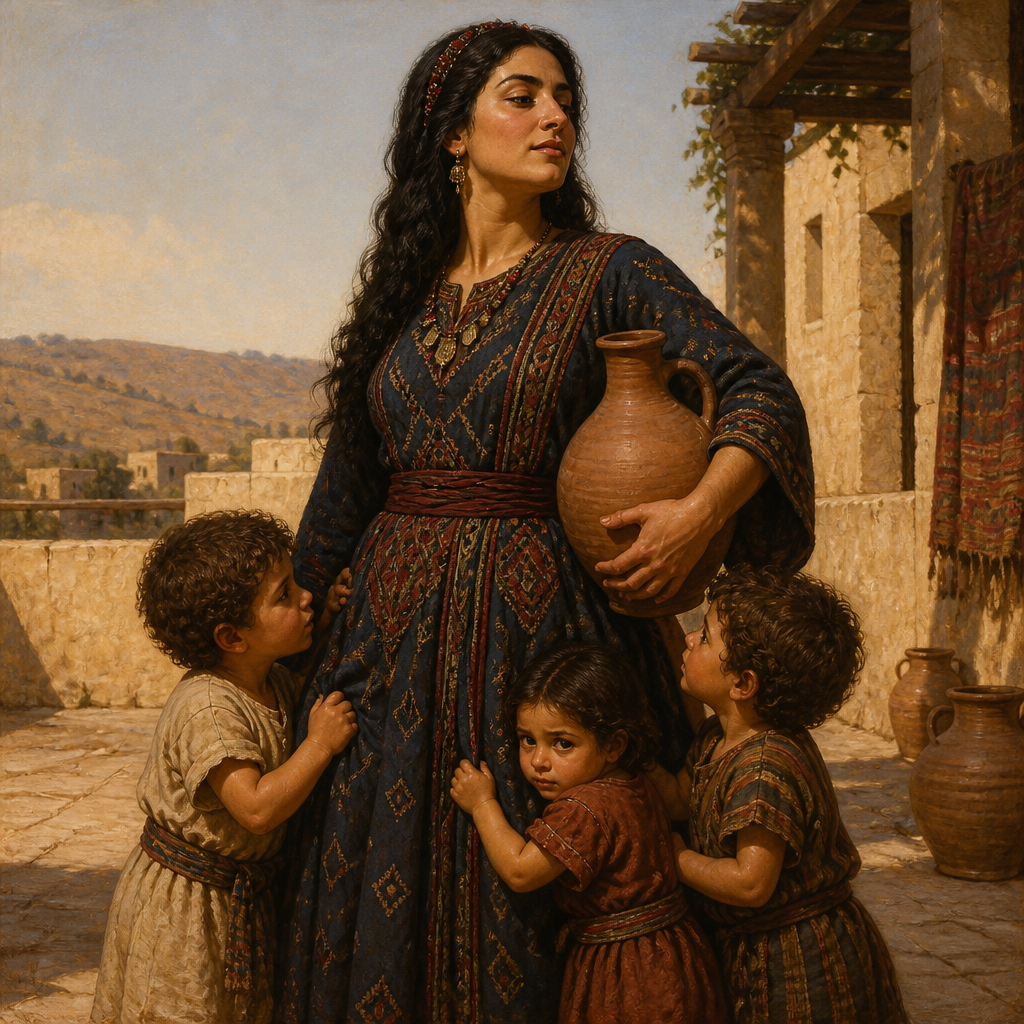
While the text is brief regarding her personal history, it highlights her presence during the annual family pilgrimages to the tabernacle at Shiloh. There, she received portions of the sacrificial meat for herself and her children. Her narrative function serves as a catalyst for Hannah’s fervent prayer and the eventual birth of Samuel, a pivotal figure in Israel's history.
Background and Family
Peninnah lived during a significant transitional period in Israel's history, often categorized within the early United Monarchy or the closing years of the Period of the Judges (c. 1050 BC). She was married to Elkanah, a man of the hill country of Ephraim. The biblical text in 1 Samuel 1:2 notes that Elkanah practiced polygamy, a social structure present though regulated in ancient Israelite law. Within this marriage, Peninnah is explicitly noted for having "sons and daughters," contrasting sharply with Hannah’s lack of children.
Major Life Events
The primary record of Peninnah’s life centers on the family's religious life at Shiloh, the site of the Ark of the Covenant before the construction of the Temple in Jerusalem. Each year, Elkanah traveled to Shiloh to worship and sacrifice to the Lord of Hosts. During these events, the distribution of sacrificial portions underscored the family dynamics. According to 1 Samuel 1:4:
"And whenever the day came for Elkanah to present his sacrifice, he would give portions to his wife Peninnah and to all her sons and daughters."
Though she received these portions, the text suggests a household divided by favoritism and rivalry. Elkanah gave a "double portion" to Hannah because he loved her, despite her barrenness. The biblical account notes that Peninnah acted as a "rival" to Hannah, provoking her severely to irritate her because the Lord had closed Hannah’s womb. This domestic tension reached its peak during the Shiloh pilgrimages, leading to Hannah's weeping and refusal to eat, which eventually prompted Hannah's vow to God and the birth of Samuel.
Relationship to Other Biblical Figures
Peninnah’s most significant relationships are defined by her marriage to Elkanah and her rivalry with Hannah. As the mother of Elkanah’s older children, she held a secure legal and social status that was traditionally afforded to fertile wives in the Ancient Near East. However, she occupied a secondary place in her husband's affections compared to Hannah. Her children, though mentioned as a group ("all her sons and daughters"), are not named individually in the Masoretic Text. Following the birth of Samuel and Hannah's subsequent children, Peninnah fades from the biblical narrative.
Spiritual Significance
In a scholarly and theological context, Peninnah represents the human element of provocation that often precedes divine intervention. Her presence in the text highlights the theme of the "reversal of fortunes," a common motif in Hebrew scripture where the lowly or barren are exalted by God while the proud or secure are eclipsed. While Peninnah fulfilled the traditional cultural expectations of a wife by providing heirs, the narrative focus shifts entirely to Hannah’s line due to the prophetic importance of Samuel. Peninnah serves as the necessary foil to emphasize Hannah's desperation and God’s eventual provision of a leader for Israel.
Peninnah’s role in the biblical canon is largely structural; she provides the domestic tension required to move Hannah toward her historic petition at Shiloh. Her actions reflect the complexities and frequent frictions of polygamous households in the ancient world. Theologically, she is often viewed as a symbol of the 'fruitful' who lack the spiritual depth or favor eventually granted to the 'barren' who wait upon the Lord.
Furthermore, the mention of her many 'sons and daughters' serves to magnify the miracle of Samuel’s birth. By establishing that Elkanah already had an established lineage through Peninnah, the text emphasizes that Samuel was not merely a biological necessity for Elkanah’s line, but a specific, divinely appointed gift for the nation of Israel.
Frequently Asked Questions
What does the name Peninnah mean?
The name Peninnah (פְּנִנָּה) is traditionally interpreted to mean 'pearl' or 'coral' in Hebrew.
How many children did Peninnah have?
The Bible does not give an exact number, but 1 Samuel 1:4 refers to 'all her sons and daughters,' indicating she had at least four children (minimum two of each) and likely more.
Why did Peninnah provoke Hannah?
The text states she provoked Hannah to 'irritate her' because the Lord had closed Hannah's womb. This was likely driven by the domestic rivalry for Elkanah's primary affection, which he openly showed to Hannah.
What happened to Peninnah after Samuel was born?
The biblical record does not mention Peninnah again after the initial events of 1 Samuel 1. Once Hannah gives birth to Samuel and later other children, Peninnah's role in the narrative concludes.
Family & Relationships
 Elkanah, Father of SamuelHusband1 Samuel 1:4Stated
 PeninnahThis page
Connected Figures
Family
Husband · 1 Samuel 1:4
A devout Levite of the era of the conquest and the judges, known as the husband of Hannah and the father of the prophet Samuel.
Mentions by Book
- 1 Samuel2
Scripture References
All 2 indexed verses, in canonical order, from the Berean Standard Bible.
1 Samuel · 2
- 1 Samuel 1:2Partial
He had two wives, one named Hannah and the other Peninnah. And Peninnah had children, but Hannah had none.
- 1 Samuel 1:4
And whenever the day came for Elkanah to present his sacrifice, he would give portions to his wife Peninnah and to all her sons and daughters.