Herod the Great
Who was Herod the Great in the Bible?
The Roman-appointed King of Judea who sought to kill the infant Jesus and ordered the Massacre of the Innocents in Bethlehem.
This is one of 3 people named Herod in the Bible. See all 3 →
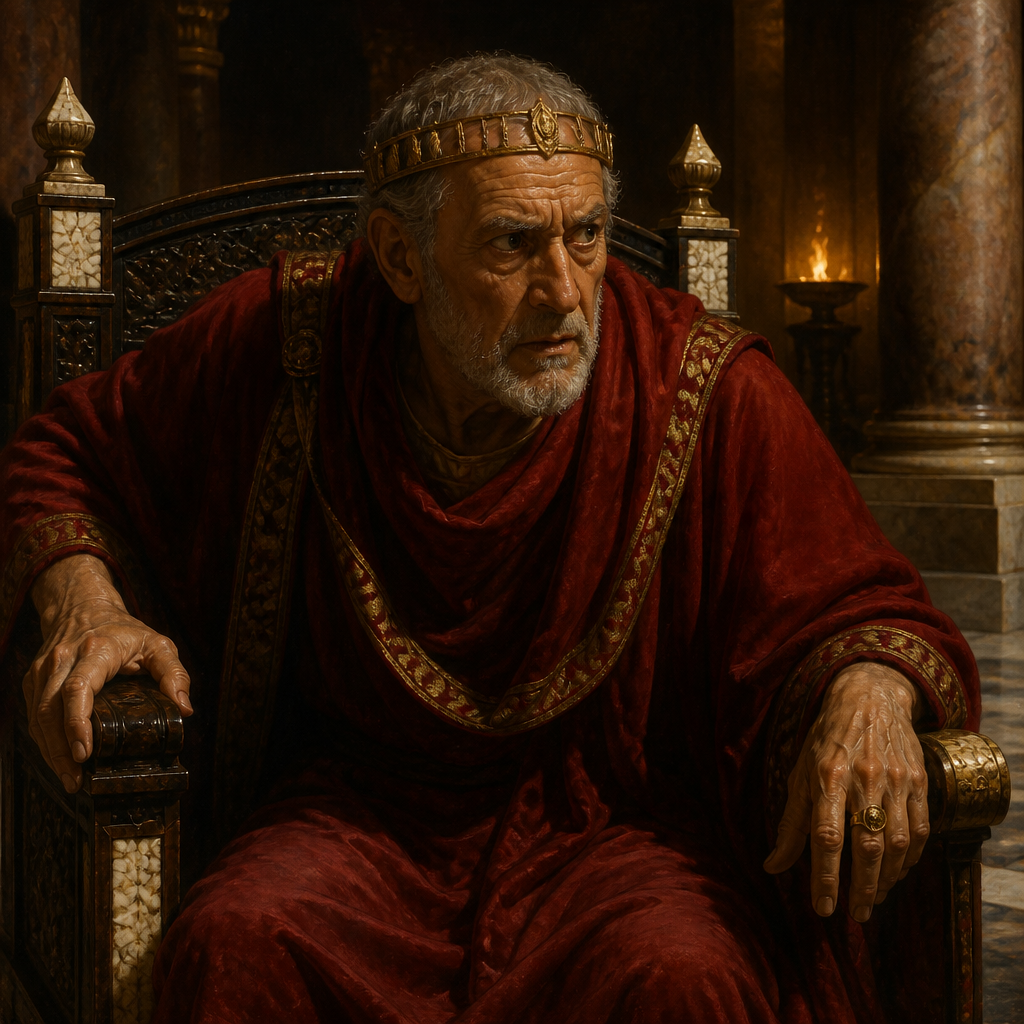
Herod, traditionally identified as Herod the Great, was the reigning King of Judea during the birth of Jesus Christ. His rule was characterized by immense political power and a profound paranoia regarding his domestic security and the legitimacy of his throne. He appears in the Gospel accounts as a formidable and ruthless monarch, whose reaction to the news of a rival 'King of the Jews' set the stage for the flight of the Holy Family into Egypt.
Historically and biblically, Herod is noted for his grand architectural projects, including a praetorium mentioned in the Book of Acts, and his role in the complex administrative transition of Judea under Roman authority. However, his primary biblical legacy is defined by his confrontation with the Magi and his subsequent attempt to eliminate the infant Christ through a violent decree in the Bethlehem region.
Background and Family
Herod ruled Judea during a pivotal transition in the late 1st century BC and early 1st century AD. Though his family was of Edomite origin, he rose to prominence within the Roman political sphere, eventually being named King of Judea by the Roman Senate. The biblical record highlights the complex nature of his lineage through the mention of his sons who inherited his partitioned kingdom. These include Archelaus, who reigned in Judea immediately following Herod's death (Matthew 2:22), and his other sons, Herod the Tetrarch and two sons named Philip.
Herod's family dynamics were inextricably linked to his political survival. The Gospel of Matthew notes that upon his death, his kingdom did not pass to a single successor but was divided, reflecting the fractious nature of his household and the oversight of Rome. His residence and administrative centers were of such scale that even decades after his death, his 'Praetorium' remained a site of significant legal proceedings, including the imprisonment of the Apostle Paul (Acts 23:35).
Major Life Events
The Visit of the Magi
The defining moment of Herod's biblical narrative begins in Matthew 2, when Magi from the east arrived in Jerusalem inquiring about the one born 'King of the Jews.' The text notes that when Herod heard this, he was 'disturbed, and all Jerusalem with him' (Matthew 2:3). This reaction underscores Herod's insecurity; any claim to the Judean throne outside his own lineage was viewed as a direct threat to his sovereignty.
Herod acted with characteristic deception, secretly summoning the Magi to determine when the star identifying the new king had appeared. He instructed them to return to him after finding the child, claiming he also wished to worship Him. However, his true intention was the assassination of the child, a plan thwarted when the Magi were warned in a dream to avoid Herod on their return journey.
The Massacre of the Innocents
Upon realizing he had been outwitted by the Magi, Herod was filled with rage. In a desperate attempt to ensure the death of the prophesied king, he issued a decree to put to death all male children in Bethlehem and the surrounding vicinity who were two years old and under (Matthew 2:16). This event, often called the Massacre of the Innocents, fulfills the prophetic lamentation of Jeremiah regarding the weeping in Ramah. The Holy Family, however, escaped this violence because Joseph was warned by an angel to flee to Egypt.
Death and Succession
Herod’s death is recorded as a significant turning point in the life of Jesus. It was only after Herod’s death that the angel of the Lord appeared to Joseph in Egypt, signaling that it was safe to return to the land of Israel (Matthew 2:19). The Gospel of Matthew specifically mentions that Herod's son Archelaus succeeded him in Judea, a fact that caused Joseph to divert the family to the district of Galilee for safety.
Relationship to Other Biblical Figures
Herod's interactions were primarily defined by power and fear. He consulted the chief priests and teachers of the law to locate the birthplace of the Messiah, showing that while he was not a religious leader, he was aware of the Messianic expectations of the Jewish people. His relationship with the Magi was one of manipulation, while his relationship with his sons was one of cold succession. Most significantly, Herod stands as the first earthly antagonist to Jesus Christ, representing the worldly powers that opposed the arrival of the Kingdom of God.
Spiritual Significance
In the biblical narrative, Herod serves as a foil to the humble Kingship of Jesus. While Herod occupied a throne of stone and gold maintained by Roman steel and infant blood, Jesus was born in a manger in Bethlehem. Herod’s attempt to kill the 'true King' echoes the older narrative of Pharaoh’s attempt to kill the Hebrew infants in Egypt, positioning Jesus as the new Moses who survives a tyrant's wrath to lead His people to salvation. Herod’s legacy in Scripture is a cautionary tale of the futility of human power when it stands in opposition to the divine purposes of God.
Herod represents the height of earthly opposition to the Messiah during the incarnation. His reign marks the chronological beginning of the New Testament era, establishing the political environment into which Jesus was born. Theologically, Herod’s failure to destroy the Christ child emphasizes God's sovereignty over earthly rulers and the fulfillment of prophecy despite violent opposition.
Additionally, Herod’s mention in the Book of Acts regarding his Praetorium highlights the lasting physical and institutional impact of his reign. He provides the historical anchor for the infancy narratives, ensuring that the Gospel is understood not as a myth, but as an event occurring within the specific, recorded history of the Roman Empire and the Judean monarchy.
Josephus names many sons of Herod the Great and describes how his kingdom was divided at his death; the only son Scripture names as his is Archelaus (Matthew 2:22).
Frequently Asked Questions
Why did Herod want to kill Jesus?
Herod viewed Jesus as a political threat. When the Magi asked for the 'King of the Jews,' Herod feared a rival claimant to his throne who might lead a revolt or garner the loyalty of the Jewish people.
Which son succeeded Herod the Great in Judea?
According to Matthew 2:22, Herod was succeeded in Judea by his son Archelaus. Because of Archelaus's reputation, Joseph decided to take Jesus and Mary to Galilee instead of returning to Judea.
How did Herod find out where the Messiah was to be born?
Herod called together the chief priests and teachers of the law, who pointed to the prophecy in Micah 5:2 stating that the Ruler would come from Bethlehem in Judea.
What is the Massacre of the Innocents?
It is the event described in Matthew 2:16 where Herod, in a fit of rage, ordered the execution of all male children aged two and under in Bethlehem to ensure he killed the newborn King.
Did Herod ever meet Jesus?
No. According to the Gospel of Matthew, Herod died while Jesus was still a young child living in Egypt. They never had a face-to-face encounter.
Family & Relationships
 Herod the GreatThis page
Children
 ArchelausSonMatthew 2:22Stated
Connected Figures
Family
Son · Matthew 2:22
Herod Archelaus, son of Herod the Great, ruled Judea, Samaria, and Idumea after his father; Joseph was afraid to go there and, after a warning in a dream, settled his family in Nazareth.
The GospelsFirst: Matthew 2:224 versesEthnarch of Judea, Samaria, and Idumea
Categories
Mentions by Book
- Matthew11
- Luke2
- Acts1
Scripture References
All 14 indexed verses, in canonical order, from the Berean Standard Bible.
Matthew · 11
- Matthew 2:1
After Jesus was born in Bethlehem in Judea, during the time of King Herod, Magi from the east arrived in Jerusalem,
- Matthew 2:3
When King Herod heard this, he was disturbed, and all Jerusalem with him.
- Matthew 2:7
Then Herod called the Magi secretly and learned from them the exact time the star had appeared.
- Matthew 2:12
And having been warned in a dream not to return to Herod, they withdrew to their country by another route.
- Matthew 2:13
When the Magi had gone, an angel of the Lord appeared to Joseph in a dream. “Get up!” he said. “Take the Child and His mother and flee to Egypt. Stay there until I tell you, for Herod is going to search for the Child to kill Him.”
- Matthew 2:15
where he stayed until the death of Herod. This fulfilled what the Lord had spoken through the prophet: “Out of Egypt I called My Son.”
- Matthew 2:16
When Herod saw that he had been outwitted by the Magi, he was filled with rage. Sending orders, he put to death all the boys in Bethlehem and its vicinity who were two years old and under, according to the time he had learned from the Magi.
- Matthew 2:19
After Herod died, an angel of the Lord appeared in a dream to Joseph in Egypt.
- Matthew 2:22
But when he learned that Archelaus was reigning in Judea in place of his father Herod, he was afraid to go there. And having been warned in a dream, he withdrew to the district of Galilee,
- Matthew 14:1Partial
At that time Herod the tetrarch heard the reports about Jesus
Cited as evidence on a family card; added so References, Key Verses and Mentions by Book share one index.
- Matthew 14:3Partial
Now Herod had arrested John and bound him and put him in prison on account of Herodias, his brother Philip’s wife,
Cited as evidence on a family card; added so References, Key Verses and Mentions by Book share one index.
Luke · 2
- Luke 1:5
In the time of Herod king of Judea there was a priest named Zechariah, who belonged to the priestly division of Abijah, and whose wife Elizabeth was a descendant of Aaron.
- Luke 3:1Partial
In the fifteenth year of the reign of Tiberius Caesar, while Pontius Pilate was governor of Judea, Herod tetrarch of Galilee, his brother Philip tetrarch of Ituraea and Trachonitis, and Lysanias tetrarch of Abilene,
Cited as evidence on a family card; added so References, Key Verses and Mentions by Book share one index.
Acts · 1
- Acts 23:35
he said, “I will hear your case when your accusers arrive.” Then he ordered that Paul be kept under guard in Herod’s Praetorium.
Others Named Herod the Great
Compare all 3 bearers →Herod Agrippa IActs 12:1
A grandson of Herod the Great who executed the apostle James and imprisoned Peter in an effort to suppress the early Christian movement in Judea.
Herod AntipasMatthew 14:1
The regional ruler of Galilee and Perea who beheaded John the Baptist and participated in the trial of Jesus Christ.