Shelemiah, Father of Hananiah
Who was Shelemiah, Father of Hananiah, in the Bible?
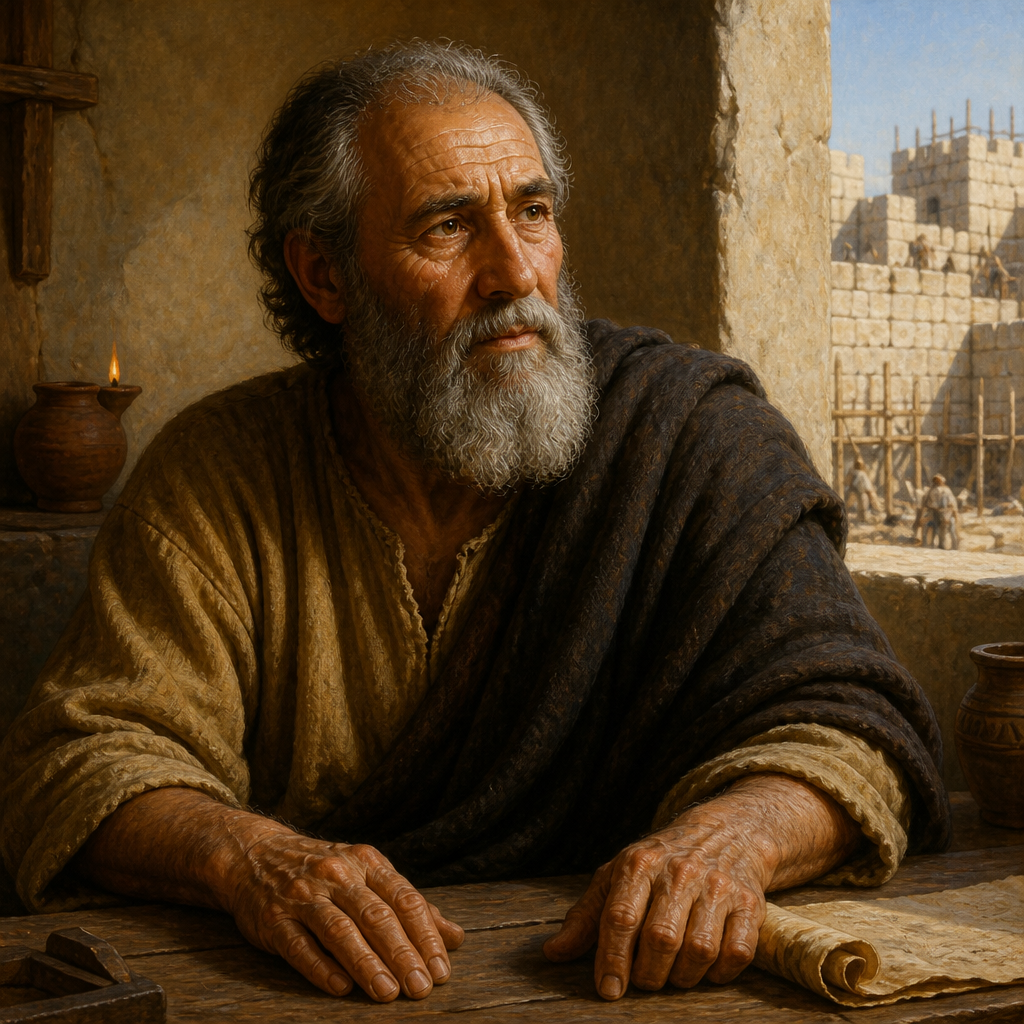
Shelemiah was an Israelite during the Post-Exilic Period whose son, Hananiah, helped rebuild the walls of Jerusalem under Nehemiah's leadership.
This is one of 8 people named Shelemiah in the Bible. See all 8 →
Shelemiah is a figure mentioned in the context of the restoration of Jerusalem following the Babylonian Exile. Though his personal biography is not detailed at length in the biblical record, he is identified as the father of Hananiah, a man who played a visible role in the physical and communal reconstruction of the holy city during the mid-5th century BC.
His mention occurs within the 'Wall Builders' list in the Book of Nehemiah. This ledger serves as a historical document of the families and individuals who committed their resources and labor to securing Jerusalem’s perimeter against external threats. Shelemiah’s inclusion, via his son’s lineage, signifies his family’s standing among the returning exiles who remained faithful to the covenantal task of restoration.
Background and Family
Shelemiah lived during the Post-Exilic Period, a time characterized by the return of Jewish remnants from Babylon to Judea. While the text of Nehemiah 3:30 does not explicitly state Shelemiah's occupation or his specific location of residence, the context of the chapter implies he was part of the community that had successfully navigated the transition from captivity to resettlement.
He is primarily identified by his relationship to his son, Hananiah. In the genealogical and social structure of the time, the mention of a father’s name in a public record of work was a mark of honor, indicating that the family unit was contributing to the national interest. Unlike some other individuals mentioned in Nehemiah 3 who are identified by their professional guilds—such as goldsmiths or perfumers—Shelemiah is identified solely by his paternity, leaving his specific vocation unknown to history.
Major Life Events
The biblical record concerning Shelemiah is focused on the year 444 BC, the period during which Nehemiah arrived in Jerusalem to lead the rebuilding effort. Although Shelemiah himself is not recorded as laying stones on the wall, his legacy is tied to the actions of his son, Hananiah.
According to the text, Hananiah was one of the individuals who "repaired another section" (Nehemiah 3:30). This phrasing suggests that Hananiah (and by extension, the house of Shelemiah) was responsible for more than a single portion of the wall, or perhaps took over a section after completing an initial task. The specific location of their work was adjacent to the efforts of Hanun, the sixth son of Zalaph, and Meshullam son of Berechiah. This placement in the northern or eastern sectors of the wall reconstruction indicates the family was integrated into the organized labor force overseen by the Persian-appointed governor.
Relationship to Other Biblical Figures
Shelemiah’s primary biblical connection is to his son, Hananiah. Hananiah is distinguished in the text as one of the faithful laborers who worked alongside other prominent figures of the restoration, such as Nehemiah. The association with Hanun and Meshullam in the text suggests a collaborative environment where Shelemiah’s family worked in close proximity to other returning exiles committed to the survival of the Jewish state.
Spiritual Significance
In the theology of the Post-Exilic Period, the act of rebuilding Jerusalem was viewed as a physical manifestation of spiritual devotion. By providing a son who was willing to engage in the dangerous and grueling work of wall construction, Shelemiah is portrayed as a contributor to the preservation of the people of God. The mention of his name in the permanent record of the Bible underscores the importance of the family unit in the maintenance of faith and national identity. Even though his personal deeds are obscured by time, his name remains associated with the restoration of the Holy City and the fulfillment of the prophetic promises regarding the return from exile.
Shelemiah represents the 'unsung' generation of the return from exile—those whose names are preserved primarily through the service of their children. His presence in the text reinforces the importance of lineage and family contribution in the rebuilding of the community of faith. Theologically, he illustrates that participation in God's work, whether through direct labor or through the raising of faithful descendants, is worthy of historical remembrance.
Frequently Asked Questions
Who was Shelemiah's son?
His son was Hananiah, who is recorded in Nehemiah 3:30 as one of the men who repaired a section of the Jerusalem wall.
What tribe did Shelemiah belong to?
The biblical text does not specify Shelemiah's tribe, though he was part of the Jewish community that returned from the Babylonian Exile.
When did Shelemiah live?
Shelemiah lived during the Post-Exilic Period, specifically during the mid-5th century BC (around 444 BC) when Nehemiah was governor of Judah.
Did Shelemiah help build the wall himself?
The Bible only explicitly mentions his son Hananiah doing the work; however, Hananiah is identified as 'son of Shelemiah' to denote the family's participation.
Family & Relationships
 Shelemiah, Father of HananiahThis page
Children
 Hananiah, Son of ShelemiahSonNehemiah 3:30Stated
Connected Figures
Family
Son · Nehemiah 3:30
A Judean laborer who assisted in the reconstruction of the walls of Jerusalem under the leadership of Nehemiah during the post-exilic return.
Exile and ReturnFirst: Nehemiah 3:301 versesWall-builder / Laborer
Categories
Mentions by Book
- Nehemiah1
Scripture References
All 1 indexed verse, in canonical order, from the Berean Standard Bible.
Nehemiah · 1
- Nehemiah 3:30
Next to him, Hananiah son of Shelemiah, as well as Hanun the sixth son of Zalaph, repaired another section. Next to them, Meshullam son of Berechiah made repairs opposite his own quarters.
Others Named Shelemiah
Compare all 8 bearers →Shelemiah, Father of IrijahJeremiah 37:13
Shelemiah was a man of the Divided Monarchy period whose son, Irijah, served as a captain of the guard during the siege of Jerusalem.
Shelemiah, son of BaniEzra 10:39
Shelemiah was an Israelite among those who returned from the Babylonian Exile and was identified as one who had married a foreign woman.
Shelemiah, Father of JehucalJeremiah 37:3
A man of the Divided Monarchy whose son served as a royal official under King Zedekiah during the final days of Jerusalem.
Shelemiah son of AbdeelJeremiah 36:26
A high-ranking official under King Jehoiakim tasked with the arrest of the prophet Jeremiah and his scribe Baruch.
Shelemiah, Son of BinnuiEzra 10:41
An Israelite during the post-exilic period who was among those required to separate from foreign wives under the reforms of Ezra.
Shelemiah, Ancestor of JehudiJeremiah 36:14
An ancestor of Jehudi, the court official who read Jeremiah’s prophecy to the officials of King Jehoiakim during the Divided Monarchy.
Shelemiah the PriestNehemiah 13:13
A faithful priest appointed by Nehemiah as a treasurer to manage the storerooms and distribute supplies to the Levites in post-exilic Jerusalem.