Jedaiah, Son of Harumaph
Who was Jedaiah, Son of Harumaph, in the Bible?
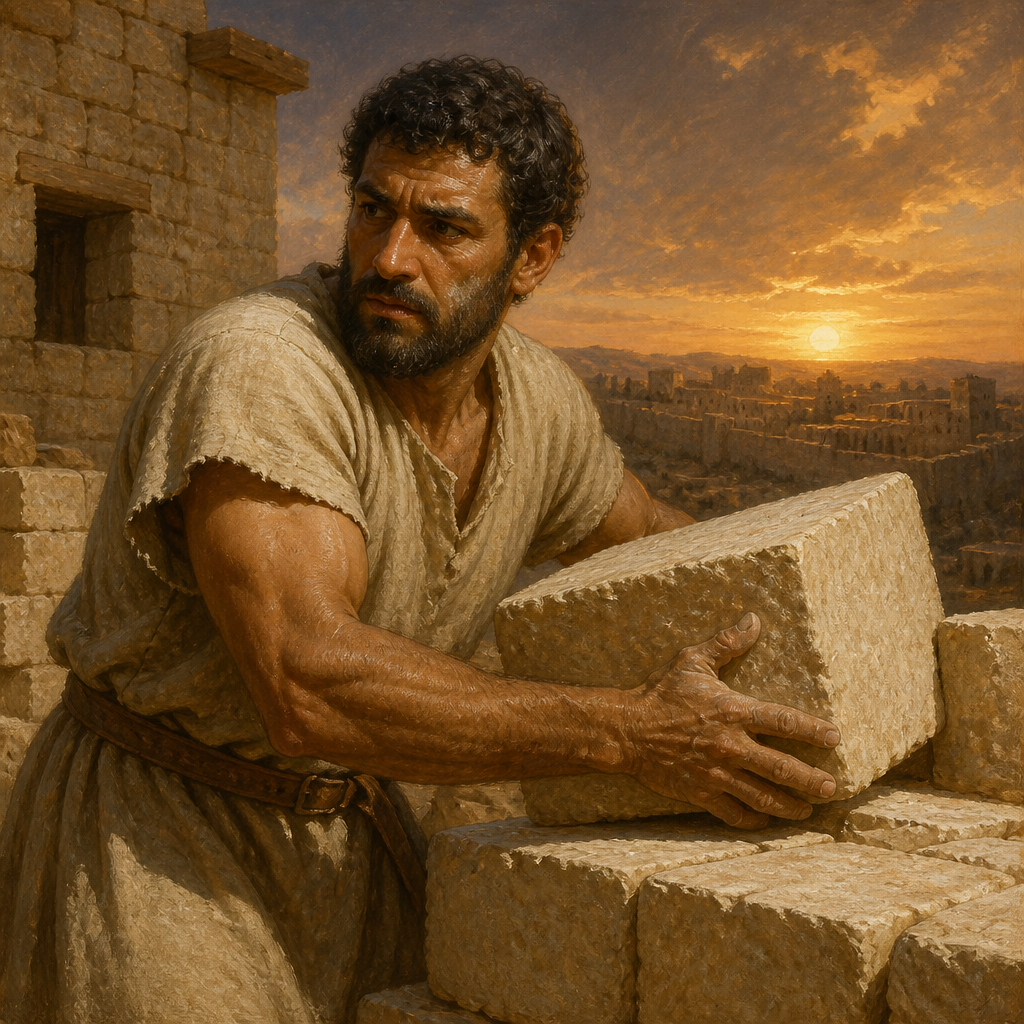
A participant in the post-exilic restoration of Jerusalem who repaired the section of the city wall directly opposite his own home.
This is one of 6 people named Jedaiah in the Bible. See all 6 →
Jedaiah, son of Harumaph, was a Jewish man who lived during the mid-5th century BC, specifically during the era of the Exile and Return. He is historically situated within the period of the Persian Empire's hegemony over Judea, a time when Jewish exiles were returning to their ancestral lands to reconstruct their national and religious identity. His presence in the biblical record is documented solely within the context of the massive infrastructural project led by Nehemiah: the rebuilding of the walls of Jerusalem.
While Jedaiah is a common name in the post-exilic records, this specific individual is distinguished by his parentage as the son of Harumaph. His contribution to the history of Israel is defined by his labor and cooperation during a time of intense external opposition and internal reform. He represents the class of laypeople or local residents who took personal responsibility for the security and restoration of the Holy City following the Babylonian destruction.
Background and Family
The biblical record concerning Jedaiah, son of Harumaph, is remarkably concise, appearing only in the third chapter of the Book of Nehemiah. His name, Jedaiah (יְדָיָה), is a theophoric Hebrew name meaning "praising Yahweh" or "he who knows Yahweh." He is identified specifically as the son of Harumaph to distinguish him from other contemporaries bearing the same name.
Though his tribal affiliation is not explicitly stated in the text of Nehemiah 3:10, his participation in the wall-building effort suggests he was a resident of Jerusalem during the governorship of Nehemiah. The name Harumaph is rare and its meaning is debated; some scholars suggest it may mean "slit-nosed" or "flat-nosed," though in the context of a genealogical list, it serves primarily as a familial identifier.
Major Life Events
The single recorded event in the life of Jedaiah occurs in 444 BC, during the twentieth year of King Artaxerxes I of Persia. Following Nehemiah’s arrival in Jerusalem and his clandestine inspection of the city’s ruins, a systematic plan was developed to repair the breaches in the city wall. Jedaiah was one of the many workers who answered Nehemiah's call to action.
According to Nehemiah 3:10, Jedaiah was assigned to a specific section of the wall: "next to [the previous workers], Jedaiah son of Harumaph made repairs across from his house." This detail is significant for understanding the logistics of Nehemiah’s project. By assigning residents to repair the sections of the wall immediately adjacent to their own dwellings, Nehemiah maximized the workers' motivation. Jedaiah was not merely working for a national cause; he was literally fortifying the defense of his own home and family.
Jedaiah worked alongside other notable figures in this sector, including Hattush son of Hashabneiah. This proximity in the text suggests that Jedaiah’s residence was located in a specific quarter of Jerusalem, likely on the eastern side near the Temple area, where several homes were built close to the fortifications.
Relationship to Other Biblical Figures
Jedaiah’s primary biblical relationship is his father, Harumaph. Beyond this, he is linked through shared labor to the wider community of the restoration. The text places him in the immediate vicinity of Hattush. Unlike the priestly Jedaiahs mentioned in the books of Ezra and Zechariah, this Jedaiah is presented as a private citizen or homeowner. He operated under the administrative authority of Nehemiah, the governor of Judah, and worked within a coalition that included priests, Levites, merchants, and various district rulers.
Spiritual Significance
In the context of biblical history, Jedaiah, son of Harumaph, serves as a model of practical faithfulness. The theological weight of his mention lies in the concept of "repairing the breach." While he is not credited with a prophetic word or a military victory, his willingness to labor on a mundane construction project is recorded as an act of service to God.
His story emphasizes the importance of local responsibility. By focusing his efforts "across from his house," he demonstrates that the restoration of the whole community begins with the individual taking responsibility for their immediate sphere of influence. In the narrative of the Exile and Return, Jedaiah represents the thousands of unnamed or briefly mentioned individuals whose physical labor was essential to the fulfillment of the prophetic promises regarding the restoration of Zion.
Jedaiah, son of Harumaph, is significant as a representative of the faithful remnant who returned to Jerusalem. His inclusion in the registry of wall-builders in Nehemiah 3 underscores the biblical theme that every individual has a specific role to play in the work of God, regardless of their status or the brevity of their mention. His work directly contributed to the physical security of the city that would eventually house the Second Temple.
Theologically, Jedaiah's placement 'across from his house' is often cited in homiletics to illustrate the principle of domestic stewardship and the idea that spiritual and communal rebuilding starts at home. He is a testament to the fact that the biblical record values the contributions of the common citizen as much as those of the high-ranking leaders.
Frequently Asked Questions
What does the name Jedaiah mean?
The name Jedaiah (יְדָיָה) is of Hebrew origin and generally translates to 'praising Yahweh' or 'known by Yahweh.'
Where is Jedaiah, son of Harumaph, mentioned in the Bible?
He is mentioned only once in the Bible, in Nehemiah 3:10, as one of the individuals who helped rebuild the walls of Jerusalem.
What part of the wall did Jedaiah repair?
The Bible specifies that Jedaiah repaired the section of the Jerusalem wall that was 'across from his house,' indicating he worked on the portion closest to his own residence.
Who was Jedaiah's father?
His father was a man named Harumaph. This patronymic is used to distinguish him from other men named Jedaiah in the post-exilic period.
Which king was ruling when Jedaiah repaired the wall?
Jedaiah lived during the reign of King Artaxerxes I of Persia, who authorized Nehemiah's mission to rebuild Jerusalem's walls around 444 BC.
Family & Relationships
Parents
 HarumaphFatherNehemiah 3:10Stated
 Jedaiah, Son of HarumaphThis page
Connected Figures
Family
Father · Nehemiah 3:10
The father of Jedaiah, a worker who participated in the reconstruction of Jerusalem's walls under Nehemiah.
Categories
Mentions by Book
- Nehemiah1
Scripture References
All 1 indexed verse, in canonical order, from the Berean Standard Bible.
Nehemiah · 1
- Nehemiah 3:10
next to him, Jedaiah son of Harumaph made repairs across from his house; and next to him, Hattush son of Hashabneiah made repairs.
Others Named Jedaiah
Compare all 6 bearers →Jedaiah, Priestly Leader of the First ReturnNehemiah 12:7
A prominent priest and leader who returned to Jerusalem from the Babylonian exile during the days of High Priest Jeshua.
Jedaiah, Exile from BabylonZechariah 6:10
A returning exile from Babylon who provided gold and silver for the symbolic crowning of the High Priest Joshua during the restoration of Jerusalem.
Jedaiah, son of Joiarib1 Chronicles 9:10
A prominent priest of the tribe of Levi who returned from the Babylonian exile and served as a head of a paternal house in Jerusalem.
Jedaiah, Priest of the Second Division1 Chronicles 24:7
Jedaiah was a prominent priest during the United Monarchy whose lineage was selected as the second of the twenty-four priestly divisions established for service in the Temple.
Jedaiah, Son of Shimri1 Chronicles 4:37
A descendant of Simeon during the Divided Monarchy whose lineage is preserved in the genealogical records of the chronicler.