Manoah
Who was Manoah in the Bible?
A man of the tribe of Dan and the father of Samson, who received a divine visitation announcing the birth of a son who would begin to deliver Israel from the Philistines.
Manoah was a prominent figure during the Period of the Judges in Israel, residing in the town of Zorah. As a member of the Danite clan, he lived during a time when the Israelites were under the oppression of the Philistines. The biblical narrative focuses on Manoah’s role as the patriarch of a family chosen by God for a specific redemptive purpose. Though his wife was initially barren, a condition of significant social and spiritual weight in the ancient Near East, they were visited by the Angel of the LORD who promised the birth of a son.
His character is portrayed as one of piety and caution. Upon hearing of his wife’s encounter with a divine messenger, Manoah immediately sought God in prayer for further guidance, demonstrating a desire to be faithful to the instructions regarding the child's upbringing. His life serves as the domestic backdrop for the emergence of Samson, one of Israel's most famous and complex judges. Manoah’s story is preserved in the Book of Judges, providing a rare glimpse into a private family's religious life during a chaotic era of national apostasy.
Background and Family
Manoah was a Danite from the town of Zorah, located in the Shephelah (the foothills between the Judean mountains and the coastal plain). The tribe of Dan was positioned on the frontier of Philistine territory, making Manoah’s family particularly vulnerable to the four decades of Philistine domination mentioned in Judges 13:1. Manoah is introduced as the husband of a woman whose name is not recorded in the biblical text, but who is identified as having been barren and childless. This detail aligns the family with other significant patriarchal narratives where divine intervention overcomes barrenness to bring about a child of destiny.
Major Life Events
The Divine Announcement
The central event in Manoah’s life began when the Angel of the LORD appeared to his wife, informing her that she would conceive and bear a son. This child was to be a Nazirite from the womb, set apart for God’s service to begin the deliverance of Israel. When his wife reported this to him, describing the messenger as a "man of God" with a terrifying appearance, Manoah responded with a prayer for the messenger to return. He specifically requested that the man of God teach them "how to raise the boy who is to be born" (Judges 13:8).
The Second Visitation
God granted Manoah’s request, and the Angel appeared again to the woman while she was in a field. She quickly summoned Manoah, who then questioned the messenger regarding the boy's "rule of life and mission." The Angel reiterated the Nazirite restrictions: the mother was to avoid wine, fermented drink, and anything unclean, and the child’s hair was never to be cut.
During this interaction, Manoah demonstrated hospitality, a hallmark of patriarchal virtue, by offering to prepare a young goat for the visitor. However, the Angel declined to eat and instructed Manoah to offer a burnt offering to the LORD instead. At this stage, the text notes that Manoah still did not realize the visitor was the Angel of the LORD. He even asked for the visitor's name so they could honor him later, to which the Angel replied, "Why do you ask my name, seeing it is wonderful?" (Judges 13:18).
The Sacrifice and Revelation
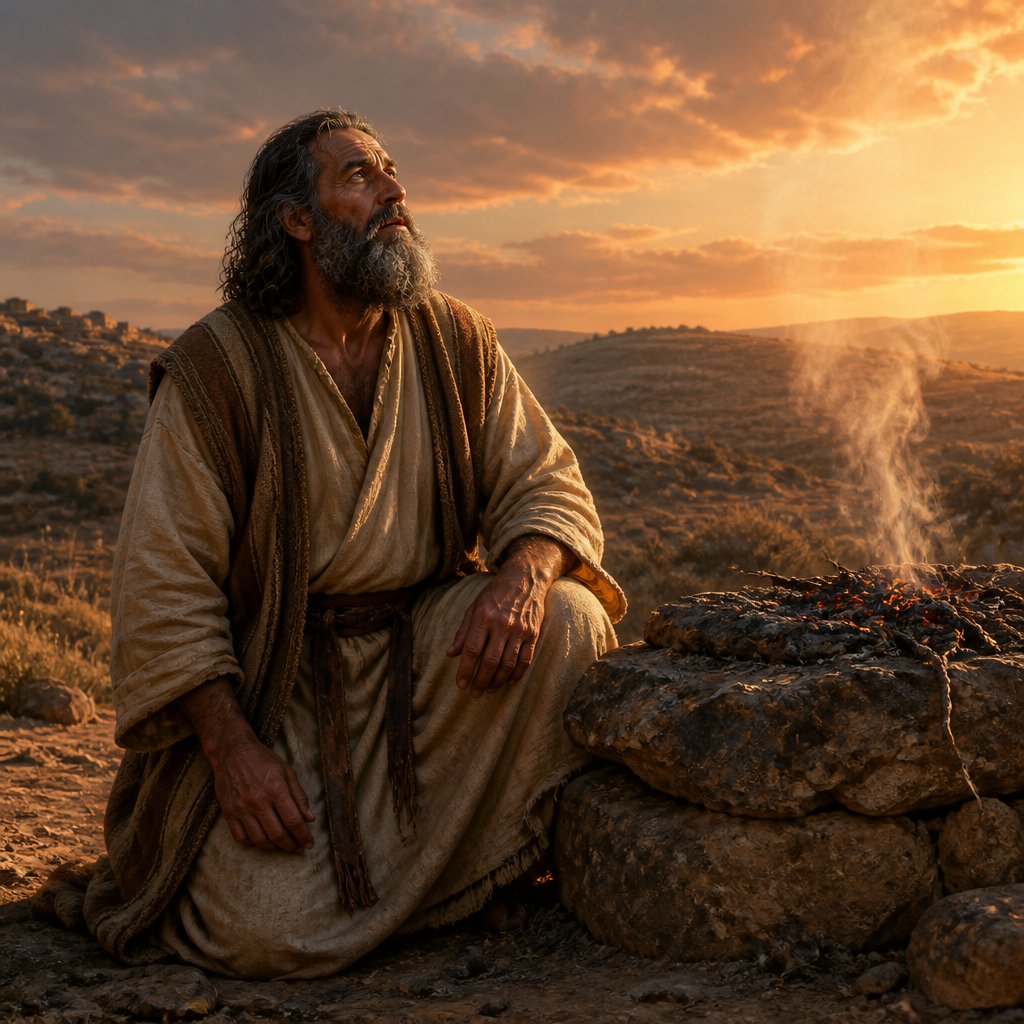
Manoah proceeded to offer the goat and a grain offering on a rock. As the flames rose toward heaven, a miraculous event occurred: the Angel of the LORD ascended in the flame of the altar. Witnessing this, Manoah and his wife fell facedown to the ground. This supernatural departure finally revealed the Angel's true identity to Manoah. Overwhelmed by the holiness of the encounter, Manoah feared for their lives, stating, "We are going to die, for we have seen God!" (Judges 13:22). His wife, showing a more pragmatic spiritual discernment, comforted him by pointing out that if God intended to kill them, He would not have accepted their offering or promised them a son.
Relationship to Other Biblical Figures
Manoah’s primary relationship in the biblical record is with his son, Samson. While the text focuses largely on Samson's exploits, Manoah is mentioned again when Samson seeks a wife among the Philistines in Timnah. Manoah and his wife initially objected to the union, urging Samson to find a wife from among their own people, though they did not realize the situation was being directed by the LORD. Ultimately, Manoah’s role concludes with his death; the final mention of him in the Book of Judges records that Samson was buried in the family tomb between Zorah and Eshtaol, specifically identified as the "tomb of his father Manoah" (Judges 16:31).
Spiritual Significance
Manoah represents the faithful remnant within the tribe of Dan. In an era marked by the phrase "everyone did what was right in his own eyes," Manoah’s immediate reflex was to seek divine instruction through prayer. His story emphasizes the theme of God’s sovereignty over the womb and His initiative in raising up leaders for Israel. The interaction between Manoah and the Angel also serves as a "theophany" (a manifestation of God), illustrating the bridge between the human and the divine during the transition from the period of the Patriarchs to the period of the Monarchy.
Manoah is significant as the father of Samson, the final judge mentioned in the main narrative of the Book of Judges. His life highlights the importance of the Nazirite vow and the role of the family in God’s plan for national deliverance. The account of Manoah and his wife is one of the few instances in the Book of Judges where the focus shifts from the battlefield to the domestic sphere, demonstrating that God's work begins in the home and through the faithfulness of individual parents.
Theologically, Manoah’s encounter with the Angel of the LORD is a critical text for understanding Old Testament appearances of God. The fear Manoah expresses after the sacrifice reflects the ancient Israelite understanding that no one can see God and live, yet the subsequent birth of Samson demonstrates God's grace and His desire to use ordinary individuals to achieve His purposes for Israel.
Frequently Asked Questions
What tribe did Manoah belong to?
Manoah belonged to the tribe of Dan, specifically from the clan of the Danites residing in Zorah.
How did Manoah react to the angel's appearance?
Initially, Manoah did not recognize the visitor as an angel. Once the angel ascended in the altar's flame, Manoah was terrified and believed he and his wife would die because they had seen God.
What did Manoah ask the Angel of the LORD?
Manoah asked the Angel for his name and for specific instructions on how to raise the child who had been promised to them.
Where was Manoah buried?
The Bible does not explicitly describe Manoah's funeral, but it notes that his son Samson was buried in Manoah's family tomb located between Zorah and Eshtaol.
Did Manoah support Samson's marriage to the Philistine woman?
No, Manoah and his wife initially questioned and discouraged Samson's choice, asking why he could not find a wife among his own relatives or the people of Israel.
Family & Relationships
 Samson's MotherWifeJudges 13:21Stated
 ManoahThis page
Children
 SamsonSonJudges 16:31Stated
Connected Figures
Family
Wife · Judges 13:21
The wife of Manoah and mother of Samson, she was an unnamed woman chosen by the Angel of the LORD to bear a child dedicated as a Nazirite for the deliverance of Israel.
Conquest and JudgesFirst: Judges 13:224 versesHomemakerDan
Son · Judges 16:31
A judge of Israel endowed with supernatural strength by the LORD to initiate the deliverance of his people from Philistine oppression.
Conquest and JudgesFirst: Judges 13:2440 versesJudge of IsraelDan
Categories
Mentions by Book
- Judges14
Scripture References
All 14 indexed verses, in canonical order, from the Berean Standard Bible.
Judges · 14
- Judges 13:2
Now there was a man from Zorah named Manoah, from the clan of the Danites, whose wife was barren and had no children.
- Judges 13:8
Then Manoah prayed to the LORD, “Please, O Lord, let the man of God You sent us come to us again to teach us how to raise the boy who is to be born.”
- Judges 13:9Partial
And God listened to the voice of Manoah, and the angel of God returned to the woman as she was sitting in the field; but her husband Manoah was not with her.
- Judges 13:11
So Manoah got up and followed his wife. When he came to the man, he asked, “Are you the man who spoke to my wife?” “I am,” he said.
- Judges 13:12
Then Manoah asked, “When your words come to pass, what will be the boy’s rule of life and mission?”
- Judges 13:13
So the angel of the LORD answered Manoah, “Your wife is to do everything I told her.
- Judges 13:15
“Please stay here,” Manoah said to the angel of the LORD, “and we will prepare a young goat for you.”
- Judges 13:16Partial
And the angel of the LORD replied, “Even if I stay, I will not eat your food. But if you prepare a burnt offering, offer it to the LORD.” For Manoah did not know that it was the angel of the LORD.
- Judges 13:17
Then Manoah said to the angel of the LORD, “What is your name, so that we may honor you when your word comes to pass?”
- Judges 13:19Partial
Then Manoah took a young goat and a grain offering and offered them on a rock to the LORD. And as Manoah and his wife looked on, the LORD did a marvelous thing.
- Judges 13:20
When the flame went up from the altar to the sky, the angel of the LORD ascended in the flame. When Manoah and his wife saw this, they fell facedown to the ground.
- Judges 13:21Partial
And when the angel of the LORD did not appear again to Manoah and his wife, Manoah realized that it had been the angel of the LORD.
- Judges 13:22
“We are going to die,” he said to his wife, “for we have seen God!”
- Judges 16:31
Then Samson’s brothers and his father’s family came down, carried him back, and buried him between Zorah and Eshtaol in the tomb of his father Manoah. And he had judged Israel twenty years.