Hezekiah's Illness and the Babylonian Envoys
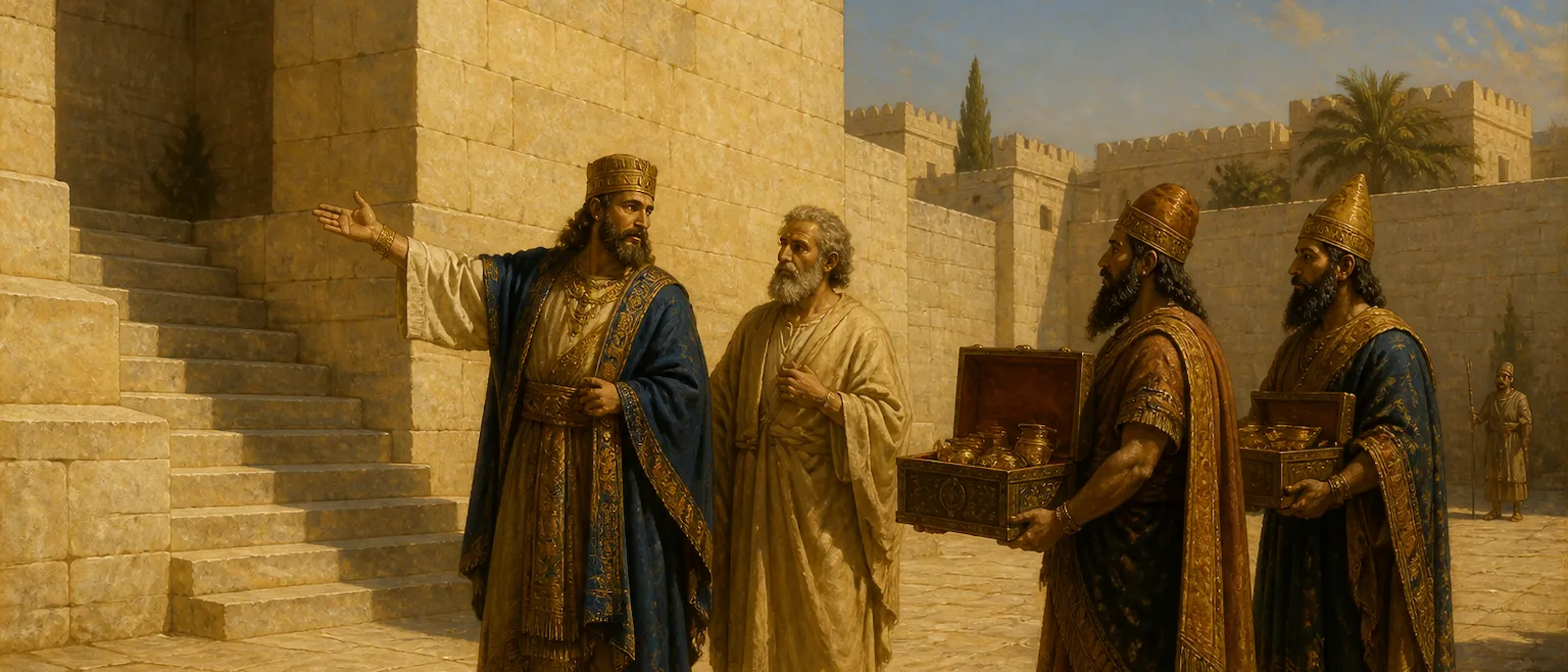
King Hezekiah recovers from a terminal illness through divine intervention and subsequently displays the treasures of Jerusalem to envoys sent by the king of Babylon.
- 2 Kings 20; 2 Chronicles 32:24-26; 2 Chronicles 32:31; Isaiah 38; Isaiah 39
- Jerusalem
- 3 named participants
What the passage records
2 Kings 20; 2 Chronicles 32:24-26; 2 Chronicles 32:31; Isaiah 38; Isaiah 39Hezekiah became deathly ill, and the prophet Isaiah son of Amoz told him to set his house in order because he would die. Hezekiah turned his face to the wall and asked the LORD to remember how faithfully and wholeheartedly he had walked before Him. Hezekiah wept bitterly (2 Kings 20:1-3). Before Isaiah had left the middle courtyard, the word of the LORD sent him back to say that Hezekiah’s prayer had been heard and his tears seen. He would recover, go up to the house of the LORD on the third day, and receive fifteen more years of life. Isaiah ordered a lump of figs to be applied to the boil, and Hezekiah recovered (2 Kings 20:4-7).
Hezekiah asked Isaiah for a sign that the LORD would heal him. Isaiah offered a choice between the shadow advancing ten steps or going back ten steps. Hezekiah said it was easy for the shadow to lengthen ten steps, so he asked for it to go back. Isaiah called out to the LORD, who brought the shadow back the ten steps it had descended on the stairway of Ahaz (2 Kings 20:8-11). At that time Merodach-baladan son of Baladan, king of Babylon, sent letters and a gift to Hezekiah because he had heard of Hezekiah’s illness. Hezekiah received the envoys and showed them everything in his treasure house—the silver and gold, the spices and precious oil, his armory, and everything found in his storehouses (2 Kings 20:12-13).
Isaiah then asked Hezekiah what the men had seen. Hezekiah answered that they had seen everything in his palace and that nothing among his treasures had been withheld. Isaiah prophesied that a time would come when everything in the palace and everything his fathers had stored up would be carried off to Babylon; nothing would remain. Some of Hezekiah’s descendants would also be taken away to serve as eunuchs in the palace of the king of Babylon. Hezekiah accepted the word of the LORD as good because there would be peace and security in his lifetime (2 Kings 20:14-19).
Outcome
Isaiah prophesied the future Babylonian captivity of Judah and the removal of Hezekiah's descendants, a word which Hezekiah accepted as good for his own lifetime (2 Kings 20:17-19).
Who was there
3 people from 2 Kings 20; 2 Chronicles 32:24-26; 2 Chronicles 32:31; Isaiah 38; Isaiah 39 are listed here.


