Palal
Who was Palal in the Bible?
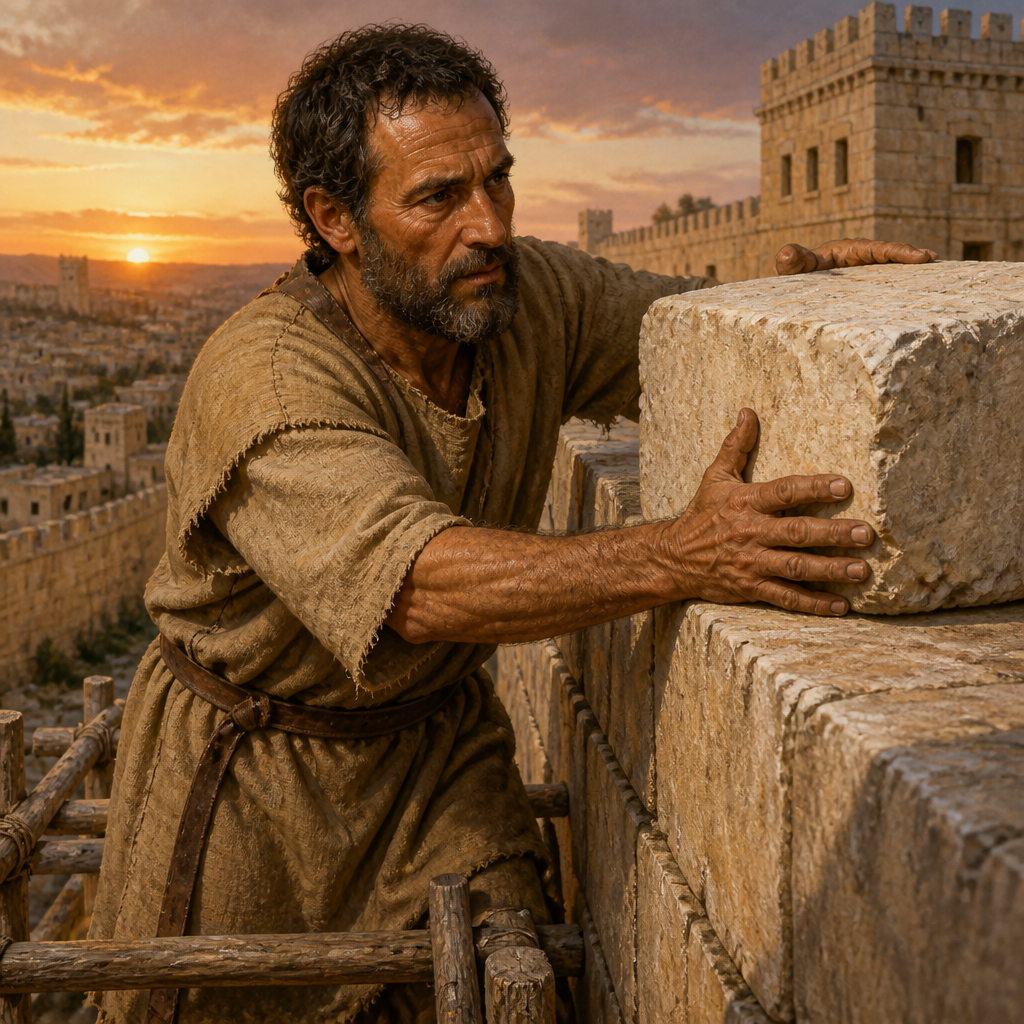
Palal was a post-exilic Israelite who assisted in Nehemiah’s reconstruction of the walls of Jerusalem, working on a strategic section near the royal palace.
Palal, the son of Uzai, is a figure mentioned in the Old Testament during the period of the Jewish return from Babylonian exile. His name, derived from a Hebrew root meaning 'to judge' or 'to intervene,' appears within the record of those who participated in the monumental task of rebuilding Jerusalem’s fortifications under the leadership of Nehemiah.
Though his biblical footprint is confined to a single verse, his inclusion in the genealogical and labor records of Nehemiah 3 signifies his status as a head of a household or a man of sufficient means to oversee a specific segment of the wall. His contribution was concentrated on a high-value area of the city’s defense, involving the royal infrastructure of the Persian-era Judean administration.
Background and Family
Palal is identified in the biblical record as the son of Uzai. Beyond this patronymic, the text provides no specific information regarding his tribal affiliation or his lineage. However, his participation in the rebuilding of Jerusalem indicates he was among the Jewish exiles (the golah) who returned to Judah from Babylon. The fact that he was assigned a specific, sensitive portion of the wall suggests he was a man of recognized standing within the community of the returnees.
Major Life Events
The primary and only recorded event in Palal’s life occurs in the mid-5th century BC, specifically around 444 BC, during the governorship of Nehemiah. Following the decree of Artaxerxes I, the Jewish community began repairing the breached walls of Jerusalem. Palal is credited with repairing the section described as being "opposite the angle and the tower that juts out from the upper palace of the king near the courtyard of the guard" (Nehemiah 3:25).
This location was of significant tactical and symbolic importance. The "angle" (or corner) and the projecting tower associated with the "upper palace" suggest that Palal was responsible for a portion of the wall that protected the administrative or royal residence area—likely the old palace of the Davidic kings or the current governor’s residence. His section was adjacent to the work performed by Pedaiah son of Parosh.
Relationship to Other Biblical Figures
Palal is directly linked to his father, Uzai, who is not mentioned elsewhere in the biblical canon. In the context of the wall project, he worked in proximity to Pedaiah son of Parosh. The mention of these names side-by-side illustrates the collaborative nature of the project, where families and individuals of various social strata worked on contiguous sections to ensure a continuous line of defense.
Spiritual Significance
While Palal is a minor figure, his presence in the Book of Nehemiah highlights the theological theme of communal restoration. The detailed recording of his name and his specific contribution serves as a testament to the biblical emphasis on individual faithfulness in the service of the covenant community. By repairing the wall "opposite the angle," Palal contributed to the physical security of the city that housed the Second Temple, thereby facilitating the restoration of organized worship and Jewish identity in the post-exilic era.
Palal’s significance lies in his role as a dedicated laborer in the restoration of Jerusalem. His work on the wall signifies the transition from the vulnerability of the exile to the re-establishment of a fortified holy city. The meticulous detail regarding the location of his work emphasizes the historical reality of the restoration and the importance of every individual’s contribution to the collective spiritual and physical security of Israel.
Frequently Asked Questions
What does the name Palal mean?
The name Palal (פָּלָל) comes from a Hebrew root meaning 'judge' or 'one who intervenes.'
Which part of the Jerusalem wall did Palal repair?
He repaired the section opposite the 'angle' (corner) and the tower projecting from the upper palace near the courtyard of the guard.
Who was Palal's father?
Palal was the son of Uzai.
During which historical period did Palal live?
He lived during the Post-Exilic Period, specifically during the time of Nehemiah in the 5th century BC.
How many times is Palal mentioned in the Bible?
Palal is mentioned only once, in Nehemiah 3:25.
Family & Relationships
Parents
 UzaiFatherNehemiah 3:25Stated
 PalalThis page
Connected Figures
Family
Father · Nehemiah 3:25
A father during the Post-Exilic period whose son, Palal, assisted Nehemiah in the reconstruction of Jerusalem's walls.
Categories
Mentions by Book
- Nehemiah1
Scripture References
All 1 indexed verse, in canonical order, from the Berean Standard Bible.
Nehemiah · 1
- Nehemiah 3:25
and Palal son of Uzai made repairs opposite the angle and the tower that juts out from the upper palace of the king near the courtyard of the guard. Next to him, Pedaiah son of Parosh