Simon, Brother of Jesus
Who was Simon, Brother of Jesus, in the Bible?
The biological or step-brother of Jesus Christ, mentioned in the Gospels as one of the members of the immediate family of Joseph and Mary.
Simon is documented in the New Testament as one of the 'brethren' of Jesus. He appears in the Synoptic Gospels during moments of communal observation where the local population of Nazareth questions the authority of Jesus by citing His humble origins and specific family members. While Simon is not a central protagonist in the narrative of the Galilean ministry, his presence serves as a critical genealogical and historical anchor for the humanity of Jesus.
Historically and theologically, Simon is categorized within the 'Desposyni' (those related to the Lord). Within the context of the early Church, his identity is often intertwined with legal and familial structures of the first-century Jewish community. His inclusion in the lists of Jesus' brothers alongside James, Joses, and Judas provides a glimpse into the domestic environment from which the Christian movement emerged.
Background and Family
Simon is explicitly named in the Gospel of Matthew (13:55) and the Gospel of Mark (6:3) as one of the four brothers of Jesus. The Marcan passage records the astonishment of the people of Nazareth, who ask: 'Is not this the carpenter, the son of Mary, the brother of James, and Joses, and of Juda, and Simon? and are not his sisters here with us?' This familial grouping defines Simon’s primary historical context. He was a member of a large Judean/Galilean family, presumably raised in Nazareth in the household of Joseph and Mary.
Scholarly debate regarding Simon’s exact biological relationship to Jesus has persisted for centuries, largely divided along denominational and tradition-based lines. The 'Helvidian' view holds that Simon was a younger biological son of Mary and Joseph, born after Jesus. The 'Epiphanian' view suggests Simon was a son of Joseph from a previous marriage, making him a step-brother to Jesus. A third view, the 'Hieronymian' (favored by Jerome), argues that the Greek term adelphos (brother) was used more broadly to refer to cousins. Regardless of the biological nuances, the biblical text positions Simon as an immediate member of the earthly family unit of Jesus.
Major Life Events
While Simon does not have a recorded solo dialogue in the New Testament, his life intersects with several pivotal moments in the life of Jesus. He is implicitly included in the group of family members who, early in Jesus’ ministry, expressed concern or skepticism regarding His public activities. In Mark 3:21, it is noted that Jesus’ family went out to 'lay hold on him,' believing He was 'beside himself' (out of his mind).
Simon was likely among the brothers mentioned in John 7:3-5, where the text states that 'neither did his brethren believe in him' at that specific time. This skepticism is a crucial element of the family narrative, illustrating the internal domestic conflict Jesus faced. However, this stance appears to have shifted following the Resurrection. In Acts 1:14, Simon is presumed to be among 'the brethren' who joined the Apostles and Mary in the upper room for prayer and supplication in the days leading up to Pentecost. This suggests that Simon, along with his brothers, transitioned from skepticism to active participation in the early Christian community in Jerusalem.
Relationship to Other Biblical Figures
Simon’s identity is most clearly defined through his siblings. His most prominent brother, James (the Just), became a pillar of the Jerusalem Church and the author of the Epistle of James. His other brothers, Joses (Joseph) and Judas (Jude), are also cited in the lists of the family of Jesus.
Church tradition outside the immediate biblical canon sometimes links this Simon with Simeon of Jerusalem, who is credited by the historian Hegesippus as the second bishop of Jerusalem. According to these early Christian accounts, after the martyrdom of James the Just (Simon's brother), the surviving community chose Simon (Simeon) to lead them because he was a cousin or brother of the Lord, surviving until the reign of Trajan. While the New Testament does not explicitly confirm this promotion, the biblical trajectory of 'the brothers of the Lord' suggests they held high status and leadership roles in the Judeo-Christian sect of the first century.
Spiritual Significance
Simon’s significance lies primarily in providing historical evidence for the humanity of Jesus. As one of the named 'brothers of the Lord,' he grounds the narrative in a specific familial and genealogical context, refuting early gnostic claims that Jesus did not possess a real physical body or family. His presence in the New Testament records the complexity of Jesus’ domestic life and the ultimate conversion of His household.
Furthermore, Simon represents the transition of the physical family of Jesus into the spiritual family of the Church. By appearing in the list of faithful gathered in Jerusalem after the Ascension, he demonstrates that the earthly relatives of Jesus submitted to His messianic identity, contributing to the stability and leadership of the early Christian movement in the 1st century.
The figure of Simon underscores the 'scandal of the Incarnation.' By naming specific brothers like Simon, the Gospel writers emphasize that Jesus was not a phantom or a distant deity, but a human being with a verifiable family and social history. Simon represents the portion of humanity that is closest to the Divine yet struggles to recognize it because of the 'familiarity' of daily life.
Simon’s eventual inclusion in the prayer circle of Acts 1 signifies the power of the Resurrection to transform familial relationships. For the early Church, the presence of Jesus’ brothers provided a living link to the historical Jesus. Simon’s existence served as a testament to the reality of Jesus’ growth, His earthly home, and the radical transition of His kin from family members to faithful disciples.
Frequently Asked Questions
Was Simon a younger or older brother of Jesus?
The New Testament does not specify birth order, though he is usually listed last among the four brothers, which may suggest he was the youngest.
Does Simon appear in the Book of Acts?
He is included in the general reference to the 'brethren' of Jesus in Acts 1:14, who were gathered in prayer with the Apostles after the Ascension.
Did Simon believe in Jesus during His ministry?
According to John 7:5, his brothers did not initially believe in Him, but they are later shown as believers after the Resurrection.
Is this Simon the same person as Simon Peter?
No. This Simon is specifically identified as the brother of Jesus, distinct from Simon Peter the Apostle.
What happened to Simon after the Bible ends?
Church tradition suggests he may have become the leader of the church in Jerusalem after his brother James was martyred, living to a very old age.
Family & Relationships
Parents
 Joseph, Earthly Father of JesusFatherMatthew 1:24
Inferred
Matthew 13:55 names Simon and Joseph in the same verse but does not state a father tie between them; the link rests on the surrounding narrative.Evidence: Matthew 1:24; Matthew 13:55
 Mary, Mother of JesusMotherMatthew 13:55Stated
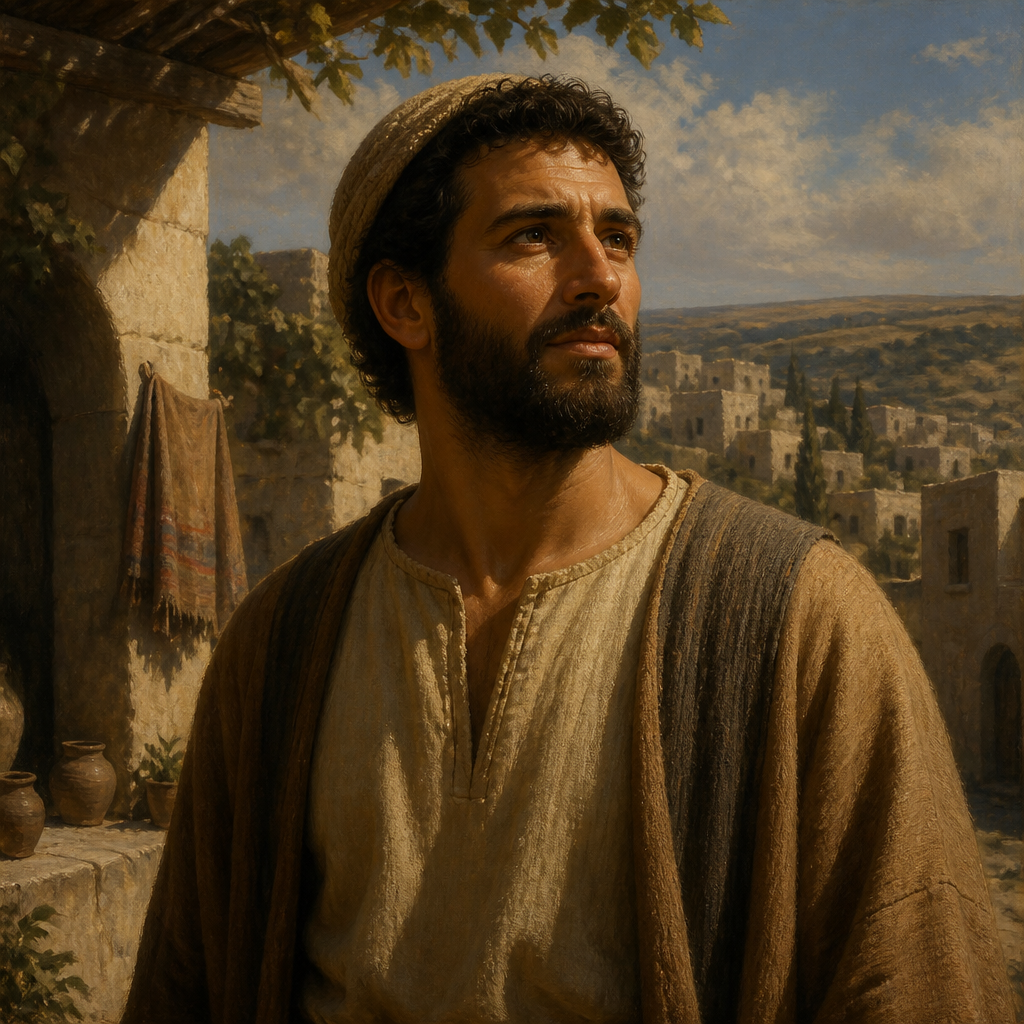 Simon, Brother of JesusThis page
 James, Brother of JesusBrotherMatthew 13:55Stated
 JesusBrotherMatthew 1:18
Inferred
Reconstructed through Mary: Matthew 1:18 ties Jesus to Mary; Matthew 13:55 ties Mary to Simon. No verse states the brother link between Jesus and Simon directly.Evidence: Matthew 1:18; Matthew 13:55
 Jude, the Brother of JesusBrotherMatthew 13:55Stated
Connected Figures
Family
Father · Matthew 1:24
A righteous descendant of David who served as the legal father of Jesus and the husband of the Virgin Mary during the early 1st century AD.
The GospelsFirst: Matthew 1:1618 versesCarpenter / BuilderJudah
Mother · Matthew 13:55
The mother of Jesus Christ, chosen by God to bear the Messiah, who stood by the cross (John 19:25-27) and was among those praying in the upper room after the ascension (Acts 1:14).
Brother · Matthew 13:55
The brother of Jesus Christ who transitioned from a skeptic to a primary leader of the early Christian church in Jerusalem and author of the Epistle of James.
In JerusalemFirst: Matthew 13:5515 versesLeader of the Jerusalem ChurchJudah
Brother · Matthew 1:18
The central figure of the New Testament, Jesus was born of Mary in Bethlehem, performed numerous miracles, and was crucified under Pontius Pilate before rising from the dead.
The GospelsFirst: Matthew 1:11,174 versesCarpenter, TeacherJudah
Brother · Matthew 13:55
Jude was a brother of Jesus and James who identified himself as a servant of Christ and authored the General Epistle of Jude.
To the Ends of the EarthFirst: Jude 1:16 versesAuthor, Church LeaderJudah
Categories
Mentions by Book
- Matthew3
- Mark1
- Jude1
Scripture References
All 5 indexed verses, in canonical order, from the Berean Standard Bible.
Matthew · 3
- Matthew 1:18Partial
This is how the birth of Jesus Christ came about: His mother Mary was pledged in marriage to Joseph, but before they came together, she was found to be with child through the Holy Spirit.
Cited as evidence on a family card; added so References, Key Verses and Mentions by Book share one index.
- Matthew 1:24Partial
When Joseph woke up, he did as the angel of the Lord had commanded him and embraced Mary as his wife.
Cited as evidence on a family card; added so References, Key Verses and Mentions by Book share one index.
- Matthew 13:55
“Isn’t this the carpenter’s son? Isn’t His mother’s name Mary, and aren’t His brothers James, Joseph, Simon, and Judas?
Mark · 1
- Mark 6:3
Isn’t this the carpenter, the son of Mary and the brother of James, Joses, Judas, and Simon? Aren’t His sisters here with us as well?” And they took offense at Him.
Jude · 1
- Jude 1:1Partial
Jude, a servant of Jesus Christ and a brother of James, To those who are called, loved by God the Father, and kept in Jesus Christ:
Cited as evidence on a family card; added so References, Key Verses and Mentions by Book share one index.