Herodias
Who was Herodias in the Bible?
Herodias was a member of the Herodian dynasty who left her husband Philip to marry his brother Herod Antipas; when John the Baptist condemned the marriage, she prompted her daughter to ask for his head.
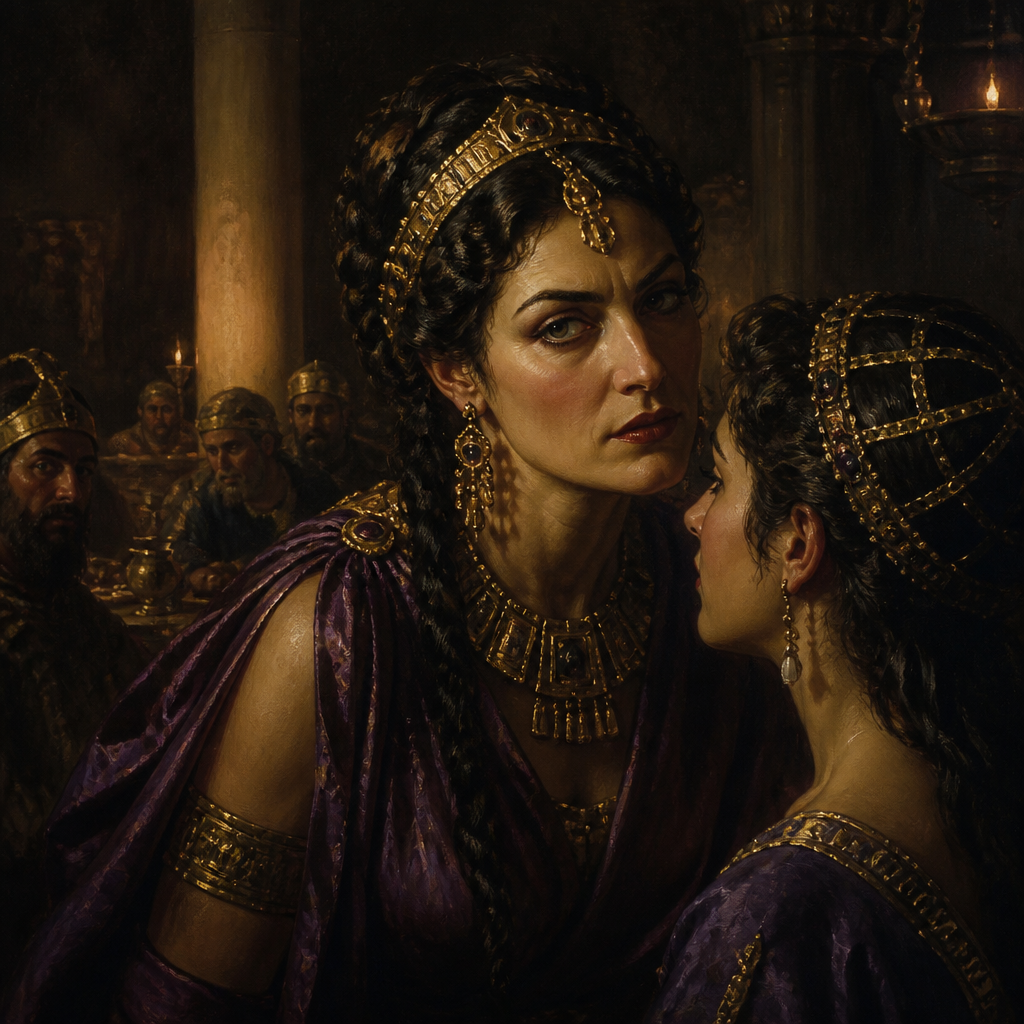
Herodias (c. 15 BC – after 39 AD) was a prominent member of the Herodian dynasty during the Roman occupation of Judea. She is best known in the New Testament for her direct role in the death of John the Baptist, an event recorded in the Gospels of Matthew and Mark. As the granddaughter of Herod the Great, her life was characterized by the complex political and familial intrigues that defined the Judean ruling class under Roman suzerainty.
Herodias's legacy is primarily framed by her conflict with John the Baptist, who publicly denounced her marriage to Herod Antipas as unlawful. This theological and social clash culminated in a famous banquet scene involving her daughter, Salome, leading to one of the most dramatic and gruesome executions in the New Testament. Beyond the biblical narrative, extra-biblical sources like Josephus provide further context regarding her family lineage and her eventual exile.
Background and Family
Herodias was born into one of the most volatile and powerful families in the ancient Levant. She was the daughter of Aristobulus IV, who was the son of Herod the Great and the Hasmonean princess Mariamne I. This lineage gave Herodias both the political weight of the Idumean Herodian line and the priestly prestige of the Hasmoneans. However, her early life was marked by tragedy; her father was executed by her grandfather, Herod the Great, in 7 BC on charges of conspiracy.
Following the custom of the Herodian dynasty to consolidate power through endogamy, Herodias was first married to her half-uncle, Herod II (sometimes referred to as Herod Philip I, not to be confused with Philip the Tetrarch). With him, she had a daughter, Salome. However, Herodias eventually left her first husband to marry his half-brother, Herod Antipas, the Tetrarch of Galilee and Perea. This transition was not merely a romantic shift but a calculated political move, as Antipas held significantly more regional authority than her first husband.
Major Life Events
The central event of Herodias's biblical biography is her conflict with John the Baptist. According to Jewish Law (Leviticus 18:16 and 20:21), a man was forbidden from marrying his brother's wife while the brother was still living. John the Baptist, a popular ascetic prophet, publicly condemned the union between Herodias and Antipas. This critique was not just a moral objection but a political threat, as it challenged the legitimacy of the Tetrarch's rule among the Jewish population.
While Herod Antipas feared John because of the prophet's popularity and perceived holiness, Herodias harbored a deep-seated grudge (Mark 6:19). The Gospel narratives suggest that she actively sought a way to silence him. Her opportunity arrived during the celebration of Antipas's birthday. Her daughter, Salome, performed a dance that so pleased Antipas that he offered her anything she desired, up to half his kingdom.
"And she went out, and said unto her mother, What shall I ask? And she said, The head of John the Baptist." (Mark 6:24, KJV)
Following her mother’s instruction, Salome requested the head of John on a platter. Antipas, bound by his public oath and his guests' presence, reluctantly ordered the execution. This event fixed Herodias’s reputation in Christian tradition as a manipulative and vengeful figure.
Relationship to Other Biblical Figures
Herodias’s relationships are a map of the first-century Judean political landscape. She was the sister of Herod Agrippa I, who would later become King of Judea and is mentioned in Acts 12 as the persecutor of the early church. Her marriage to Herod Antipas placed her in direct contact with the ministry of Jesus, as Antipas was the ruler who interrogated Jesus during His trial (Luke 23).
Notably, Herodias is often contrasted with other women in the Gospels. While women like Mary Magdalene and Joanna (the wife of Antipas’s steward Chuza) supported Jesus’ ministry, Herodias represented the violent resistance of the establishment. Her influence over Antipas was significant; Josephus notes that it was Herodias who later pressured Antipas to travel to Rome to seek the title of 'King' from Emperor Caligula, a move that backfired and led to their mutual downfall.
Spiritual Significance
Herodias represents the violent intersection of secular power and prophetic witness. Her inclusion in the Gospels serves to illustrate the moral decay of the Hasmonean-Herodian line and the dangers of political expediency over spiritual law. Theologically, she is frequently compared to Jezebel, embodying the 'enemy of the prophet' who uses proximity to power to silence the voice of God. Her story emphasizes that the message of the Gospel (and its precursor, John's call to repentance) often meets with lethal resistance from those whose social standing is built on unrighteousness.
In theological discourse, Herodias serves as a cautionary archetype of the 'worldly woman' who prioritizes status and pride over divine truth. Her reaction to John’s rebuke illustrates the hardening of the heart against conviction. Instead of repentance, she chose the elimination of the messenger. This parallels the behavior of Queen Jezebel in the Old Testament, who similarly sought the life of the prophet Elijah.
In the broader context of the New Testament, the story of Herodias and John the Baptist functions as a precursor to the passion of Christ. The dynamic between a righteous prophet, a weak-willed ruler (Antipas/Pilate), and a manipulative instigator highlights the cost of discipleship and the inherent conflict between the Kingdom of God and the kingdoms of men. The eventual exile of Herodias to Lugdunum in Gaul, where she and Antipas died in obscurity, is often interpreted by historical commentators as a divine judgment on their actions.
Frequently Asked Questions
Why was Herodias's marriage to Herod Antipas considered a sin?
According to Levitical law (Lev. 18:16), it was forbidden to marry a brother's wife while the brother was still alive. Since Herod Philip (her first husband) was still living, the marriage was considered incestuous and adulterous.
Did Herodias personally kill John the Baptist?
No, she did not perform the execution. She orchestrated it by instructing her daughter, Salome, to ask for John's head as a reward for her dance, forcing Herod Antipas to carry out the deed.
What happened to Herodias after the death of John the Baptist?
According to the historian Josephus, she was eventually exiled to Gaul (modern-day France) with Herod Antipas after he was accused of conspiracy against Emperor Caligula. She chose to go into exile with him rather than accept the Emperor's offer of mercy.
Is Salome's name mentioned in the Bible?
No, the New Testament refers to her only as the 'daughter of Herodias.' The name Salome is provided by the Jewish historian Flavius Josephus in his work 'Antiquities of the Jews.'
How was Herodias related to Herod the Great?
She was his granddaughter. Her father was Aristobulus IV, one of the sons Herod the Great had executed.
Family & Relationships
 Herod AntipasHusbandMark 6:17Stated
 Philip, Son of Herod the GreatHusbandMark 6:17Stated
 HerodiasThis page
Children
 The Daughter of HerodiasDaughterMatthew 14:6Stated
Connected Figures
Family
Husband · Mark 6:17
The regional ruler of Galilee and Perea who beheaded John the Baptist and participated in the trial of Jesus Christ.
The GospelsFirst: Matthew 14:125 versesTetrarch of Galilee and Perea
Husband · Mark 6:17
Philip was a member of the Herodian dynasty and the original husband of Herodias, whose subsequent marriage to Herod Antipas led to the imprisonment of John the Baptist.
Daughter · Matthew 14:6
The daughter of Herodias and Philip who famously danced for Herod Antipas, leading to the execution of John the Baptist.
The GospelsFirst: Matthew 14:67 versesPrincess of the Herodian Dynasty
Categories
Mentions by Book
- Matthew3
- Mark4
- Luke1
Scripture References
All 8 indexed verses, in canonical order, from the Berean Standard Bible.
Matthew · 3
- Matthew 14:3
Now Herod had arrested John and bound him and put him in prison on account of Herodias, his brother Philip’s wife,
- Matthew 14:6
On Herod’s birthday, however, the daughter of Herodias danced before them and pleased Herod
- Matthew 14:8Partial
Prompted by her mother, she said, “Give me here on a platter the head of John the Baptist.”
Cited as a key verse; added so References, Key Verses and Mentions by Book share one index.
Mark · 4
- Mark 6:17
For Herod himself had ordered that John be arrested and bound and imprisoned, on account of his brother Philip’s wife Herodias, whom Herod had married.
- Mark 6:19
So Herodias held a grudge against John and wanted to kill him. But she had been unable,
- Mark 6:22
When the daughter of Herodias came and danced, she pleased Herod and his guests, and the king said to the girl, “Ask me for whatever you wish, and I will give it to you.”
- Mark 6:24Partial
Then she went out and asked her mother, “What should I request?” And her mother answered, “The head of John the Baptist.”
Cited as a key verse; added so References, Key Verses and Mentions by Book share one index.
Luke · 1
- Luke 3:19
But when he rebuked Herod the tetrarch regarding his brother’s wife Herodias and all the evils he had done,