Timaeus
A man from the first-century AD primarily identified as the father of Bartimaeus, the blind beggar healed by Jesus near Jericho.
Timaeus is a figure mentioned in the New Testament during the final journey of Jesus toward Jerusalem. He is defined exclusively by his paternity, serving as the namesake for his son, Bartimaeus. While Timaeus does not appear personally in the narrative, his name is preserved in the Gospel record to provide a specific genealogical marker for one of the most famous recipients of Jesus' healing ministry.
His mention occurs in the context of Jesus leaving the city of Jericho. As a large crowd followed the Teacher, Timaeus's son was positioned by the roadside, an encounter that would lead to a significant public miracle. The inclusion of Timaeus's name is a rare stylistic choice in the Gospels, which often leave the parents of miracle recipients anonymous.
Background and Family
Timaeus lived during the first century AD, during the period of the Roman occupation of Judea. The biblical text provides no specific details regarding his tribe, occupation, or place of residence, though the location of his son in Jericho suggests the family may have been associated with that region. The name Timaeus is Greek in origin (Timaios), meaning "highly prized" or "honorable." Some scholars suggest the name could also be a Hellenized version of a Hebrew or Aramaic root, but the Greek form is what appears in the Marcan record.
His primary legacy in the biblical text is his son, Bartimaeus. The name "Bartimaeus" is a patronymic construction, combining the Aramaic prefix Bar (meaning "son of") with the father’s name, Timaeus. Mark 10:46 explicitly clarifies this for the reader, stating, "Bartimaeus, the son of Timaeus."
Major Life Events
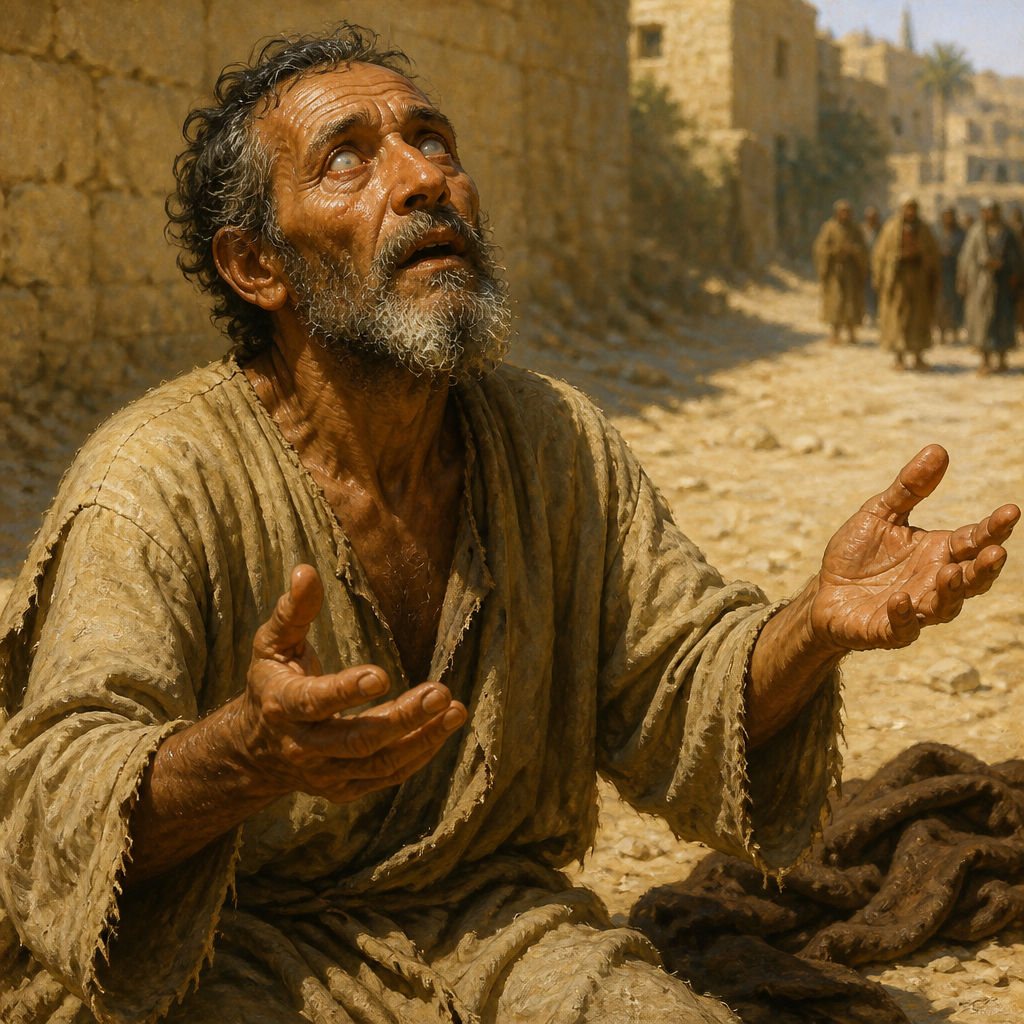
The biblical record does not describe any specific actions performed by Timaeus. He is mentioned only at the moment his son encounters Jesus of Nazareth. Because his son was a blind beggar, it is often inferred that the family may have suffered from significant economic or social hardship, as blindness in the first century frequently led to a life of destitution and reliance on public alms. Whether Timaeus was alive at the time of Jesus' visit to Jericho remains unstated, as the text focuses entirely on the interaction between Jesus and the younger Bartimaeus.
Relationship to Other Biblical Figures
Timaeus is linked directly to two figures: his son, Bartimaeus, and indirectly to Jesus. The mention of his name serves to ground the story of the blind man's healing in a specific historical and familial context. In the Gospel of Mark, such specific naming often suggests that the individual or their family was known to the early Christian community for whom the Gospel was written.
Spiritual Significance
While Timaeus is a silent figure in the text, his presence in the Gospel of Mark is significant for literary and historical reasons. By identifying Bartimaeus as the "son of Timaeus," the author provides a level of detail that distinguishes this healing from other anonymous accounts. In a spiritual sense, the name Timaeus represents the lineage from which the cry for mercy arose. His son's persistent shouting—"Jesus, Son of David, have mercy on me!"—resulted in a miraculous restoration of sight, making the house of Timaeus a witness to the messianic power of Jesus.
Spiritual Significance
Timaeus is significant primarily as a genealogical marker that provides historical weight to the miracle of Bartimaeus. The specific inclusion of his name in Mark 10:46 is often cited by scholars as evidence that Timaeus or his son were recognizable figures in the early Church, moving the story from a generic parable to a documented event involving a specific family.
Theologically, the name Timaeus contributes to the theme of identity. While Bartimaeus was known to the world only as the 'son of Timaeus'—defined by his earthly father and his disability—his encounter with Jesus granted him a new identity as a follower of Christ. Timaeus remains a notable example of how a relatively obscure individual can be immortalized in scripture through the faith and experiences of their children.
Frequently Asked Questions
What does the name Timaeus mean?
The name Timaeus is Greek (Τιμαῖος) and generally translates to 'honorable' or 'highly prized.'
Where in the Bible is Timaeus mentioned?
He is mentioned only once in the Bible, in Mark 10:46.
Was Timaeus present when Jesus healed his son?
The Bible does not state whether Timaeus was present; it only identifies him as the father of the man being healed.
Was Timaeus Jewish or Greek?
While his name is Greek, he lived in the region of Jericho and his son used the Aramaic title 'Son of David,' suggesting they were likely Jewish, as Greek names were common among Jews in the first century AD.