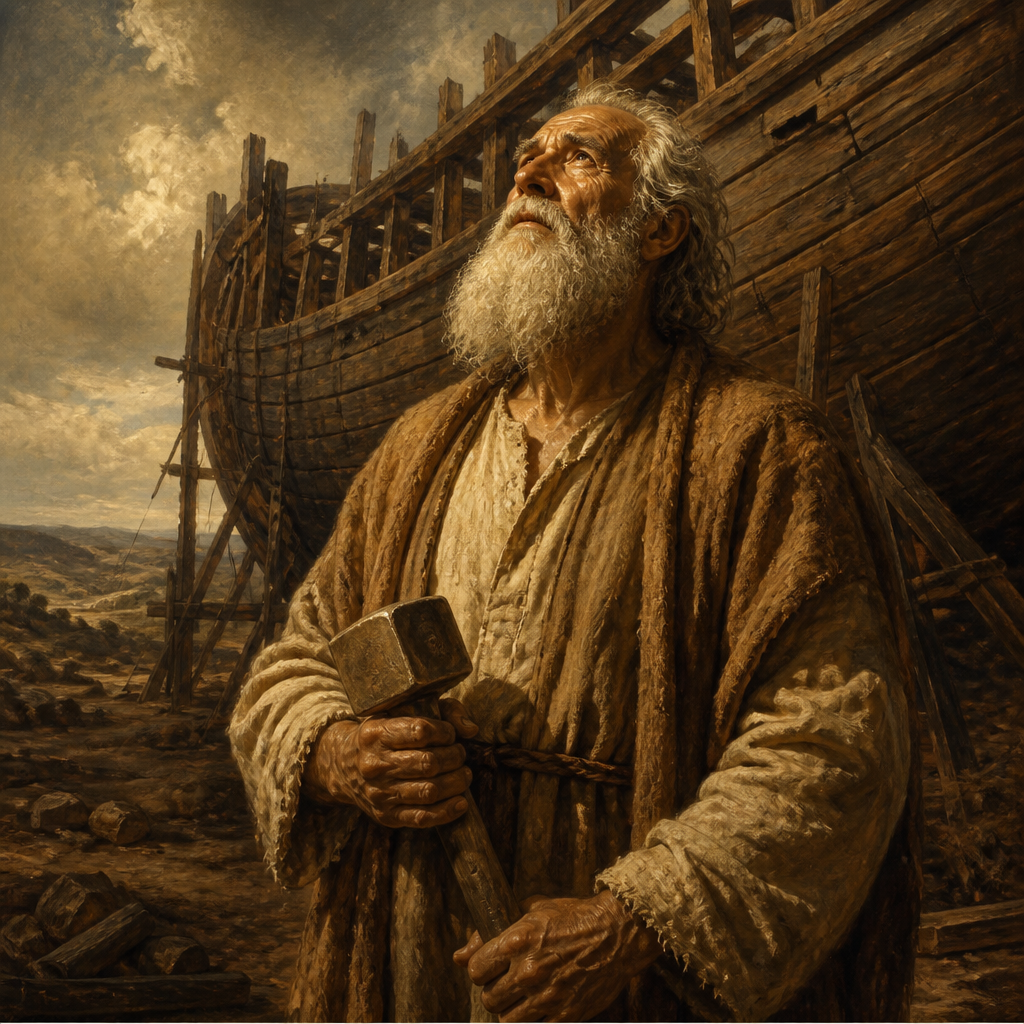
Lamech
Lamech was the son of Methuselah and the father of Noah, known for his prophecy regarding his son providing comfort from the cursed ground.
Lamech was a patriarch in the antediluvian (pre-Flood) line of Seth, appearing in the genealogies of Genesis and 1 Chronicles. As the ninth generation from Adam, he represents a crucial link in the preservation of the righteous line that eventually culminated in the survival of humanity through the Great Flood. He is distinguished by his longevity and his recorded speech at the birth of his son, Noah.
His life spans a period of extreme antiquity according to the Masoretic text, existing in a world rapidly approaching a state of pervasive corruption. Unlike many of his contemporaries who are mentioned only via their birth and death ages, Lamech is characterized by a specific hope for relief from the toil mandated by the fall of man in Eden.
Background and Family
Lamech was born to Methuselah, the longest-lived human recorded in the biblical narrative. He was part of the genealogy frequently referred to as the 'Line of Promise' or the 'Sethite Line,' which is contrasted with other lineages in early Genesis. According to the chronological data provided in Genesis 5, Lamech was born when Methuselah was 187 years old. He lived for 777 years, a number often noted by scholars for its numerical symbolism of completion or divine perfection, particularly in contrast to the shorter lifespans that would follow the Flood.
Lamech’s family life is centered on his role as a father, specifically as the father of Noah. The text notes that he had 'other sons and daughters,' indicating that the family unit was large and part of a broader community of the descendants of Seth. His life overlapped with many of the original patriarchs; based on the standard chronology, Lamech would have been born while Adam was still alive, potentially allowing for the direct oral transmission of the account of Eden across the generations.
Major Life Events
The defining moment in the biblical record of Lamech’s life is the birth of his son, Noah. In Genesis 5:28–29, the narrative pauses the genealogical listing to record Lamech’s specific reaction to this birth. He bestows the name Noah (derived from the Hebrew nuakh, meaning rest or comfort) upon the child, accompanied by a prophetic declaration:
"He will comfort us in the labor and painful toil of our hands caused by the ground the Lord has cursed."
This statement is the only recorded dialogue for Lamech and serves as a vital historical marker. It shows that the patriarchs were acutely aware of the 'curse' placed upon the earth following the fall of Adam (Genesis 3:17). Lamech’s life was defined by this 'painful toil,' suggesting that the environmental and spiritual conditions of the pre-flood world were increasingly burdensome.
Lamech died at the age of 777, notably passing away only five years before the start of the Great Flood. This timing suggests that he was spared from the global judgment that his son Noah would eventually navigate. His death marks the end of the final era of the antediluvian world before the dramatic reset of the human population.
Relationship to Other Biblical Figures
Lamech occupies a central position between the oldest man who ever lived (Methuselah) and the savior of the human race (Noah). His relationship with Methuselah connects him to the very beginning of human history, while his relationship with Noah connects him to the future.
In the New Testament, Lamech is included in the genealogy of Jesus Christ as documented in the Gospel of Luke (Luke 3:36). This inclusion affirms his status as a direct ancestor of the Messiah, placing him within the legal and biological line of the 'Seed of the Woman' promised in Genesis 3:15. His presence in this list reinforces the historical continuity between the first man, Adam, and the 'Second Adam,' Jesus.
Spiritual Significance
Spiritionally, Lamech represents the 'expectation of the faithful.' His naming of Noah is not merely a fatherly sentiment but a prophetic act. It demonstrates a belief in God's eventual provision of relief and a recognition that the current state of the world—characterized by labor and thorns—was not the intended finality for image-bearers of God.
Scholarship often highlights that Lamech’s prophecy was fulfilled in two ways: first, in a literal sense, as Noah provided a way for humanity to survive and eventually discovered viticulture (planting a vineyard); and second, in a typological sense, where the 'rest' Noah offered points toward the ultimate rest found in the work of Christ. Lamech lived in a time of darkening morality, yet his recorded words focus exclusively on the hope for divine intervention. He serves as an example of a man who, despite living in a cursed environment, maintained a focus on the promises of God regarding restoration and comfort.
Spiritual Significance
Lamech’s primary theological significance lies in his prophetic naming of Noah. By articulating the need for 'comfort' (nacham) from the labor of the cursed ground, Lamech links the struggle of his generation directly back to the Fall in Eden. He is the first person in the Bible to explicitly express a longing for the reversal of the curse, marking him as a figure of hope amidst the encroaching judgment of the Flood. Furthermore, as a link in the Lucan genealogy, he establishes the biological continuity of the Messianic line.
His lifespan of 777 years is often seen as a symbolic counter-point to the corruption of his era, representing a life lived within the limits of God's sovereign timing. Because he died shortly before the Flood, his life also illustrates the biblical theme of the righteous being taken away before a time of great calamity, reflecting a form of divine mercy.
Frequently Asked Questions
How old was Lamech when he died?
Lamech lived to be 777 years old, according to Genesis 5:31.
Did Lamech live to see the Flood?
No, based on biblical chronology, Lamech died approximately five years before the Flood began.
What does the name Noah mean according to Lamech?
Lamech associated the name with 'comfort' or 'rest,' stating that his son would bring relief from the toil caused by the cursed ground.
Was Lamech a prophet?
While not titled a prophet, his statement regarding Noah in Genesis 5:29 is considered a prophetic utterance concerning the future of humanity.
Is Lamech mentioned in the New Testament?
Yes, Lamech is listed in the genealogy of Jesus found in Luke 3:36.