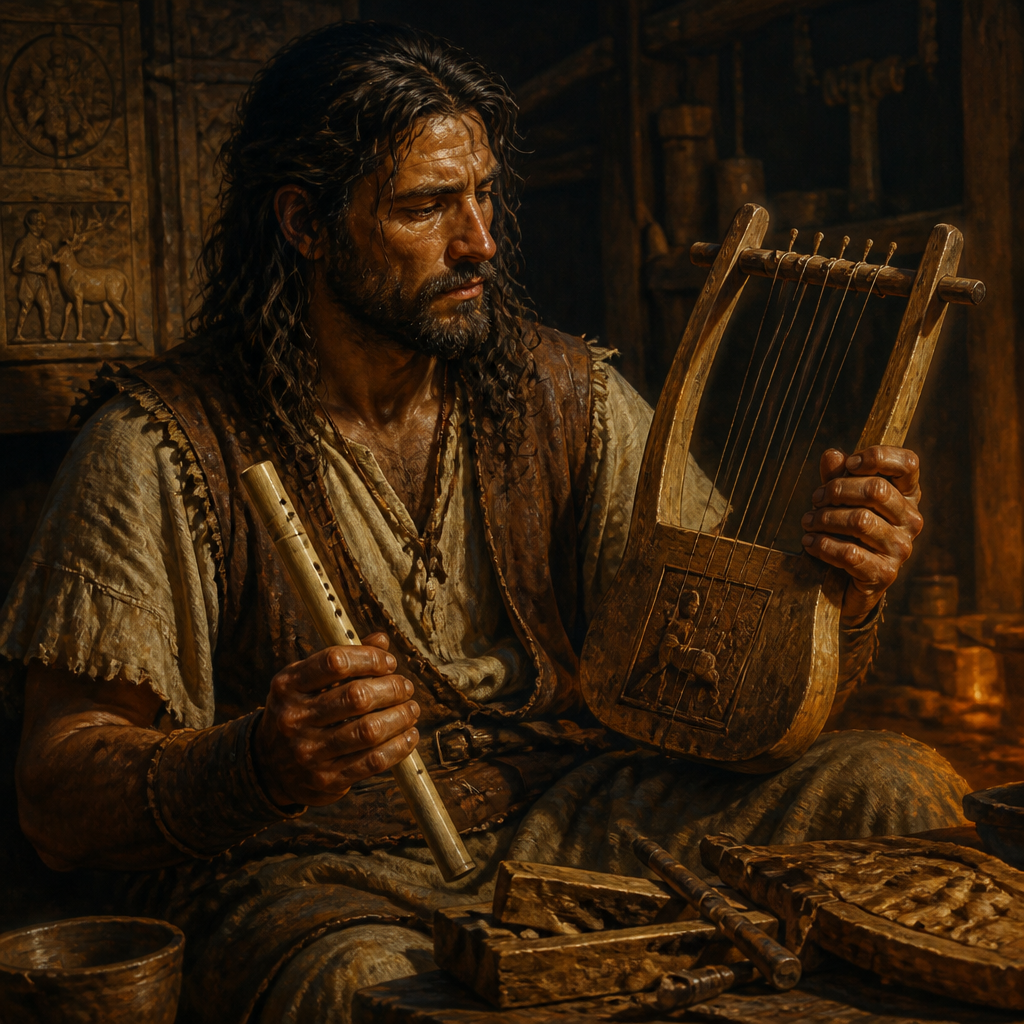
Tubal-cain
According to the Book of Genesis, Tubal-cain was an antediluvian artisan identified as the first forger of bronze and iron tools.
Tubal-cain is a figure appearing in the fourth chapter of the Book of Genesis, representing the seventh generation of humanity starting from Adam. As a member of the lineage of Cain, he is credited with the revolutionary technological advancement of metalworking. He is the son of Lamech and Zillah, and he stands as the final descendant of Cain mentioned in the genealogical record before the narrative shifts focus toward the line of Seth.
While his presence in the biblical text is brief, Tubal-cain is historically and theologically significant as the pioneer of the 'Age of Metals.' His name has become synonymous with craftsmanship and industrial innovation. In the context of the Cainite genealogy, he represents the zenith of human cultural and technological development achieved by a civilization operating apart from the direct providence of God.
Background and Family
Tubal-cain emerges in the biblical narrative within the context of the first recorded instances of polygamy and urban development. He was the son of Lamech, a man noted for his aggressive poem of vengeance, and Lamech's second wife, Zillah. Tubal-cain was part of a uniquely gifted sibling group; his half-brothers were Jabal, the father of those who live in tents and raise livestock, and Jubal, the father of all who play stringed instruments and pipes. He also had a sister named Naamah.
This family unit represents the diversification of human society into specialized roles. While his brothers focused on agriculture and the arts, Tubal-cain specialized in the material sciences. The lineage of Cain, beginning with the construction of the first city (Enoch), culminates in the technical mastery displayed by Tubal-cain. This progress highlights the biblical theme that even within a lineage characterized by spiritual alienation, human ingenuity and the 'cultural mandate' to subdue the earth remain intact.
Major Life Events
The primary event associated with Tubal-cain is his establishment of metallurgy. Genesis 4:22 describes him as an 'instructor of every artificer in brass and iron' (KJV) or a 'forger of all instruments of bronze and iron' (ESV). The Hebrew word lōṭēš implies one who sharpens, hammers, or polishes, suggesting that Tubal-cain was not merely a theorist but a master craftsman who manipulated raw ore into functional implements.
This transition from stone tools to metal alloys (bronze) and eventually iron represents a massive shift in human capability. The ability to create sharper, more durable tools allowed for more efficient farming, complex construction, and, inevitably, more effective weaponry. Biblical scholars often note that Tubal-cain’s work likely provided the physical means for the violence that characterized the antediluvian world, a period the Bible describes as being 'filled with violence' (Genesis 6:11).
Relationship to Other Biblical Figures
Tubal-cain's relationship with his father, Lamech, is structurally critical to the Genesis 4 narrative. Immediately following the mention of Tubal-cain’s birth and occupation, Lamech recites a 'Sword Song' to his wives. In this poem, Lamech boasts of killing a young man for wounding him. Many commentators suggest that the tools forged by Tubal-cain provided Lamech with the weapons needed to exact this disproportionate revenge. Whereas Cain killed Abel with whatever was at hand, Lamech’s generation possessed specialized weapons of war.
His relationship with his sister Naamah is also noteworthy for its rarity. Biblical genealogies seldom mention daughters unless they are of particular importance or signify the end of a specific narrative line. Together with his brothers, Tubal-cain illustrates the totality of human civilization: subsistence (Jabal), soul/culture (Jubal), and industry/defense (Tubal-cain).
Spiritual Significance
Theologically, Tubal-cain serves as a study in the 'Common Grace' of God and the 'Depravity of Man.' Despite being part of the 'cursed' line of Cain—a lineage that moved 'east of Eden' away from the presence of the Lord—Tubal-cain was endowed with immense creative and intellectual capacity. This demonstrates that technical skill and artistic brilliance are gifts from God that can exist in individuals who do not follow Him.
However, the placement of Tubal-cain's achievements alongside Lamech’s boast of violence serves as a warning. The Bible presents the advancement of the Cainites as a double-edged sword: as man becomes more capable of building and creating, he also becomes more efficient at destroying. Tubal-cain’s bronze and iron represent the pinnacle of human self-sufficiency that eventually led to the judgment of the Great Flood. He stands as the representative of an era where human technology outpaced human morality, a theme that resonates throughout the rest of the biblical canon.
Spiritual Significance
Tubal-cain's significance lies in his identification as the 'father of metallurgy,' marking the transition of human society into an industrialized state. In the biblical framework, he represents the height of human technological achievement prior to the Flood, illustrating that civilization can flourish materially even while decaying spiritually. His work provided the tools for both progress and warfare, highlighting the ethical ambiguity of human invention.
Furthermore, as the final named descendant in Cain’s line, he completes the picture of a society that sought to find security and meaning through its own efforts—building cities, domesticating livestock, creating music, and forging weapons—rather than through reconciliation with God. His legacy is the physical infrastructure of the world that would soon be judged by the Deluge.
Frequently Asked Questions
What does the name Tubal-cain mean?
The name is often interpreted as 'Produced by Cain' or 'Thou wilt be brought of Cain.' The 'Tubal' portion may be related to the Hebrew root for 'bringing' or 'producing,' while 'Cain' identifies his lineage/ancestor.
What metals did Tubal-cain work with?
The Bible specifically mentions bronze (often translated as brass in older versions) and iron. This is notable as it suggests a high level of heat management and alloying knowledge.
Was Tubal-cain alive during the time of Noah?
Based on the genealogical timelines in Genesis 4 and 5, Tubal-cain was a contemporary of the later generations before the Flood, likely making him a contemporary of Noah's father, Lamech of the line of Seth.
Is Tubal-cain related to the 'Tubal' mentioned in the Table of Nations?
No. Tubal-cain was a descendant of Cain (Genesis 4), whereas the Tubal mentioned in Genesis 10 was a son of Japheth and a grandson of Noah.
What is the significance of his sister Naamah being mentioned?
Naamah's inclusion is rare for biblical genealogies. Jewish tradition suggests she was either the wife of Noah or a person of great cultural influence, though the Bible itself does not state her role beyond her name.