Jubal
Jubal was a descendant of Cain and is traditionally recognized as the father of all who play the harp and the flute, establishing the foundation of musical arts.
Jubal is a figure appearing in the early chapters of the Book of Genesis, specifically within the genealogy of Cain. Though his mention in the biblical text is brief, he occupies a significant position in the narrative of human cultural development. He is the second son of Lamech and Adah, belonging to the seventh generation from Adam through the line of Cain.
In the biblical tradition, Jubal is credited with the invention of musical instruments, specifically stringed and wind instruments. This attribution identifies him as a pivotal figure in the transition of humanity from basic survival to the cultivation of the arts. His life reflects the rapid diversification of human labor and creativity that occurred among the early inhabitants of the earth as described in the Primeval History.
Background and Family
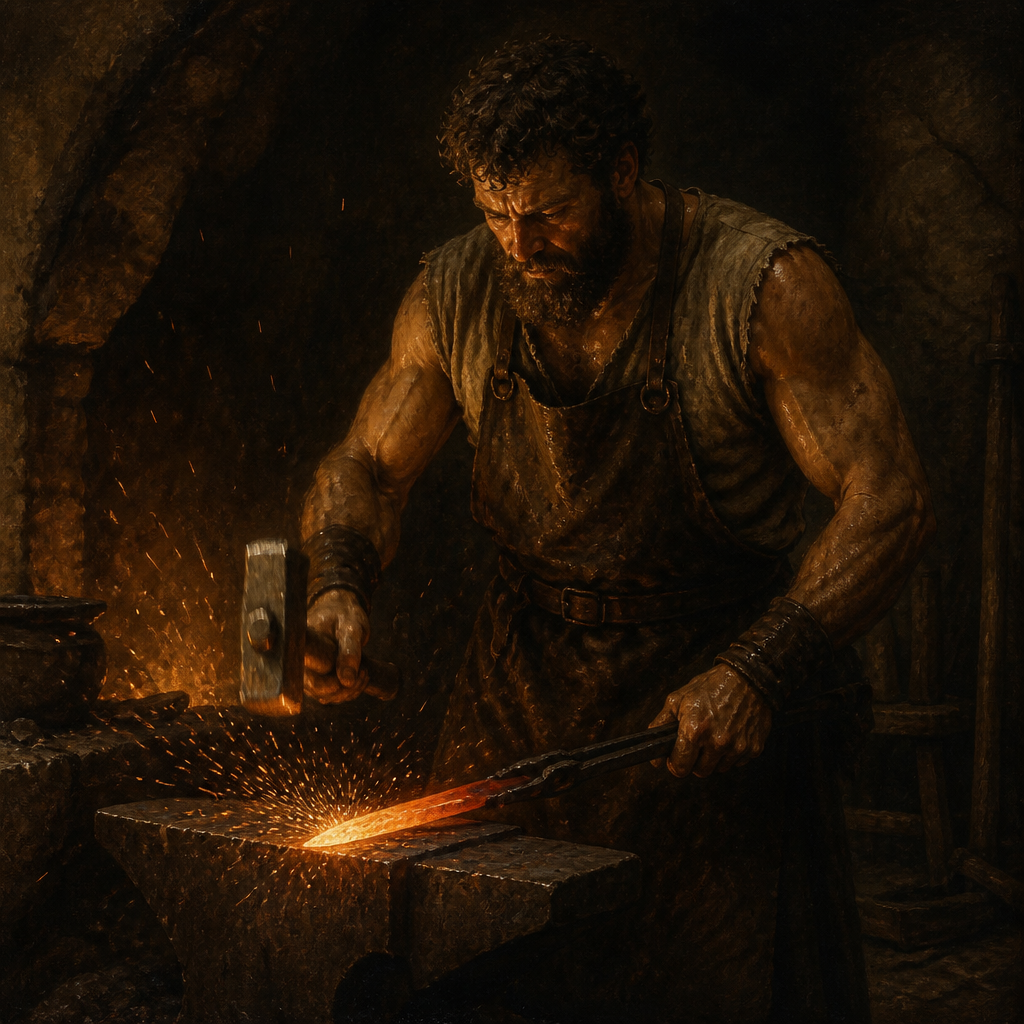
Jubal appears in Genesis 4:21 within the context of the 'Cainite genealogy.' He was the son of Lamech, the first polygamist mentioned in the Bible, and Lamech's first wife, Adah. Jubal was part of a uniquely talented household of siblings. His older brother, Jabal, is described as the father of those who live in tents and raise livestock. His half-brother, Tubal-Cain (born to Lamech’s second wife, Zillah), was the first to forge tools out of bronze and iron. He also had a sister named Naamah.
This familial structure suggests a period of intense innovation. While the line of Cain is often associated with spiritual estrangement from God following the murder of Abel, the text highlights that this lineage was also responsible for the foundations of human civilization—urbanization, nomadic husbandry, metallurgy, and music.
Major Life Events
The biblical record does not provide a narrative of Jubal’s life in the way it does for figures like Abraham or David. Instead, his legacy is defined by a single, monumental achievement: the invention of the kinnor (harp or lyre) and the ugab (flute or pipe).
Genesis 4:21 states that he was 'the father of all those who play the harp and flute.' In the Ancient Near Eastern context, the term 'father' often denotes a founder, patron, or the first of a guild. By establishing these two categories of instruments—string and wind—Jubal is depicted as the progenitor of the musical arts. This suggests that the early descendants of Cain were not merely surviving but were thriving enough to devote time to aesthetic expression and the complex craft of instrument making.
Relationship to Other Biblical Figures
Jubal’s relationship to his family is central to understanding his role in the Genesis narrative. He is the direct descendant of Cain, the son of Adam and Eve who committed the first murder. This placement is significant because it shows that cultural and technological progress continued even in a lineage marked by sin and exile.
His brother Jabal and half-brother Tubal-Cain represent the practical and industrial sides of civilization, while Jubal represents the artistic side. Together, the sons of Lamech represent a 'triad' of human mastery over the environment: Jabal over the biological world (livestock), Tubal-Cain over the material world (metal), and Jubal over the auditory/spiritual world (music).
Spiritual Significance
In theological discourse, Jubal represents the concept of 'Common Grace.' This is the idea that God bestows gifts, talents, and cultural progress upon all of humanity, regardless of their spiritual standing. Even though Jubal belongs to the line of Cain—a lineage often contrasted with the more 'godly' line of Seth—he is credited with a gift that brings beauty and joy to the world.
However, some commentators also note the irony of Jubal’s contribution. While music is a gift, it appears in a chapter dominated by the hubris of Lamech, who used his skills to compose a song of violence and vengeance (Genesis 4:23-24). This suggests that while Jubal’s invention was inherently good, the artistic output of his family was susceptible to the same corruption that affected their ancestor, Cain. For the biblical author, Jubal serves as a reminder that human ingenuity is a double-edged sword: it can reflect the image of a creative God, but it can also be used to celebrate human autonomy and sin.
Spiritual Significance
Jubal represents the origin of the arts in human history. His presence in the Bible affirms that music and creativity are foundational elements of the human experience, established shortly after creation. He serves as the primary example of how culture and technology flourished among the earliest generations of humanity.
Theologically, Jubal’s inclusion in the line of Cain demonstrates that God allows even those separated from Him to contribute meaningfully to the world's development. Music, as fathered by Jubal, becomes a universal language that predates the Tower of Babel, illustrating the shared heritage of human talent.
Frequently Asked Questions
What instruments did Jubal invent?
Jubal is credited with inventing the 'kinnor' and the 'ugab,' which are generally translated as the lyre (or harp) and the pipe (or flute).
Who was Jubal's father?
Jubal's father was Lamech, a descendant of Cain.
Was Jubal related to Noah?
They were distantly related through the first man, Adam. However, Jubal belonged to the line of Cain, while Noah belonged to the line of Seth.
Does Jubal appear in the New Testament?
No, Jubal is only mentioned in the Book of Genesis.
What does the name Jubal mean?
The name is often associated with the Hebrew word 'yubal,' meaning a stream or watercourse, or 'yobel,' meaning a trumpet or ram's horn.