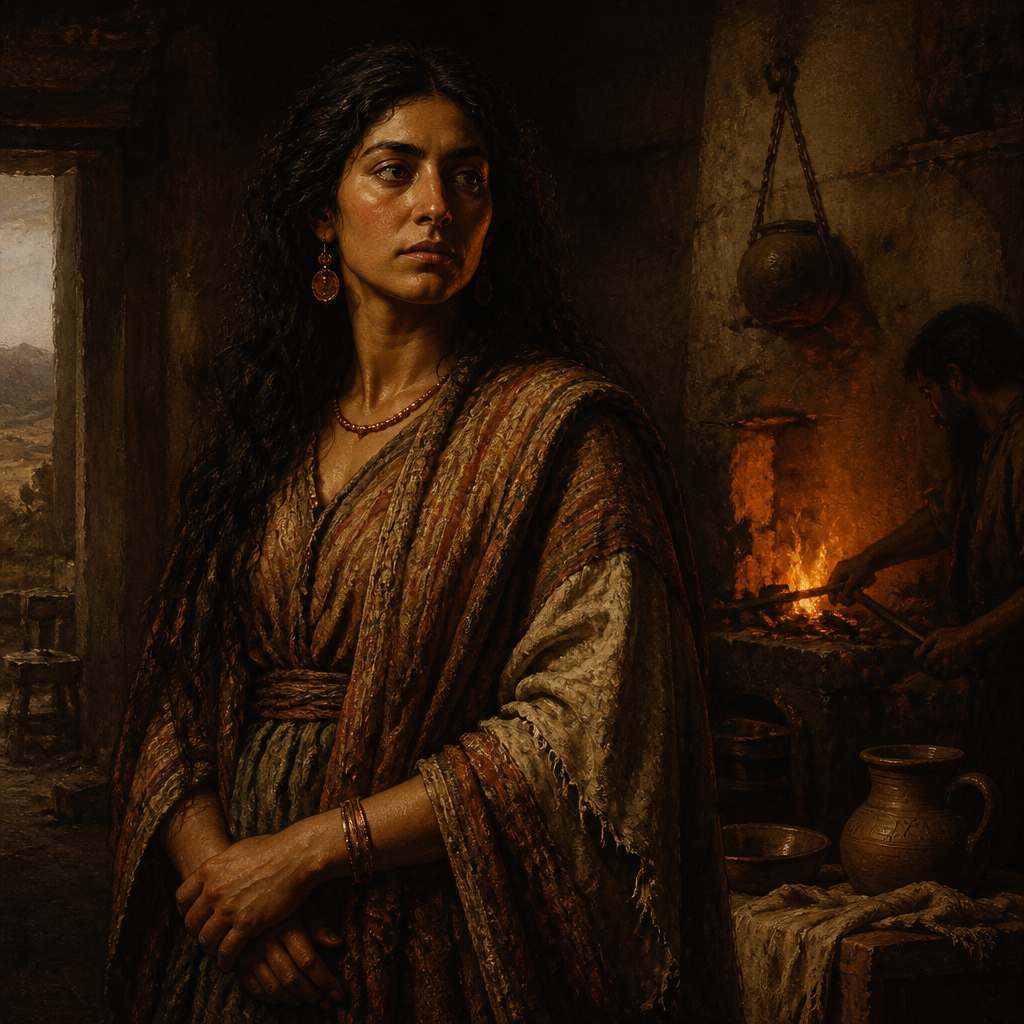
Adah
Adah was the first wife of Lamech and the second woman named in the Bible after Eve, playing a pivotal role in the antediluvian genealogy of Cain.
Adah occupies a unique and historically significant position in the opening chapters of the Book of Genesis. As one of the wives of Lamech, who was a fifth-generation descendant of Cain, Adah is the first woman mentioned by name in the biblical text after Eve. Her inclusion in the narrative signals a transition from the primal origins of humanity toward the development of complex social structures and civilization. Through her name and the accomplishments of her children, she represents the flourishing of culture and the 'adornment' of human life in the era preceding the Great Flood.
While her direct dialogue is not recorded, Adah is a central figure in the 'Song of Lamech,' one of the oldest fragments of poetry found in the Hebrew Bible. Her presence in the text provides a window into the domestic life of the Cainite line, a lineage characterized by both rapid technological advancement and increasing moral instability. As the mother of Jabal and Jubal, Adah is the progenitor of specific human crafts, marking her family as the founders of various pillars of ancient civilization, including nomadic shepherding and the musical arts.
Background and Family
Adah appears in Genesis 4, within the genealogical record of Cain, the firstborn son of Adam and Eve who was exiled after the murder of his brother Abel. The text identifies Adah as one of the two wives of Lamech, the son of Methushael. This detail is of immense sociological and theological importance, as it constitutes the first biblical record of polygamy. By taking two wives—Adah and Zillah—Lamech is presented as departing from the monogamous precedent established with the creation of Adam and Eve in the Garden of Eden.
The name Adah is derived from the Hebrew root 'adah, which translates to 'ornament,' 'decoration,' or 'beauty.' In the context of the antediluvian (pre-Flood) world, names often reflected the character or the perceived role of the individual. Scholars suggest that Adah’s name likely points to the emergence of aesthetic value and the concept of feminine grace within a society that was rapidly expanding its material capabilities.
Major Life Events
Adah’s life is defined primarily by her role as a mother and her witness to Lamech’s violent confession. The biblical narrative focuses on her offspring, Jabal and Jubal, who are credited with establishing critical cultural institutions. Jabal is described as the 'father of those who live in tents and raise livestock' (Genesis 4:20), indicating that Adah’s firstborn was the founder of the nomadic, pastoral way of life. Her second son, Jubal, is called 'the father of all who play stringed instruments and pipes' (Genesis 4:21), marking the formal beginning of musical artistry and structural entertainment.
A defining moment in Adah's recorded history is her role as an audience to Lamech’s poetic boast. In Genesis 4:23-24, Lamech addresses his wives directly: 'Adah and Zillah, listen to me; wives of Lamech, hear my words.' In this address, Lamech confesses to killing a man for wounding him and a young man for injuring him. He proclaims that if Cain’s vengeance was sevenfold, his own shall be seventy-sevenfold. This passage, often called the 'Sword Song,' places Adah at the center of a household that was both culturally sophisticated and deeply entrenched in the cycle of violence that characterized the Cainite line.
Relationship to Other Biblical Figures
Adah’s primary relationship is with Lamech, to whom she is linked in the first recorded instance of bigamy. Her relationship with her co-wife, Zillah, is not explored in terms of sibling rivalry or cooperation, unlike later biblical pairs such as Leah and Rachel. Instead, the text portrays them as a unit, typically addressed together by their husband. Through her sons, Adah is linked to the broader development of the human race; her household represents the 'world-building' aspect of Cain’s descendants, who built cities and mastered technologies while remaining estranged from God.
As the mother of Jabal and Jubal, she stands in contrast to Zillah, who bore Tubal-Cain (the master of bronze and iron) and Naamah. Together, these two women oversaw a household that effectively invented the components of a functional society: agriculture, the arts, and metallurgy. However, this progress is depicted within the framework of a lineage that is spiritually drifting toward the corruption that eventually necessitates the Flood.
Spiritual Significance
In biblical scholarship, Adah serves as a symbol of the 'splendor of the world' separated from the divine. Her name, meaning beauty, reflects the growing focus on the physical and the aesthetic in Cain’s city. While Adah herself is not condemned by the text, she is part of a narrative arc that illustrates how human culture—music, livestock management, and urbanization—can flourish even as humanity’s moral condition declines.
The fact that she is named at all is significant. In ancient genealogies, women were rarely mentioned unless their presence was vital to the narrative’s theological goals. Adah’s inclusion highlights the importance of the family unit in the transmission of both skill and sin. She represents the domestic reality of a world that is becoming increasingly 'polished' on the outside but fractured by the violence epitomized by her husband's boast. To the reader of Genesis, Adah stands at the dawn of history as a reminder that civilization’s earliest successes were born in the line of the wanderer, Cain.
Spiritual Significance
Adah serves as a landmark figure in the biblical genealogy of Cain, representing the introduction of polygamy into human history and the birth of cultural institutions. As the mother of the pioneers of pastoralism and music, she is viewed as a foundational matriarch of human civilization. Her mention signifies the Bible's recognition of the rapid development of human talent and social complexity in the generations following the expulsion from Eden.
Theologically, Adah’s presence in the 'Song of Lamech' underscores the domestic consequences of the Fall. She is part of the first recorded family to experience the normalization of violence and the distortion of the marriage covenant. Her role illustrates the tension between the inherent goodness of human creativity (as seen in her sons) and the pervasive reach of human depravity (as seen in her husband).
Frequently Asked Questions
What does the name Adah mean?
The name Adah comes from the Hebrew root meaning 'ornament,' 'beauty,' or 'adornment.'
Who was Adah's husband?
Adah was the wife of Lamech, a descendant of Cain in the fifth generation.
Why is Adah significant in the Bible?
She is the first woman named in the Bible after Eve and is part of the first recorded instance of polygamy.
Who were Adah's children?
Adah was the mother of Jabal, the father of nomads, and Jubal, the father of musicians.
Is Adah related to the line of Seth?
No, Adah belongs to the line of Cain, which the Bible describes separately from the godly line of Seth.