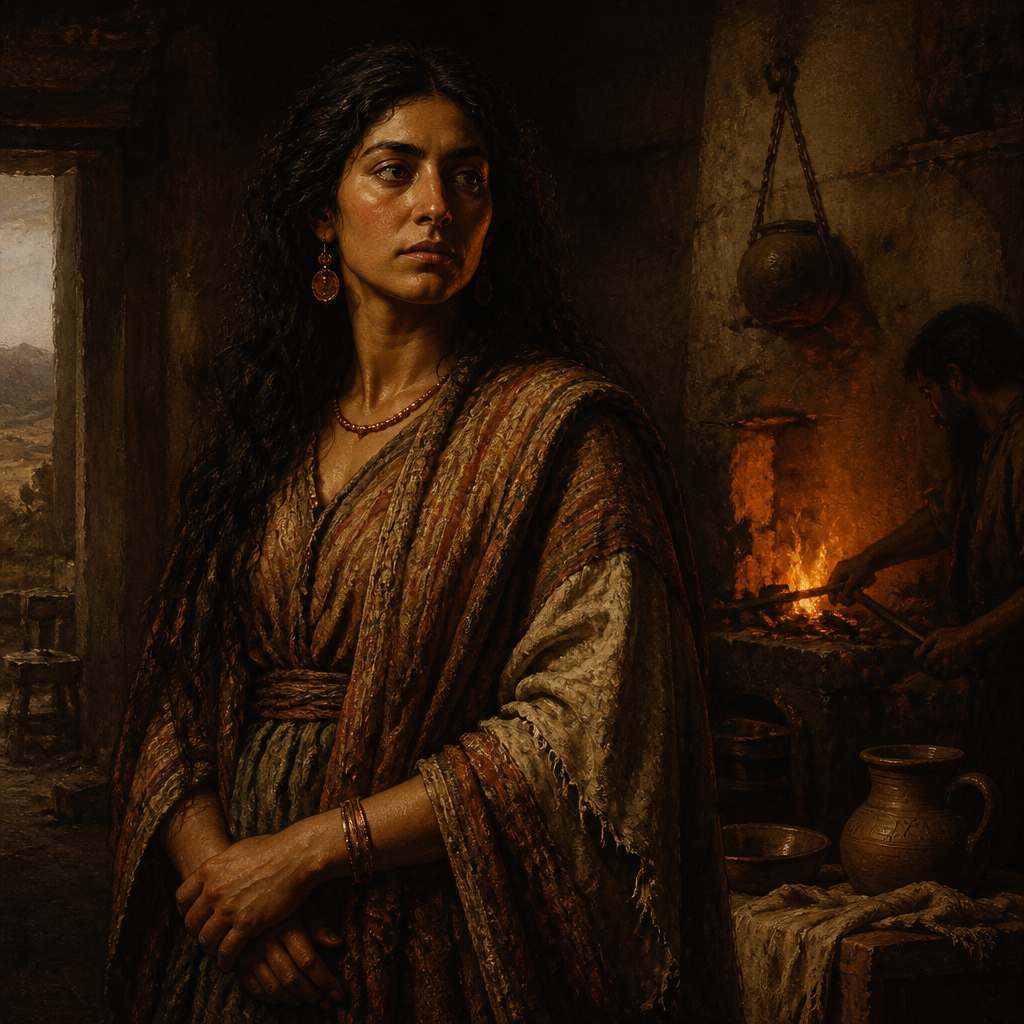
Naamah
Naamah was a pre-Flood figure from the generation of Lamech, noted in the Table of Nations as the daughter of Lamech and Zillah and the sister of Tubal-cain.
Naamah is one of the few women mentioned by name in the antediluvian genealogies of the Book of Genesis. Positioned within the line of Cain, she appears in the seventh generation from Adam, a placement that highlights her family's significant cultural and industrial influence in the early biblical narrative. Her inclusion is particularly striking given the patriarchal structure of ancient genealogies, which typically omitted daughters unless they served a specific narrative or historical purpose.
As the daughter of Lamech and Zillah and the sister of Tubal-cain, Naamah belongs to a family of innovators. Her brothers are credited with the foundations of nomadic herding, music, and metallurgy. While the biblical text provides no specific details regarding her own deeds or character, her name—meaning 'pleasant' or 'lovely'—and her placement at the end of Cain's lineage have sparked centuries of scholarly and midrashic interpretation regarding her role in the preservation of civilization or the introduction of beauty and aesthetics.
Background and Family
Naamah is introduced in Genesis 4:22 within the context of the 'Song of Lamech' and the description of his descendants. She is the daughter of Lamech, a descendant of Cain, and Zillah, one of Lamech’s two wives. The household of Lamech represents a peak of human development in the pre-Flood world. Her full brothers and half-brothers include Jabal (the father of those who live in tents and raise livestock), Jubal (the father of all who play stringed instruments and pipes), and Tubal-cain (an instructor of every craftsman in bronze and iron).
The genealogy provided in Genesis 4 is distinct from the 'Godly line' of Seth found in Genesis 5. The line of Cain is characterized by secular progress, urbanization, and a departure from the presence of the Lord. Naamah’s father, Lamech, is depicted as a man of violence and pride, yet his children are the architects of human culture. Naamah stands as the final mentioned figure of this line before the narrative shifts toward the line of Seth and the eventual account of Noah.
Major Life Events
Because the biblical record is silent on the specific actions of Naamah, her 'life events' are often reconstructed through textual analysis and historical-critical methods. In the text of Genesis, her appearance is the primary event: 'And the sister of Tubal-cain was Naamah' (Genesis 4:22). This brief mention is significant because she is one of only two women named in the entirety of Cain's genealogy—the others being Lamech's wives, Adah and Zillah.
Historically, scholars have noted that the mention of a sister in a list of male innovators suggests she may have been an innovator herself. Just as her brothers founded the industries of agriculture, music, and smithing, some commentators suggest Naamah may have been associated with the development of textiles, weaving, or cosmetic arts, though the text does not explicitly state this. Her life is set against the backdrop of an increasingly sophisticated but spiritually drifting society that would eventually lead to the divine judgment of the Great Flood.
Relationship to Other Biblical Figures
Naamah is defined primarily through her familial connections. She is the granddaughter of Methushael and the great-great-great-great-granddaughter of Cain. Her relationship with her brother, Tubal-cain, is emphasized by the text. Tubal-cain was the first to work with copper and iron, marking a transition into the Bronze and Iron Ages within the biblical timeline.
In Jewish tradition and various extrabiblical midrashim, Naamah’s relationships are expanded upon significantly. Some traditions attempt to link the line of Cain back to the line of Seth by suggesting that Naamah was the wife of Noah. According to the Bereshit Rabbah, she was called Naamah because 'her deeds were pleasant' (na'amim) and she was the woman who survived the Flood alongside the righteous Noah. However, it must be noted that the biblical text provides no confirmation of this identity, and other traditions suggest Noah’s wife was an unnamed woman from the line of Seth.
Spiritual Significance
The spiritual significance of Naamah lies in her representation of the 'world' and its inherent beauty and talent, even when separated from God. Within the Cainite lineage, human achievement flourished. Naamah, whose name denotes beauty, symbolizes the aesthetic and cultural advancements of humanity. Her inclusion suggests that while the line of Cain was characterized by rebellion, it was not devoid of grace, beauty, or familial structure.
Furthermore, Naamah’s presence at the end of the Cainite list serves as a literary 'full stop.' After her name, the lineage of Cain is no longer tracked in the Bible. This indicates the end of a chapter in human history. From a theological perspective, Naamah represents the culmination of human civilization in the antediluvian era—a civilization that had reached great heights of skill and aesthetic appeal but lacked the foundational righteousness required to avert judgment. She is a reminder that beauty and heritage, while valuable, are not substitutes for a right relationship with the Creator.
Spiritual Significance
Naamah’s mention in Genesis 4:22 is historically significant as a rare instance of a woman being named in an ancient Near Eastern genealogy. Her presence acknowledges the role of women in the foundational stages of human civilization. Theologically, she represents the end of the line for the descendants of Cain, showing that even a lineage marked by separation from God produced figures of note and 'pleasant' qualities.
In the broader biblical context, she serves as a bridge between the era of technological discovery and the era of divine judgment. Her inclusion forces the reader to acknowledge the complexity of the pre-Flood world, where cultural advancement and moral decline existed simultaneously. She remains an enigmatic figure who highlights the importance of the family unit in the early chapters of Genesis.
Frequently Asked Questions
Who was Naamah's father?
Naamah was the daughter of Lamech, a seventh-generation descendant of Cain.
What does the name Naamah mean?
The name Naamah is derived from the Hebrew word for 'pleasant,' 'lovely,' or 'beautiful'.
Was Naamah on Noah's Ark?
The Bible does not state that Naamah was on the Ark. While some Jewish traditions identify her as Noah's wife, the Book of Genesis does not provide a name for Noah's wife.
What was Naamah's occupation?
The Bible does not specify her occupation, though her brothers were pioneers in livestock, music, and metallurgy.
Why is Naamah mentioned if she has no story?
Her mention highlights her importance within the family of Lamech and suggests she was a person of significant status or influence in the pre-Flood world.