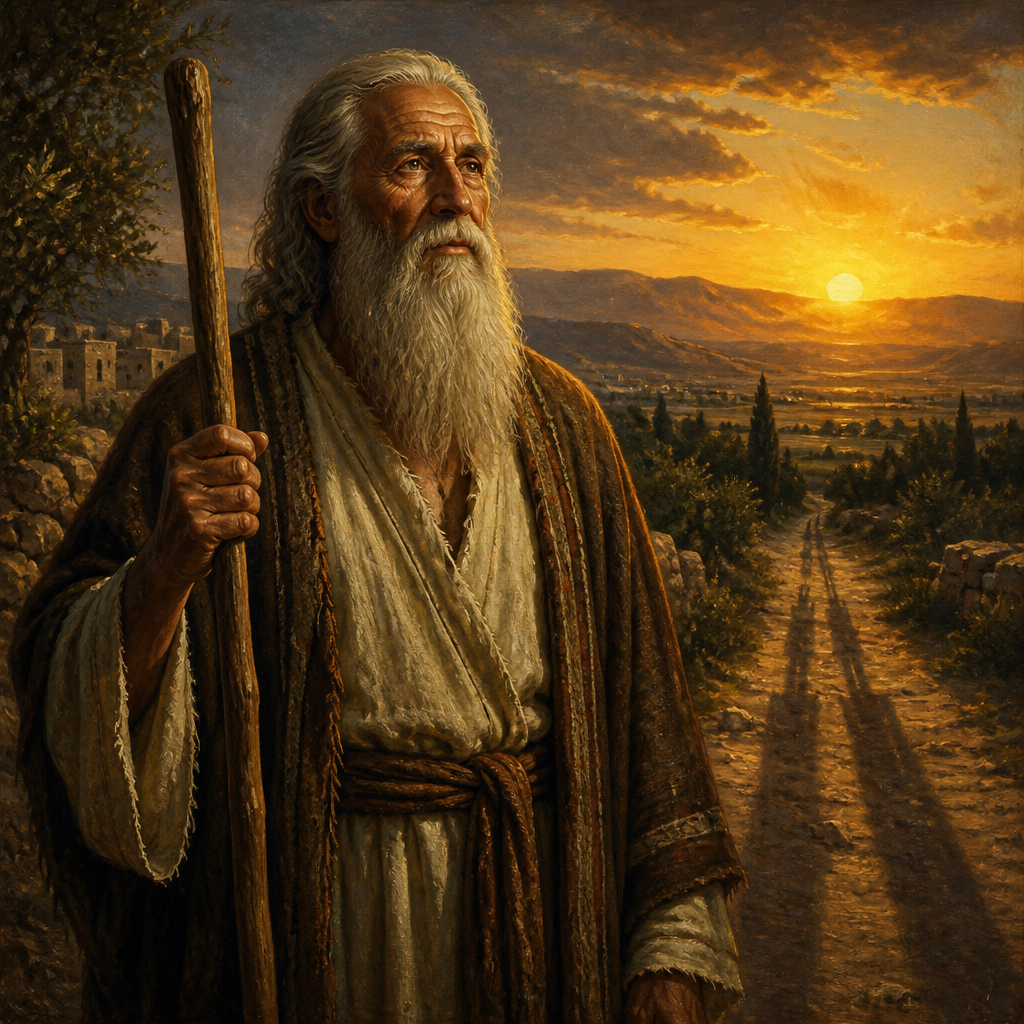
Enosh
Enosh was the son of Seth and grandson of Adam, noted in Genesis for a pivotal era when humanity began to call upon the name of the Lord.
Enosh (also spelled Enos) is a significant figure within the antediluvian (pre-flood) genealogy of the Bible. As the son of Seth and the grandson of Adam and Eve, he represents the third generation of humanity. He occupies a critical position in the lineage of the promised 'seed' mentioned in Genesis 3:15, which scholars identify as the godly line contrasting with the descendants of Cain.
While the biblical record regarding Enosh is brief in terms of narrative action, his life is associated with a transformative spiritual shift in the early history of mankind. Mentioned in the books of Genesis, 1 Chronicles, and the Gospel of Luke, Enosh preserves the continuity of the human race and the preservation of divine knowledge in an era of increasing primitive development.
Background and Family
Enosh was born to Seth when Seth was 105 years old. As the firstborn son of Seth, Enosh was born into a world still mourning the loss of Abel and dealing with the exile of Cain. His grandfather, Adam, was still alive at the time of his birth and would continue to live for several centuries alongside him. This overlap suggests that Enosh was part of a patriarchal society where oral traditions regarding the Garden of Eden and the early commands of God were directly accessible from the first man.
The name 'Enosh' itself is of linguistic interest to biblical scholars. In Hebrew, Enosh (אֱנוֹשׁ) is often translated as 'man' or 'mortal.' Unlike the name Adam, which refers to 'man' in a general or 'earth-made' sense, Enosh implies a sense of frailty, weakness, or mortality. Some commentators suggest this naming reflects a growing realization of human limitations and the reality of death in the post-fall world.
Major Life Events
According to the Masoretic Text of Genesis 5, Enosh lived a total of 905 years. He fathered his primary heir, Kenan, at the age of 90. Following the birth of Kenan, the text notes that Enosh 'had other sons and daughters,' contributing to the rapid population of the early earth. His life spanned a period of nearly a millennium, during which he witnessed the birth of several generations of descendants, including Enoch and Methuselah.
The most significant event associated with the time of Enosh is found in Genesis 4:26: 'At that time people began to call on the name of the Lord.' This brief statement has been the subject of extensive theological debate. It suggests that during Enosh’s lifetime, there was a formalization of worship or a collective turning toward Yahweh. While individual worship likely existed before him, the era of Enosh marks the beginning of communal prayer, liturgical invocation, or public proclamation of the divine name.
Relationship to Other Biblical Figures
Enosh serves as a vital link in the 'Table of Nations' and the Messianic genealogy. He is the grandson of Adam and the son of Seth, through whom the image of God was passed down (Genesis 5:3). Because the line of Cain is eventually extinguished by the Great Flood, Enosh is a direct ancestor of Noah, and subsequently, the entire post-flood human race.
In the New Testament, Enosh is explicitly listed in the genealogy of Jesus Christ in Luke 3:38. This inclusion affirms his status as a historical ancestor of the Messiah, bridging the gap between the first man (Adam) and the 'Second Adam' (Christ). By placing Enosh in this pedigree, the Gospel writers emphasize the physical and historical reality of the lineage that led to the incarnation of Jesus.
Spiritual Significance
The spiritual legacy of Enosh is defined by the phrase 'calling on the name of the Lord.' This is often interpreted in three ways by scholars:
- The Institutionalization of Worship: It may refer to the first time humans gathered for public, organized religious services, distinct from private offerings.
- Distinction from the Wicked: As the line of Cain became increasingly violent and godless (exemplified by Lamech), the line of Enosh sought the presence of God as a means of preservation and identity.
- Recognition of Dependency: Given that his name means 'mortal,' the shift toward calling on God may signify a humble recognition of human inadequacy and the need for divine intervention.
Through Enosh, we see the development of a 'remnant'—a group of people dedicated to the worship of the true God in a world that was quickly falling into the corruption that eventually necessitated the Deluge.
Spiritual Significance
Theologically, Enosh represents the survival of faith in the third generation of humanity. He is pivotal because his era marks the transition from individual family existence to a more complex social structure where public worship became necessary. The mention of 'calling on the name of the Lord' during his life suggests that even in a fallen world, communication with the Creator remained possible and was actively sought by the line of Seth.
Furthermore, his presence in the genealogies of 1 Chronicles and Luke 10 serves to validate the continuity of God's plan for redemption. By tracing the lineage of the Savior back through Enosh to Adam, the Bible establishes that the promise of a redeemer was preserved through a specific, identifiable historical line, emphasizing God’s faithfulness across millennia.
Frequently Asked Questions
What does the name Enosh mean?
The name Enosh is derived from a Hebrew root meaning 'mortal' or 'frail,' often used as a synonym for 'human being' in a context that emphasizes human weakness compared to the divine.
How long did Enosh live?
According to Genesis 5:11, Enosh lived for 905 years before he died.
Who was the father of Enosh?
Enosh was the son of Seth, the third named son of Adam and Eve.
What happened for the first time during the life of Enosh?
Genesis 4:26 states that during the time of Enosh, people began to 'call upon the name of the Lord,' which is interpreted as the beginning of public or communal worship.
Is Enosh mentioned in the New Testament?
Yes, Enosh (Enos) is mentioned in Luke 3:38 as part of the genealogy of Jesus Christ.