Enoch
The seventh patriarch from Adam who is recorded in the Book of Genesis as having 'walked with God' and being taken by God without experiencing death.
Enoch appears in the Hebrew Bible as a pivotal figure in the antediluvian (pre-flood) genealogy of Seth. He is primarily known for his unique departure from the earth; unlike his ancestors and descendants whose lives conclude with the formulaic 'and he died,' the biblical narrative states that Enoch 'was not, for God took him.' This enigmatic description has made him a subject of intense theological interest and later apocalyptic literature.
In the canonical text, Enoch is positioned as the seventh in the line of Seth, a generation often highlighted in ancient Near Eastern geneaologies as one of perfection or completion. He is the son of Jared and the father of Methuselah, the latter being the longest-lived human recorded in the Bible. His life spans 365 years—a number strikingly similar to the days in a solar year—before his translation to the divine realm.
Beyond the genealogical record in Genesis, Enoch is cited in the New Testament as a model of faith and a prophetic voice. His legacy represents a bridge between the physical world and the spiritual mysteries of the divine, serving as a rare example of a human bypass of the universal experience of death.
Background and Family
Enoch is introduced in Genesis 5, a chapter often referred to as the 'Book of the Generations of Adam.' This section of scripture tracks the lineage from Adam through his son Seth, establishing a chronological and biological link to Noah. Enoch was born to Jared when his father was 162 years old. He represents the seventh generation from Adam, a position that many biblical scholars note carries symbolic weight within the heptadic (seven-fold) structure of biblical themes, signifying a peak of righteousness or divine favor within the lineage.
At the age of 65, Enoch fathered Methuselah. The text indicates that following the birth of Methuselah, Enoch lived for another 300 years, during which he fathered other sons and daughters. This timeframe suggests that while Enoch lived in a period of increasing human longevity, his earthly lifespan of 365 years was significantly shorter than those of his peers, such as his father Jared (962 years) or his son Methuselah (969 years).
Major Life Events
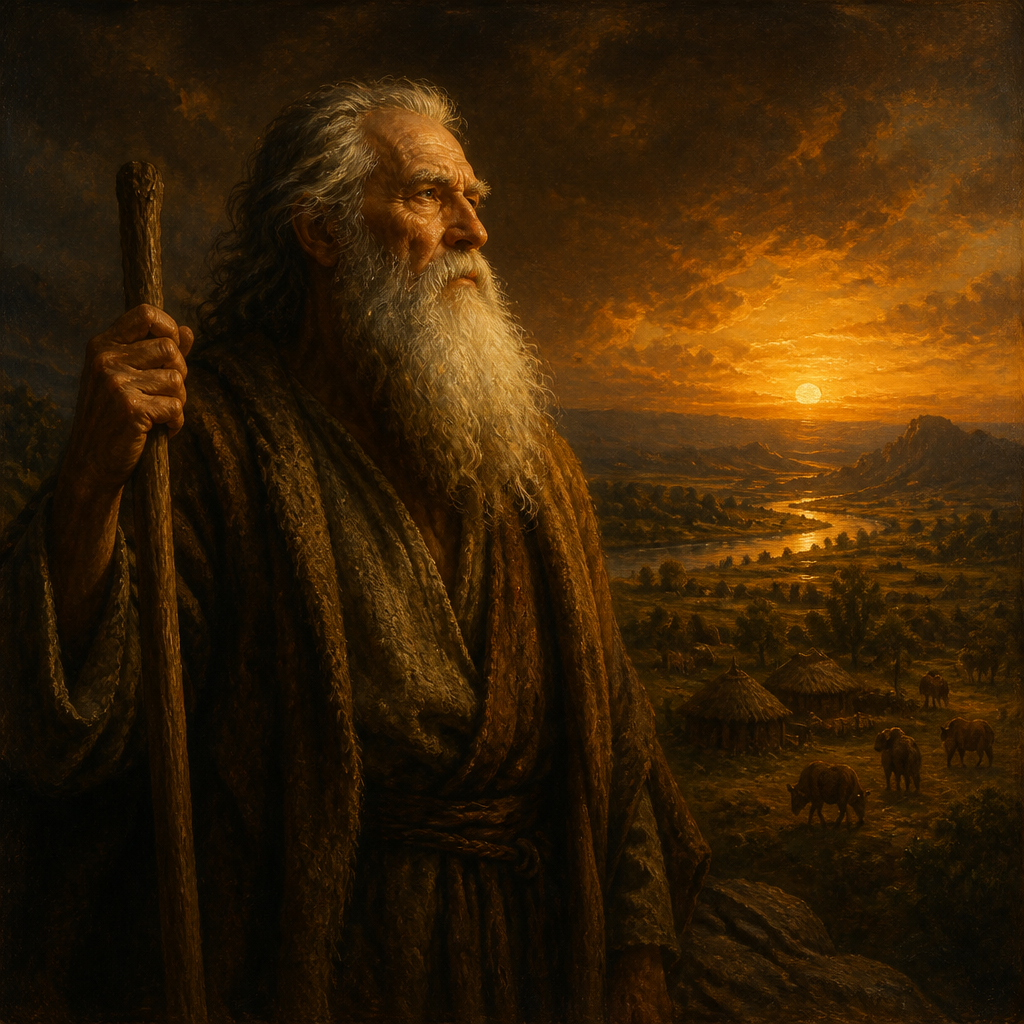
The defining characteristic of Enoch’s life is captured in the phrase, 'Enoch walked with God' (Genesis 5:22, 24). In the context of the Pentateuch, 'walking' with a deity implies a level of intimacy, devotion, and moral uprightness that distinguished him from the rest of humanity in a pre-flood world described elsewhere as increasingly corrupt. While the Genesis account is sparse on specific narrative events, this description establishes Enoch as a prototype of the righteous individual who maintains a direct communion with the Creator.
His departure from the world is the most significant event recorded. Genesis 5:24 states, 'Enoch walked with God, and he was not, for God took him.' This language is traditionally interpreted as a bodily translation or assumption into heaven, making him one of only two figures in the Hebrew Bible—alongside the prophet Elijah—to enter the afterlife without dying. In the New Testament, the author of Hebrews clarifies this event, stating that Enoch 'was taken up so that he should not see death' (Hebrews 11:5).
Relationship to Other Biblical Figures
As the father of Methuselah, Enoch is part of the direct ancestral line that leads to Noah, his great-grandson. This places him as a vital link in the survival of humanity through the Great Flood. The New Testament Book of Jude identifies Enoch as 'the seventh from Adam,' reinforcing his genealogical importance. Jude also attributes a specific prophecy to Enoch regarding the coming judgment of the ungodly, which scholars note aligns with material found in the pseudepigraphal First Book of Enoch.
In the broader biblical context, Enoch stands as a precursor to the prophets. His life demonstrates that even before the formal establishment of the Covenant with Abraham or the Giving of the Law at Sinai, a path of righteousness and divine fellowship was possible. He is often contrasted with the descendants of the line of Cain, representing the spiritual peak of the Sethite line.
Spiritual Significance
Theological interpretation of Enoch focuses heavily on the concept of 'walking with God.' This is viewed not merely as a physical journey but as a consistent lifestyle of faith and obedience. The New Testament uses Enoch as a primary example of faith; Hebrews 11 asserts that before he was taken, he was commended as having pleased God, concluding that 'without faith it is impossible to please him.'
Enoch’s translation also serves as an early biblical pointer toward the hope of an afterlife or a state beyond physical death. At a time in the biblical narrative where the consequences of the Fall (death) seemed absolute and inescapable, Enoch’s removal by God provided a theological exception that suggested the power of death was not final for those in communion with God. This has led to Enoch being a central figure in early Jewish and Christian mysticism, where he is often depicted as a scribe of divine secrets or a witness to the heavenly courts.
Spiritual Significance
Enoch’s significance lies in his role as the ultimate example of antediluvian righteousness. He proves that intimacy with God is possible even in a fallen world, and his exemption from death serves as a profound theological statement regarding God's power over the grave. By 'walking with God,' Enoch provides a definition of holiness that precedes religious law, focusing instead on personal devotion and moral integrity.
Furthermore, Enoch bridges the Old and New Testaments as a figure of prophetic authority. His inclusion in the genealogy of Jesus (Luke 3:37) and his citation in the Hall of Faith (Hebrews 11) solidify his status as a permanent witness to the rewards of faith. He essentially functions as a symbol of hope and the promise of divine presence, suggesting that the ultimate end of a life of faith is union with God Himself.
Frequently Asked Questions
Did Enoch actually die?
According to the biblical text in Genesis 5:24 and Hebrews 11:5, Enoch did not experience death. The Bible states God 'took him' so that he 'should not see death.'
How long did Enoch live on Earth?
Enoch lived 365 years on Earth before he was taken by God, which was much shorter than the typical lifespans of other patriarchs in his lineage.
What does it mean that Enoch 'walked with God'?
It signifies a life of continuous fellowship, moral purity, and deep personal relationship with the Creator, distinguishing him from his contemporaries.
Is the Book of Enoch in the Bible?
The 'Book of Enoch' is considered pseudepigrapha and is not part of the standard Protestant, Catholic, or Jewish canons, though it is quoted in the New Testament Book of Jude and is part of the Ethiopian Orthodox Tewahedo Church canon.
Who was Enoch’s most famous relative?
His son Methuselah is famous for being the oldest person in the Bible (969 years), and his great-grandson was Noah, who survived the Great Flood.