Japheth's Wife
One of the eight survivors of the Great Flood and a foundational maternal ancestor of post-diluvian humanity through the line of Japheth.
Japheth’s wife is a significant though unnamed figure in the Book of Genesis, recognized primarily as one of the eight individuals who survived the global Deluge aboard Noah’s Ark. As the spouse of Japheth, one of the three sons of Noah, she represents a critical biological bottleneck in the biblical narrative of human history. While the biblical text does not provide her personal name, her presence is essential to the divine mandate to 'be fruitful and multiply' following the retreat of the floodwaters.
Historically and theologically, she is viewed as a co-progenitor of the various peoples and nations categorized under the 'Table of Nations' in Genesis 10. Along with her mother-in-law and her two sisters-in-law, she ensured the continuity of the human race. Her life is defined by a transition from an antediluvian world marked by systemic corruption to a new covenantal beginning established between God and Noah’s family.
Background and Family
The biblical record introduces the wife of Japheth within the context of the genealogy of Noah. According to the Primeval History in Genesis, she lived during an era of significant moral decline and divine judgment. As the daughter-in-law of Noah and the wife of his son Japheth, she was part of a household described as righteous or at least set apart for preservation amidst a generation characterized by violence (Genesis 6:11-13).
While her specific lineage and parentage are not disclosed in the Masoretic Text or the Septuagint, she entered the biblical narrative as a woman already married to Japheth prior to the command to build the Ark. Her inclusion in the divine invitation to enter the vessel (Genesis 7:1) indicates her shared status within the covenantal protection afforded to Noah’s immediate family. In Jewish tradition and various pseudepigraphal works, such as the Book of Jubilees, she is sometimes given a name (such as Adataneses), though these are not considered canonical in the biblical text.
Major Life Events
The central event of Japheth’s wife’s life was the survival of the Great Flood. She, along with seven others, entered the Ark shortly before the rains began. This required a profound act of faith and physical labor, as she resided within the confined space of the vessel for over a year (approximately 370 days based on the lunar-solar calculations in Genesis 7 and 8). During this time, she would have participated in the rigorous daily maintenance and care for the animal life preserved on board.
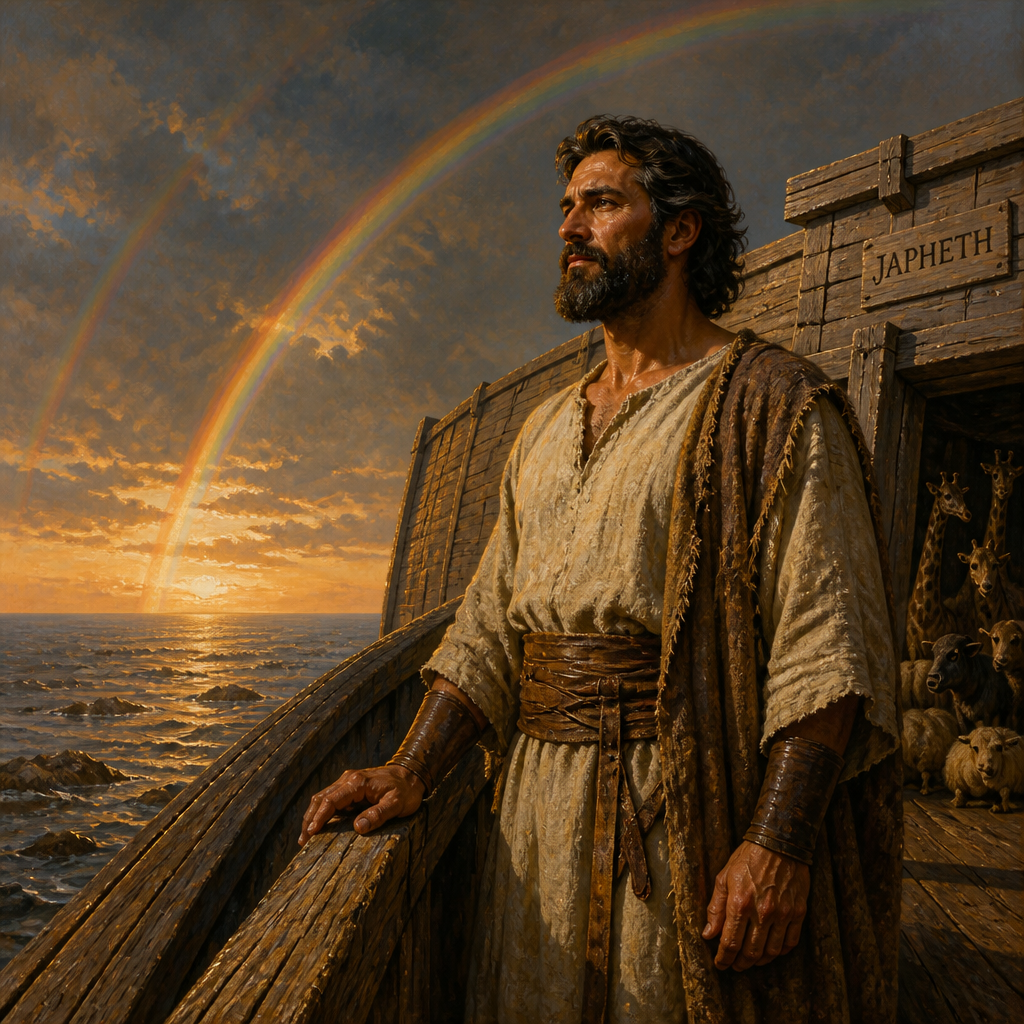
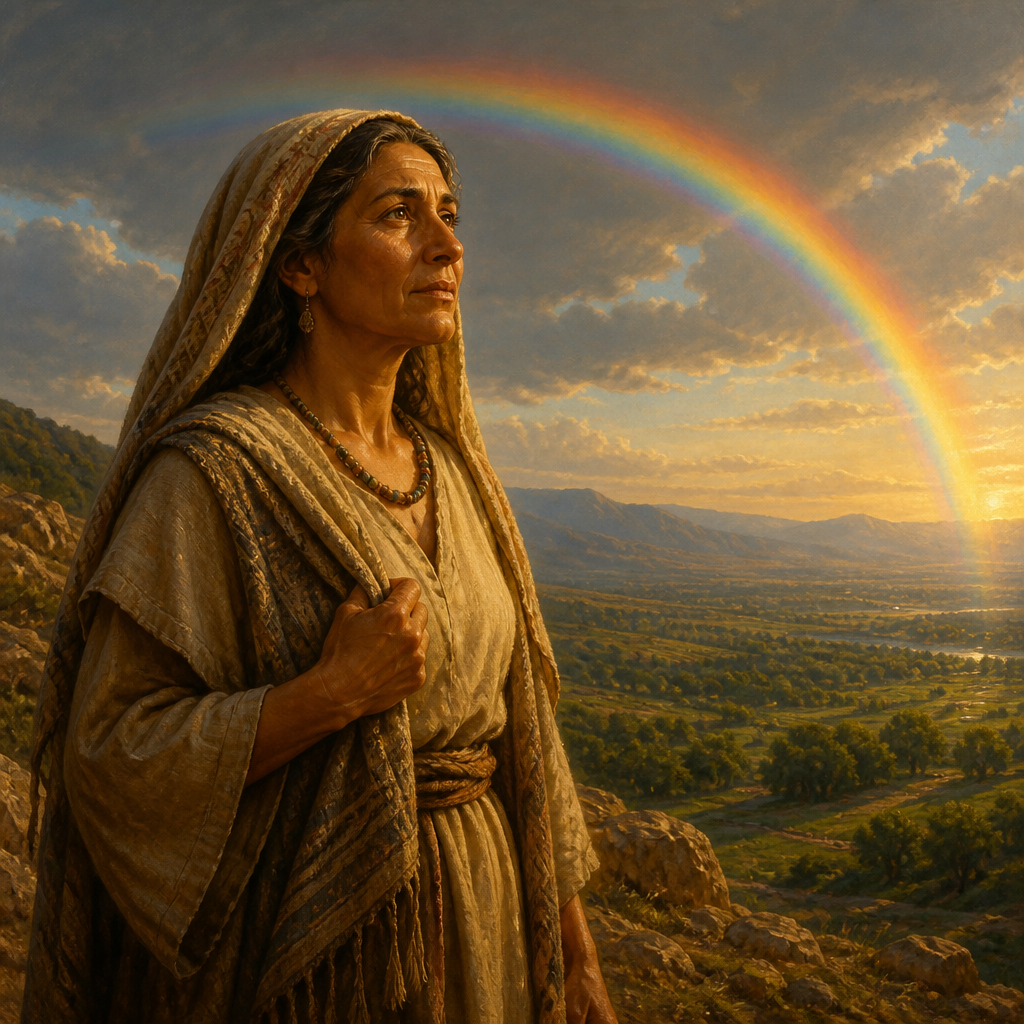
Upon exiting the Ark on Mount Ararat, she was a witness to the first sacrifice of the new world and the establishment of the Noachic Covenant, symbolized by the rainbow. Her life post-Flood was defined by the repopulation of the earth. Genesis 10:2–5 lists her sons—Gomer, Magog, Madai, Javan, Tubal, Meshech, and Tiras—who became the eponymous ancestors of the 'Isles of the Gentiles.' Her role was pivotal in the transition of humanity from a single family unit into a diverse array of linguistic and national groups spread across the northern and western regions of the known world.
Relationship to Other Biblical Figures
Japheth's wife occupied a unique position within the domestic hierarchy of the Ark survivors. She was the daughter-in-law of Noah and his wife, and a peer to the wives of Shem and Ham. The solidarity of these four women was a cornerstone of the post-Flood social structure. As the wife of Japheth, she was linked to the branch of the human family that the Bible describes as expanding primarily into the coastal and mountainous regions of Europe and Asia Minor.
Her relationship with her husband, Japheth, is often viewed through the lens of Noah’s blessing in Genesis 9:27: 'May God enlarge Japheth, and let him dwell in the tents of Shem.' This blessing of 'enlargement' directly applied to her biological role as the mother of the Japhetic line, suggesting a prolific and expansive lineage. She stood as a matriarchal figure to grandsons such as Ashkenaz, Riphath, and Togarmah, seeing her family grow into the diverse peoples that would eventually interact with the Semitic descendants in the Near East.
Spiritual Significance
In theological terms, Japheth's wife embodies the themes of preservation and providence. Her survival was not an accident of history but a result of divine grace extended to the house of Noah. In Christian typology, the Ark is often seen as a prefiguration of the Church or salvation in Christ; thus, Japheth's wife is one of the few individuals 'saved through water' (1 Peter 3:20).
Furthermore, she represents the dignity of the female role in the biblical 'creation mandate.' By participating in the renewal of the earth, she serves as a secondary 'Eve' figure. Her contribution to the 'Table of Nations' highlights the biblical view that all human ethnicities and cultures share a common ancestry and a common origin in the grace of the Flood’s aftermath. She is a reminder that the promises of God to 'be fruitful' involved the active agency and endurance of women who faced the daunting task of rebuilding civilization from the ground up.
Spiritual Significance
Japheth’s wife is significant as one of the maternal foundations of the post-Flood world. Her role in the biblical narrative emphasizes the preservation of the human race through the family unit and the fulfillment of God's command to repopulate the earth. As the mother of the Japhetic peoples, she is theologically linked to the vast expansion of nations that would eventually be brought into the covenantal history of Israel and the later Christian expansion to the Gentiles.
In the broader context of Genesis, she illustrates the concept of 'corporate salvation,' where the righteousness of a patriarch (Noah) provides a path to physical preservation for his entire household. Her presence in the Ark confirms that God’s plan for humanity's future relied on the continuation of both the male and female lines, maintaining the created order established in Eden.
Frequently Asked Questions
What was the name of Japheth's wife?
The Bible does not record her name. However, extra-biblical traditions like the Book of Jubilees refer to her as Adataneses, while other traditions suggest names like Rayne or Arisivah.
How many children did Japheth's wife have?
Genesis 10:2 names seven sons born to Japheth: Gomer, Magog, Madai, Javan, Tubal, Meshech, and Tiras. It is likely they had daughters as well, though they are not named in the text.
Where did the descendants of Japheth's wife settle?
Her descendants, known as the Japhethites, primarily settled in the 'maritime lands' or 'isles of the Gentiles,' covering areas in modern-day Europe, Asia Minor, and the Caucasus.
How long was she on the Ark?
Based on the internal chronology of Genesis 7 and 8, she was on the Ark for approximately one year and ten days.
Was she considered righteous like Noah?
While the Bible specifically praises Noah's righteousness, his entire family was spared from judgment, implying they were set apart from the corruption of the world and remained faithful to the family's mission.