Ham
The second son of Noah and an ancestor of numerous southern nations, known as one of the eight survivors of the Great Flood.
Ham is a central figure in the Genesis account of the Great Flood, identified as the second of Noah’s three sons. Along with his brothers Shem and Japheth, Ham survived the antediluvian judgment by riding within the Ark. As a primary progenitor of post-flood humanity, his lineage is traditionally associated with the peoples of Africa, the Levant, and parts of Mesopotamia.
His role in the biblical narrative is marked by both the preservation of the human race and a pivotal moment of familial discord following the flood. While he shared in the physical salvation granted to Noah’s household, his actions toward his father in a moment of vulnerability led to a lasting prophetic curse upon his son, Canaan, which serves as a significant theological and historical archetype in Hebrew scripture.
Background and Family
According to the genealogical records in Genesis 5 and 6, Ham was born to Noah after Noah had reached the age of 500. He is consistently listed second among the three brothers, following Shem and preceding Japheth. While the Bible does not name his mother, it confirms that he was married before the onset of the Great Flood. Ham and his wife were among the eight individuals—Noah, his wife, their three sons, and the three sons' wives—who were chosen by God to survive the cataclysmic judgment of the earth.
Following the exit from the Ark, Ham became the father of four sons: Cush, Mizraim, Put, and Canaan. These descendants are listed in the 'Table of Nations' (Genesis 10), which identifies them as the founders of various ethnic groups and civilizations. Specifically, his lineage is linked to the Ethiopians (Cush), the Egyptians (Mizraim), the Libyans (Put), and the inhabitants of the Levant (Canaan).
Major Life Events
The Survival of the Flood
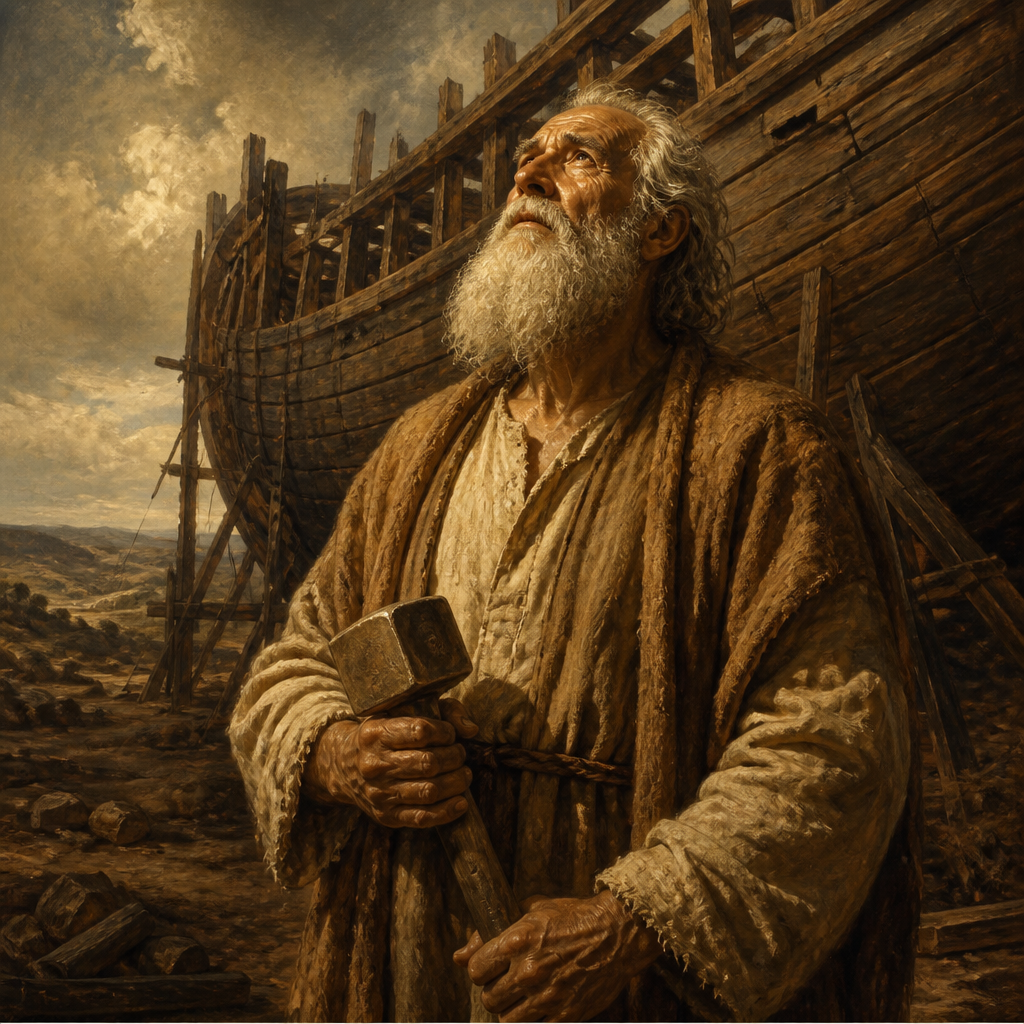
Before the flood, Ham lived in a world described as filled with violence and corruption. As part of Noah's household, Ham was involved in the decades-long preparation and construction of the Ark. His survival represents a physical salvation and the transition of humanity from the 'old world' to the 'new world.' Upon exiting the Ark on the mountains of Ararat, Ham received the same covenantal promises and commands as his father and brothers: to be fruitful, multiply, and replenish the earth.
The Incident of Noah’s Nakedness
An essential and debated episode in Ham’s life occurs in Genesis 9. Following the flood, Noah became a husbandman and planted a vineyard. After drinking wine, Noah became intoxicated and lay uncovered inside his tent. Ham entered the tent and 'saw the nakedness of his father,' and subsequently told his brothers outside. In contrast, Shem and Japheth entered the tent backward to cover their father without looking at him.
When Noah awoke and learned what had occurred, he pronounced a curse. Remarkably, the curse was directed not at Ham himself, but at Ham's youngest son, Canaan: 'Cursed be Canaan; a servant of servants shall he be unto his brethren.' This event is often interpreted by scholars as a breach of familial honor or a lack of filial piety, though some rabbinic and modern commentaries suggest deeper complexities regarding the nature of the transgression.
Relationship to Other Biblical Figures
Ham's relationship with his father, Noah, is one of the most studied dynamics in the Pentateuch. While Noah is described as 'righteous' and 'perfect in his generations,' the incident in the tent suggests a moral schism between the patriarch and his middle son. This division established a trajectory for their respective descendants.
Ham’s relationship with his brothers, Shem and Japheth, is defined by the contrast in their responses to their father’s vulnerability. This distinction creates a theological framework in which Shem is associated with the lineage of the Messiah (the Semitic people) and Japheth with the expansion of the Gentiles, while Ham's line—specifically through Canaan—is positioned in opposition to the later Israelites who would enter the Land of Promise.
Spiritual Significance
In the context of biblical history, Ham serves as a bridge between the judgment of the old world and the development of the new world’s diversity. Theologically, he represents the reality that physical salvation (surviving the flood) does not inherently equate to spiritual rectitude.
The 'Table of Nations' highlights Ham's role as the progenitor of powerful and often adversarial nations. His son Cush is the father of Nimrod, described as the first 'mighty one on the earth' and the founder of Babel. His son Mizraim is the father of the Egyptians, who would later enslave the Israelites. Thus, Ham is seen as the ancestor of the great worldly powers that often challenged the covenant people of God. Scholars emphasize that while the curse on Canaan was used historically to justify various prejudices, the biblical text limits the specific curse to the Canaanite tribes who occupied the land promised to Abraham, focusing on the geopolitical and religious conflicts of the Bronze Age.
Spiritual Significance
Ham's theological significance lies primarily in his role as a progenitor and the catalyst for the Curse of Canaan. He represents the survival of human nature—including its capacity for sin and disrespect—through the judgment of the Flood. The narrative of his actions toward his father serves to explain and justify the later dispossession of the Canaanites by the Israelites, framing the conquest of the Promised Land within a long-standing familial and prophetic context.
Furthermore, Ham is significant for the 'Table of Nations,' which provides a biblical framework for understanding the origins of global civilizations. His lineage includes the builders of the first great empires (Babel and Egypt), illustrating the rapid expansion of human culture and the inherent tension between human sovereignty and divine authority in the post-diluvian world.
Frequently Asked Questions
What does the name 'Ham' mean in Hebrew?
The name Ham (חָם) is generally understood to mean 'hot' or 'warm,' often associated with the tropical southern regions inhabited by his descendants.
Why did Noah curse Canaan instead of Ham?
Scholars offer several theories: some suggest a father is most hurt by a curse on his son; others suggest Canaan may have been a participant in the act; and most emphasize that the curse was a prophetic utility to explain the future subjugation of the Canaanite nations by Israel.
Who were Ham's four sons?
Ham's sons were Cush (ancestor of Ethiopians/Sudanese), Mizraim (ancestor of Egyptians), Put (ancestor of Libyans), and Canaan (ancestor of the Canaanites).
Was Ham the youngest son of Noah?
Genesis 9:24 refers to Ham as Noah's 'youngest' (or 'little') son, though he is traditionally listed second in the triplets Shem, Ham, and Japheth.
What is the 'Table of Nations'?
Found in Genesis 10, it is a list of 70 nations that descended from Shem, Ham, and Japheth after the Flood, establishing the biblical view of human ethnography.