Onesimus
An enslaved man who fled from his master Philemon and was later converted to Christianity by the Apostle Paul, becoming a beloved brother and ministry assistant.
Onesimus was a first-century Christian convert who lived in the Roman province of Asia. Originally an enslaved servant belonging to Philemon, a wealthy leader within the church at Colossae, Onesimus eventually fled his master's household. The circumstances of his departure suggest a potential legal or financial dispute, as the Apostle Paul implies that Onesimus may have wronged Philemon or taken something upon leaving. Following his escape, he traveled to the city where Paul was imprisoned (likely Rome, though some scholars suggest Ephesus or Caesarea), where he encountered the Gospel and underwent a profound spiritual transformation.
His story is the primary focus of the Epistle to Philemon, one of Paul’s most personal letters. In it, Paul advocates for the reconciliation of Onesimus and Philemon, urging the latter to receive his former servant not as a runaway slave, but as a beloved brother in Christ. Beyond the letter to Philemon, Onesimus is mentioned in the Epistle to the Colossians, indicating that he returned to his home region as a recognized and trusted messenger of the early Church in the mid-1st century AD.
Background and Family
Historically, the name 'Onesimus' was common among the enslaved populations of the Greco-Roman world, derived from the Greek word onesimos, meaning 'useful' or 'profitable.' While the Bible providing no details regarding his parentage or place of birth, he was legally considered the property of Philemon, a prominent member of the Colossian community. Philemon’s household was significant enough to host a local church congregation, suggesting that Onesimus grew up or lived in a high-status environment, albeit within the constraints of servitude.
The sociological context of Onesimus is vital for understanding his narrative. In the Roman Empire of the 1st century AD, runaway slaves (fugitivi) faced severe legal consequences, ranging from branding to execution. Whether Onesimus fled due to mistreatment or a specific grievance is not explicitly stated, but Paul’s mention in Philemon 1:18 that he might 'owe' something suggests a financial loss incurred by Philemon upon Onesimus' departure.
Major Life Events
The turning point in the life of Onesimus occurred during his time as a fugitive. By providence or intentional search, he encountered the Apostle Paul, who was then in 'chains'—likely during his first Roman imprisonment (c. 60–62 AD). Under Paul’s mentorship, Onesimus converted to Christianity. Paul famously describes him as 'my son, whom I have begotten while in my chains' (Philemon 1:10).
Following his conversion, Onesimus became an invaluable assistant to Paul. The Apostle noted that while the man had previously been 'useless' to Philemon (a play on his name), he had now become truly 'useful' to both Paul and Philemon. Despite his desire to keep Onesimus by his side for ministry, Paul recognized the legal and moral necessity of social reconciliation. He sent Onesimus back to Colossae in the company of Tychicus, bearing two letters: the Epistle to the Colossians and the personal plea to Philemon.
Relationship to Other Biblical Figures
Onesimus’ relationships define his biblical narrative. His relationship with Philemon was transformed from that of master-and-slave to that of brothers in a common faith. Paul’s letter serves as a legal and spiritual mediation, where Paul offers to personally repay any debts Onesimus owed, mirroring the concept of substitutionary atonement.
With the Apostle Paul, Onesimus shared a deep paternal-filial bond. Paul’s advocacy for him was absolute, calling him a 'faithful and beloved brother, who is one of you' (Colossians 4:9). This public endorsement in the letter to the Colossians ensured that the church would view Onesimus as a peer and a minister rather than a criminal. Furthermore, he worked alongside Tychicus, a seasoned envoy of Paul, demonstrating his rapid growth in leadership and responsibility within the apostolic circle.
Spiritual Significance
The story of Onesimus serves as one of the most poignant illustrations of the Gospel’s power to dismantle social barriers. In a Roman society built on rigid hierarchies, the assertion that an enslaved runaway could be the spiritual equal of a wealthy householder was revolutionary.
Theologically, Onesimus represents the 'redeemed' individual. His journey—f fleeing authority, incurring debt, being found by a mediator, and being returned with grace—parallels the Christian understanding of salvation. Paul’s intercession for Onesimus ('If he has wronged you at all, or owes you anything, charge that to my account') is frequently cited by scholars as a type of the intercession of Christ for the sinner.
Furthermore, the inclusion of the letter to Philemon in the New Testament canon highlights the primitive church’s handling of the institution of slavery. While Paul does not issue a political decree for the abolition of slavery, he introduces a new ethic—the brotherhood of believers—that rendered the foundations of the institution untenable. By calling Philemon to receive Onesimus 'no longer as a slave but more than a slave, a beloved brother,' Paul fundamentally redefined human value based on spiritual identity rather than legal status.
Spiritual Significance
Onesimus is a living testimony to the transformative power of the Gospel to transcend socio-economic and legal barriers in the 1st century AD. His inclusion in the New Testament highlights the early Church's emphasis on reconciliation and grace, demonstrating that in Christ, the distinctions between slave and free are abolished in favor of a new identity as siblings in faith.
Theologically, his story provides a practical application of the doctrine of imputation and mediation. The Apostle Paul’s willingness to take Onesimus’ debt upon himself serves as a powerful metaphor for the work of Christ. Furthermore, as a minister traveling with Tychicus, Onesimus proves that past failures and legal status do not disqualify an individual from high-level service in the Kingdom of God.
Frequently Asked Questions
What does the name 'Onesimus' mean?
The name is Greek for 'useful' or 'profitable.' Paul makes a pun on this name in Philemon 1:11, noting that he was once 'useless' but had become 'useful' through his conversion.
Why did Onesimus run away from Philemon?
The Bible does not state the specific reason, but Paul’s mention of potential debts or wrongs (Philemon 1:18) suggests a conflict or theft may have occurred at the time of his departure.
Was Onesimus punished when he returned to Colossae?
The Bible does not record the outcome, but the preservation of the letter to Philemon in the New Testament suggests that Philemon granted Paul’s request and received Onesimus with grace.
Did Onesimus become a church leader?
While the Bible only describes him as a 'faithful and beloved brother' and messenger, early Christian tradition (such as the writings of Ignatius of Antioch) suggests an Onesimus became the Bishop of Ephesus, though scholars debate if this is the same man.
In which books of the Bible is Onesimus mentioned?
He is mentioned in the Epistle to Philemon and the Epistle to the Colossians (Chapter 4).
Connected Figures
Paul the Apostle
Spiritual father and advocate
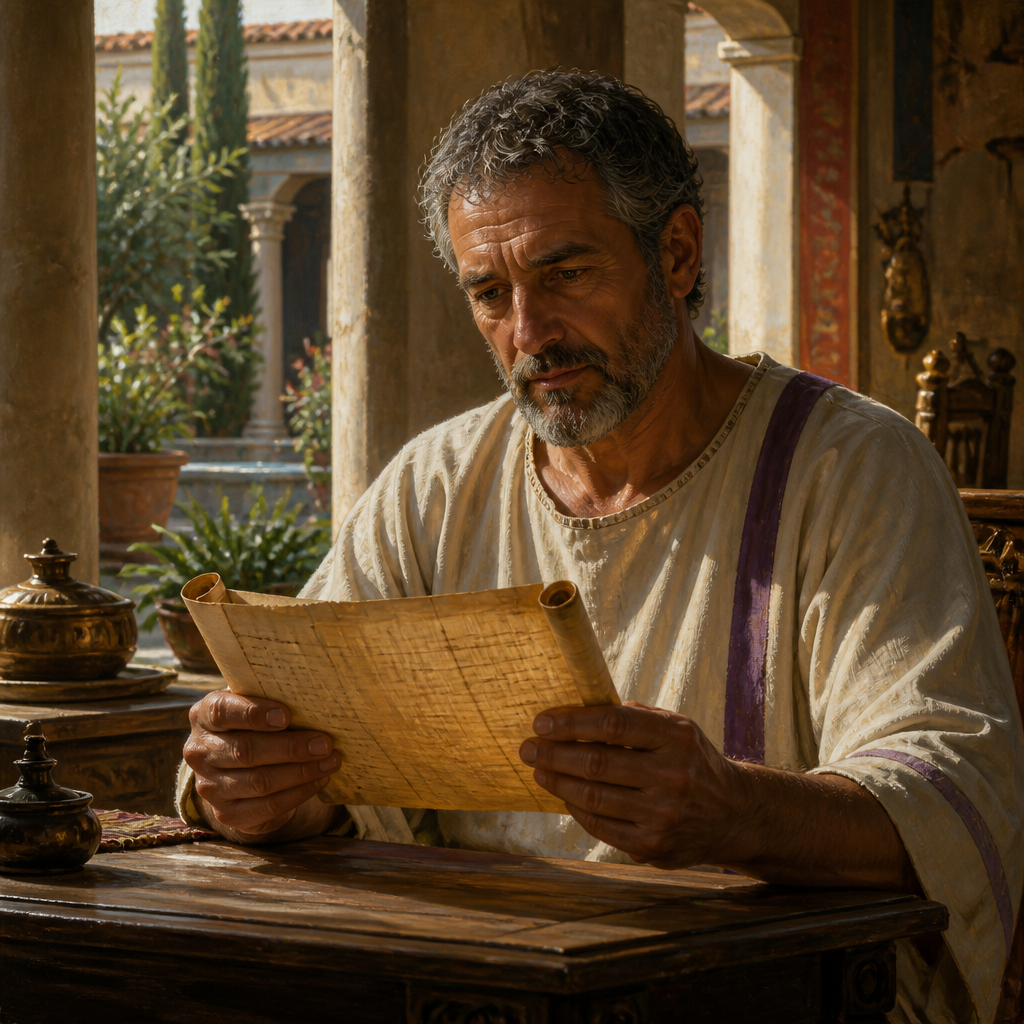
Philemon
Master and fellow Christian

Tychicus
Ministry companion and fellow messenger

Apphia
Member of the household (likely Philemon's wife)