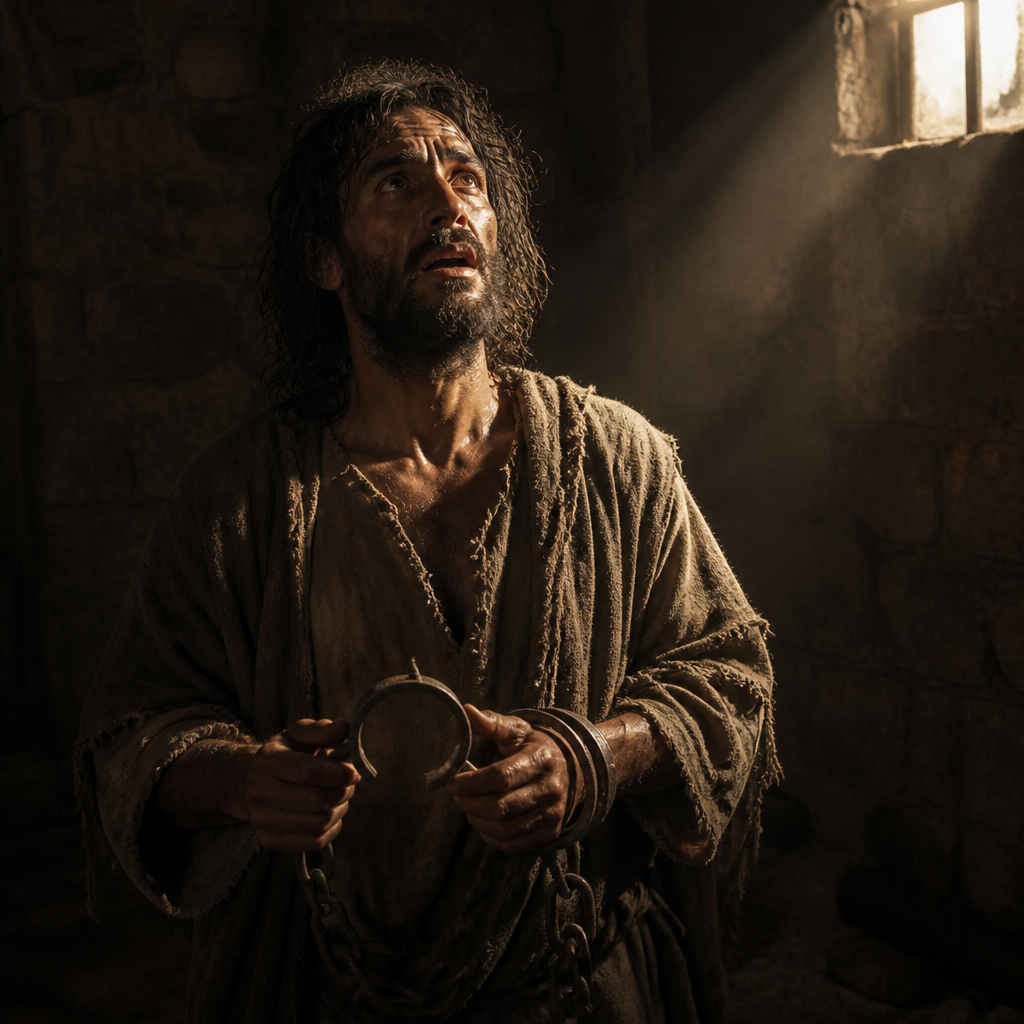
Pontius Pilate
The fifth Roman prefect of the province of Judaea, serving under Emperor Tiberius, best known for presiding over the trial of Jesus and ordering his crucifixion.
Pontius Pilate was the Roman governor of Judaea from approximately 26 to 36 AD. Appointed by the Emperor Tiberius, Pilate held the power of 'ius gladii' (the law of the sword), granting him the supreme authority to execute capital punishment within his jurisdiction. Historically and biblically, he represents the intersection of Roman imperial power and Jewish religious law during a period of intense political and social volatility.
In the New Testament, Pilate is a central figure in the Passion narratives across all four Gospels. His role is characterized by a complex struggle between his administrative duty to maintain order, his legal conviction that Jesus was innocent of sedition, and the political pressure exerted by the Jewish leadership and the Jerusalem crowds. His decision to wash his hands of Jesus' blood remains one of the most enduring symbols of judicial abdication in Western history.
Background and Family
Little is known of Pontius Pilate’s life prior to his appointment as prefect. His nomen, Pontius, suggests he may have descended from the Pontii family of Samnite origin, a fierce Italian people eventually absorbed into Rome. His cognomen, Pilatus, is of uncertain origin but may derive from the Latin pilatus (armed with a javelin) or pilleatus (wearing the felt cap of a freedman). Unlike later Roman governors who held the title of 'procurator,' Pilate was a 'prefect' (praefectus), a military rank typically held by members of the equestrian order.
Pilate’s wife is mentioned briefly in the Gospel of Matthew (27:19). Though the Bible does not name her, later Christian tradition identifies her as Claudia Procula. During the trial of Jesus, she famously sent a message to Pilate advising him to 'have nothing to do with that innocent man,' citing a disturbing dream she had suffered because of him. This detail highlights the domestic pressure Pilate faced alongside his public political crisis.
Major Life Events
Pilate’s tenure in Judaea was marked by persistent friction with his subjects. Secular historians such as Josephus and Philo describe him as stubborn and rigid. Notable conflicts included his attempt to bring Roman standards (bearing the image of Caesar) into Jerusalem and his use of Temple funds to build an aqueduct, both of which sparked significant Jewish protests.
The defining moment of Pilate’s career, however, was the trial of Jesus of Nazareth. According to the Gospels, Jesus was brought to Pilate by the Sanhedrin on charges of perverting the nation, forbidding the payment of taxes to Caesar, and claiming to be a king. Pilate’s examination of Jesus—notably his philosophical query, 'What is truth?' (John 18:38)—revealed his belief that Jesus posed no actual military or political threat to Rome.
Attempting to release Jesus, Pilate employed several strategies: he sent Jesus to Herod Antipas, he offered to release a prisoner (Barabbas) according to a Passover custom, and he had Jesus scourged in hopes of satisfying the crowd’s bloodlust with a lesser punishment. Ultimately, when the crowd suggested that releasing Jesus would make Pilate 'no friend of Caesar,' Pilate succumbed to the pressure. He publicly washed his hands to symbolize his innocence in the matter and ordered the crucifixion.
Relationship to Other Biblical Figures
Pilate’s primary interactions in the biblical text are with Jesus, the high priest Caiaphas, and Herod Antipas. His relationship with Caiaphas was one of cautious cooperation; both leaders needed to maintain the Pax Romana to keep their positions. While they were often at odds, the trial of Jesus saw them aligned in an uneasy alliance to remove a perceived agitator.
Interestingly, the Gospel of Luke notes that Pilate and Herod Antipas had been enemies, but they became friends on the day of Jesus’ trial. Additionally, Pilate interacted with Joseph of Arimathea, a member of the council who requested Jesus’ body for burial. Pilate expressed surprise that Jesus had died so quickly and granted the request only after confirmation from a centurion.
Spiritual Significance
Theologically, Pontius Pilate serves as a witness to the innocence of Christ. Three times in the Gospel of John, Pilate declares, 'I find no guilt in him.' This judicial declaration serves a greater purpose in the narrative, establishing Jesus not as a criminal, but as the spotless 'Lamb of God' who dies for the sins of others.
Pilate also embodies the tragedy of moral compromise. He is portrayed as a man who recognizes the truth but lacks the courage to act upon it, choosing political expediency over justice. The inclusion of his name in the Apostles' Creed ('suffered under Pontius Pilate') serves a twofold purpose: it anchors the crucifixion in a specific historical moment and highlights the worldly authority that stood in opposition to the Kingdom of God. In his confrontation with Jesus, the roles are ironically reversed; while Pilate believes he holds the power of life and death, Jesus informs him, 'You would have no authority over me at all unless it had been given you from above' (John 19:11).
Spiritual Significance
Pontius Pilate occupies a unique theological space as the pagan official who legally validated the crucifixion of Jesus while simultaneously testifying to His innocence. His role demonstrates the sovereignty of God over secular history, as his political vacillation directly led to the fulfillment of messianic prophecies regarding the Messiah's suffering.
Furthermore, Pilate represents the prototypical 'man of the world' confronted by the 'King of Truth.' His internal conflict and ultimate failure to protect the innocent provide a sober warning regarding the dangers of moral relativism and the soul's response to the presence of the Divine. By appearing in the universal creeds of the Church, Pilate remains a permanent witness to the historicity of Jesus' death.
Frequently Asked Questions
Did Pontius Pilate actually exist?
Yes. Beyond the biblical record, his existence is confirmed by contemporary historians like Josephus and Philo, as well as the 'Pilate Stone' discovered in Caesarea in 1961, which bears his name and title.
Why did Pilate wash his hands during the trial?
Washing his hands was a symbolic gesture intended to show the Jewish leaders and the crowd that he refused to take moral responsibility for the execution of Jesus, whom he believed to be innocent.
What happened to Pilate after the Bible?
According to the historian Josephus, Pilate was recalled to Rome in 36 AD after losing his temper and violently suppressing a Samaritan uprising. His subsequent fate is unknown, though various legends suggest he either committed suicide or converted to Christianity.
Who was Pilate's wife?
She is mentioned in Matthew 27:19 as having a dream about Jesus and warning her husband not to condemn him. Tradition often names her as Claudia Procula, and she is even venerated as a saint in the Eastern Orthodox and Ethiopian Orthodox churches.
What does 'Ecce Homo' mean?
Latin for 'Behold the man,' these are the words Pilate spoke (John 19:5) when he presented a scourged and thorn-crowned Jesus to the crowd.