The Ephesians Who Confessed Their Practices
A group of early Christian converts in Ephesus who publicly renounced their involvement in the occult by burning high-value magical scrolls.
The Ephesians who confessed their practices represent a specific group of early converts within the multi-ethnic and spiritually pluralistic city of Ephesus during the mid-1st century AD. Their actions, recorded in the Book of Acts, serves as a pivotal moment in the narrative of the Apostle Paul’s third missionary journey. These individuals were former practitioners of 'curious arts'—a term referring to the pervasive Hellenistic and Near Eastern magical traditions for which Ephesus was particularly famous throughout the Roman Empire.
Their conversion is marked by a dramatic public demonstration of repentance that remains one of the most significant recorded instances of mass renunciation of paganism in the New Testament. In response to a failed exorcism by the sons of Sceva, fear fell upon the community, leading these believers to openly confess their previous deeds. By voluntarily burning their expensive scrolls of incantations, they signaled a complete break from their occult past and a total devotion to the Christian faith.
Background and Family
The individuals known as the Ephesians who confessed their practices were residents of Ephesus, the provincial capital of Roman Asia. In the 1st century AD, Ephesus was a thriving commercial hub and the site of the Temple of Artemis, one of the Seven Wonders of the Ancient World. No specific family names are recorded for these individuals, but they likely represented a cross-section of the city’s population, which included Greeks, Romans, and Hellenized Jews.
Before their conversion, these individuals were immersed in a culture dominated by the "Ephesia Grammata" (Ephesian Letters)—six magical syllables believed to possess great power. Magic was not merely a peripheral hobby in Ephesus; it was a major industry and a core aspect of daily life, used for everything from protection and healing to competitive advantages in business. The biblical text refers to their former trade as "curious arts" (Acts 19:19), suggesting they were professional or semi-professional practitioners of sorcery, divination, and the casting of spells.
Major Life Events
The primary event involving this group occurred during the Apostle Paul’s two-year stay in Ephesus (c. 52–54 AD). This period was defined by remarkable miracles performed through Paul, such that even handkerchiefs touched by him would heal the sick. In an attempt to replicate this power, seven sons of a Jewish chief priest named Sceva tried to invoke the name of Jesus to exorcise an evil spirit. The spirit’s violent refusal to obey them—stating, "Jesus I know, and Paul I know; but who are ye?"—sent shockwaves through the Ephesian community.
As news of this event spread, "fear fell on them all" (Acts 19:17). Those who had already believed but had perhaps secretly maintained their involvement in magical arts were moved to action. They did not merely stop their practices; they came forward to "confess and shew their deeds."
This confession culminated in a massive public bonfire. The converts brought their books of enchantments and burned them in the sight of all. The text notes the economic scale of this sacrifice: the value of the scrolls totaled fifty thousand pieces of silver. In the Roman economy of the day, a single piece of silver (a drachma or denarius) was roughly equivalent to a day's wage for a common laborer. This represents approximately 137 years’ worth of wages, underscoring the sincerity and the heavy cost of their repentance.
Relationship to Other Biblical Figures
This group’s transformation is intrinsically linked to the ministry of the Apostle Paul. Paul’s teaching in the synagogue and the school of Tyrannus provided the theological foundation that eventually led to this mass renunciation. While Paul did not command the burning of the books, his presence and the power associated with his ministry created the environment where such a radical break from the past was possible.
They also stand in stark contrast to the Seven Sons of Sceva. While the sons of Sceva attempted to use the name of Jesus as a magical formula for personal gain, the Ephesian converts recognized the name of Jesus as a holy authority that demanded the destruction of their magical tools. Furthermore, their actions were the catalyst that eventually drew the ire of Demetrius the Silversmith, who feared that the growth of the Christian movement would bankrupt the local trade related to the Temple of Artemis.
Spiritual Significance
In biblical scholarship, the Ephesians who confessed their practices serve as the definitive example of "complete repentance." Their actions demonstrate that true conversion often requires the physical and financial destruction of things that formerly held spiritual power over the individual. They illustrate the transition from a worldview of manipulation (magic) to one of submission (faith).
"Many that believed came, and confessed, and shewed their deeds. Many of them also which used curious arts brought their books together, and burned them before all men: and they counted the price of them, and found it fifty thousand pieces of silver. So mightily grew the word of God and prevailed." (Acts 19:18-20, KJV)
Theologically, this event highlights the victory of the Gospel over the "powers and principalities" mentioned in Paul’s later Epistle to the Ephesians. By burning their books, they were effectively "putting off the old man" and rejecting the syncretism that plagued many early Christian communities. Their sacrifice is presented as the reason why the "word of God grew mightily and prevailed."
Spiritual Significance
The Ephesians who confessed their practices are significant because they represent the first major recorded instance of a Christian community corporately renouncing the occult. Their actions established a precedent for the exclusivity of Christian worship, asserting that the power of Christ cannot coexist with magical or pagan practices. This event is often cited in discussions regarding social justice and economic ethics, as the converts prioritized spiritual integrity over significant material wealth.
Furthermore, this narrative serves as a historical bridge to the Epistle to the Ephesians. The spiritual warfare themes found in Ephesians 6 (the Armor of God) take on a deeper resonance when viewed through the lens of this group’s history. Having once relied on magical scrolls for protection, they learned to rely on spiritual armor provided by God, marking a shift from human-controlled magic to divine-provided grace.
Frequently Asked Questions
How much was 50,000 pieces of silver worth in today's money?
While modern equivalents vary, if one piece of silver was a day's wage, 50,000 pieces represents about 137 years of labor. In modern US terms (at $15/hr), this would exceed $16 million, though historians focus more on the staggering relative value in the ancient economy.
What kind of 'magic' were these Ephesians practicing?
They practiced 'curious arts,' likely involving the 'Ephesian Letters.' This included written amulets, curse tablets, and incantations intended to influence gods or spirits for personal benefit or protection.
Did the Apostle Paul force them to burn their books?
No. The biblical text indicates the converts did this voluntarily. Paul’s success in preaching caused a fear of God to fall on the people, leading them to confess and burn their books of their own accord.
Why did they burn the books instead of selling them?
Selling the books would have allowed the harmful magical practices to continue in the hands of others. By burning them, they ensured the 'evil' content was completely removed from the world, signifying the finality of their repentance.
Were these people Jews or Gentiles?
The group likely included both. Ephesus had a large Jewish population (like the sons of Sceva) and a pagan majority. The text says fear fell on both 'Jews and Greeks' (Acts 19:17), suggesting people from both backgrounds confessed their practice of magic.
Connected Figures
Paul the Apostle
Spiritual mentor and teacher
Sons of Sceva
Catalysts whose failure prompted the group's confession
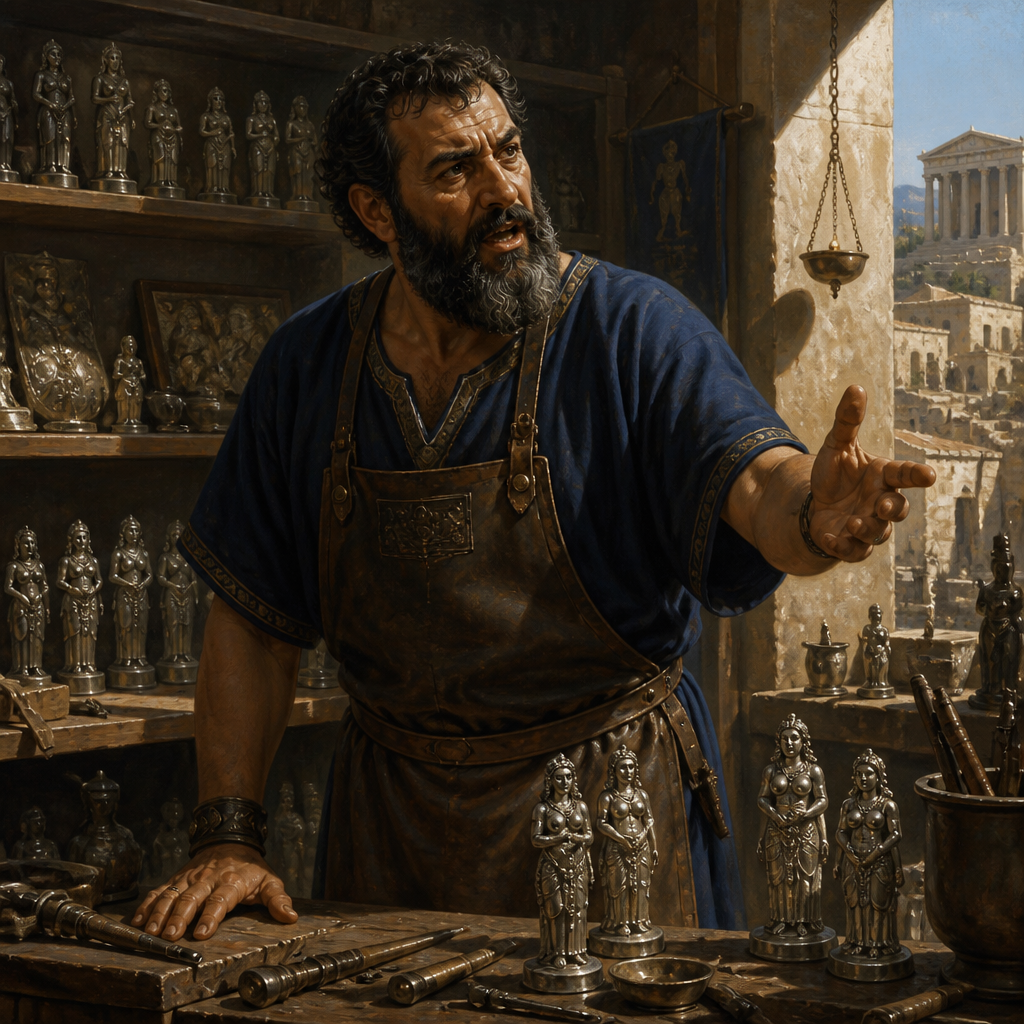
Demetrius the Silversmith
Local antagonist who opposed the economic impact of their conversion
Artemis
Goddess whose followers were converted by this movement