Nicodemus
A prominent member of the Sanhedrin and a Pharisee who transitioned from a cautious inquirer of Jesus to a courageous disciple following the crucifixion.
Nicodemus was a significant figure in the New Testament, notably appearing in the Gospel of John as a 'ruler of the Jews.' As a member of the Sanhedrin—the supreme judicial and religious council in Roman Judea—he occupied a position of immense social and religious prestige. His initial approach to Jesus was marked by academic curiosity tempered by political caution, as evidenced by his decision to seek out the Galilean teacher under the cover of darkness.
Throughout the narrative of the Fourth Gospel, Nicodemus serves as a literary and spiritual bridge between the rigid legalism of the Pharisaic establishment and the transformative message of Christ. His progression from a man of nighttime questions to a man of daytime action—openly tending to the body of the executed Jesus—provides a profound study in the gradual nature of faith and the cost of discipleship among the ruling elite of the 1st century AD.
Background and Family
Nicodemus was a Pharisee, a member of the sect known for its rigorous adherence to both the written Mosaic Law and the oral traditions. The Gospel of John further identifies him as an archōn, or a 'ruler of the Jews' (John 3:1), which signifies his membership in the Sanhedrin. While the biblical text does not provide specific genealogical details regarding his father or tribe, his status implies he was a man of substantial wealth and education. The name Nicodemus is Greek in origin ('Victor over the people'), which was not uncommon among the Jewish aristocracy during the Roman occupation.
In the sociocultural context of Jerusalem in the 1st century AD, a man in Nicodemus's position would have been expected to maintain a strict separation from 'heretical' movements or uneducated Galilean preachers. His education would have included deep mastery of the Torah and Rabbinic exegesis. Scholars often link the biblical Nicodemus with the 'Naqdimon ben Gurion' mentioned in the Talmud, a man noted for his great wealth and piety in Jerusalem, though this identification remains a matter of historical debate.
Major Life Events
The Night Visit
The most famous incident in Nicodemus’s life is his initial meeting with Jesus in Jerusalem (John 3). Approaching Jesus by night—likely to protect his reputation or to ensure an uninterrupted scholarly dialogue—Nicodemus acknowledged Jesus as a 'teacher come from God' based on the signs being performed. During this encounter, Jesus introduced the concept of being 'born again' (anōthen). Nicodemus’s literalist response—'How can a man be born when he is old?'—illustrated the difficulty the religious establishment had in grasping the spiritual, metaphorical nature of Jesus’s kingdom. This conversation contains the seminal verse John 3:16, central to Christian soteriology.
The Defense in the Sanhedrin
Nicodemus appears again in John 7:45-52 during a meeting of the chief priests and Pharisees. When the council sought to arrest Jesus without a formal hearing, Nicodemus stood as a voice of legal reason, reminding his colleagues of the demands of the Law: 'Does our law judge a man before it hears him and knows what he is doing?' His defense was met with scorn from his peers, who questioned his origins and loyalty, yet his intervention momentarily stalled the efforts to silence Jesus.
The Burial of Jesus
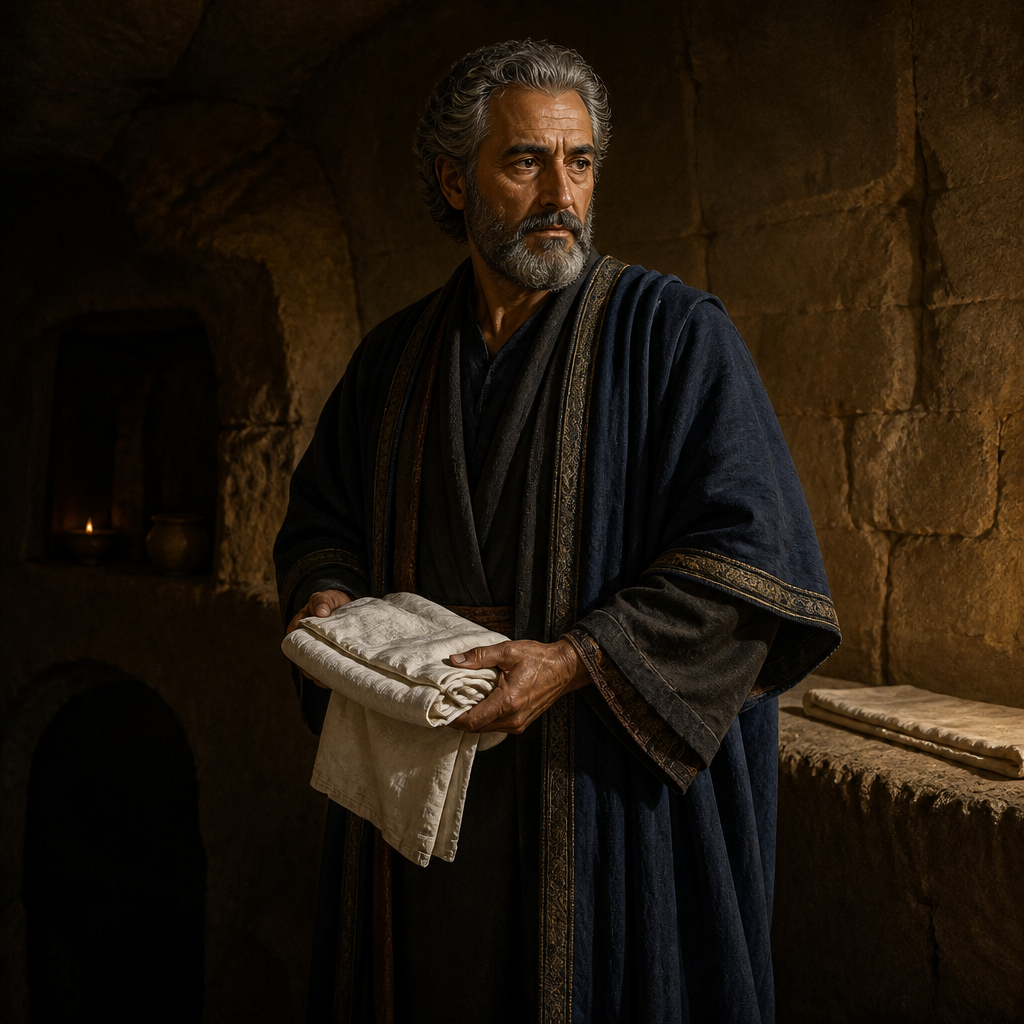
The final and most definitive appearance of Nicodemus occurs after the crucifixion (John 19:38-42). Moving from the shadows of the night and the halls of the council, he joined Joseph of Arimathea in claiming the body of Jesus. Nicodemus brought a lavish amount of burial spices—about a hundred pounds of myrrh and aloes. This act was not only one of deep devotion but also of significant political risk and staggering expense; such a quantity of spices was typically reserved for the funerals of royalty. By preparing Jesus for burial in a public manner, Nicodemus effectively signaled his break with the Sanhedrin’s majority and his alignment with the crucified Christ.
Relationship to Other Biblical Figures
Nicodemus is inextricably linked to Joseph of Arimathea. Both were wealthy men of status who were 'secret disciples' for fear of the Jewish authorities. Their partnership in the burial of Jesus provides a counter-narrative to the hostility of the religious leaders. Nicodemus’s relationship with Jesus began as a student-teacher dynamic but evolved into a commitment that transcended the risks of ritual defilement and social excommunication. Unlike the Twelve Apostles, who largely scattered during the passion, Nicodemus and Joseph remained present to perform the final acts of mercy.
Spiritual Significance
Theologically, Nicodemus represents the 'honest seeker' within a hostile system. His journey mirrors the process of spiritual awakening: from intellectual acknowledgement ('We know you are a teacher') to legal defense, and finally to sacrificial devotion. The 'hundred pounds' of spices he brought serves as a symbol of the 'kingly' burial he believed Jesus deserved, reflecting a realization of Christ’s true identity. In Christian tradition, he is often viewed as a patron of those who struggle to reconcile their professional or social status with the radical demands of faith. His life stands as a testament that the grace of 'being born again' is available even to those entrenched in the most rigid of religious and political structures.
Spiritual Significance
Nicodemus serves as the primary audience for Jesus’s most famous discourse on the necessity of spiritual rebirth. His presence in the Gospel of John highlights the internal diversity of the Pharisaic movement, proving that not all religious leaders were monolithic in their opposition to Jesus.
Furthermore, his act of bringing an extravagant amount of burial spices (John 19:39) fulfills a symbolic role, treating the crucified Jesus as a royal figure. This transition from a fearful, nighttime inquirer to a bold, daytime witness provides a template for the transformative power of Christ’s message on the intellectual and social elite, emphasizing that the gospel penetrates even the highest levels of society.
Frequently Asked Questions
Why did Nicodemus visit Jesus at night?
While the Bible does not explicitly state the reason, most scholars believe he chose the night to avoid the scrutiny of his fellow Pharisees and members of the Sanhedrin, or to have a private, uninterrupted philosophical discussion.
Was Nicodemus a secret disciple?
Yes, for a time. John 19:38-39 implies that like Joseph of Arimathea, he was a disciple who had previously kept his allegiance hidden for fear of the Jewish leaders.
What does the name Nicodemus mean?
The name is Greek (Nikodēmos) and means 'victor over the people' or 'conqueror of the people.'
Did Nicodemus become a Christian?
While the New Testament does not describe his life after the burial of Jesus, church tradition and the apocryphal 'Gospel of Nicodemus' suggest he was later baptized and persecuted for his faith.
What was the significance of the 100 pounds of spices Nicodemus brought?
This quantity (roughly 75 modern lbs or 33 kg) was exceptionally large and expensive. It was a royal amount, signaling that Nicodemus viewed Jesus as a King, even in death.
Connected Figures
Jesus Christ
Teacher and Savior
Joseph of Arimathea
Ally in the burial of Jesus
Gamaliel
Contemporary member of the Sanhedrin