Achaicus
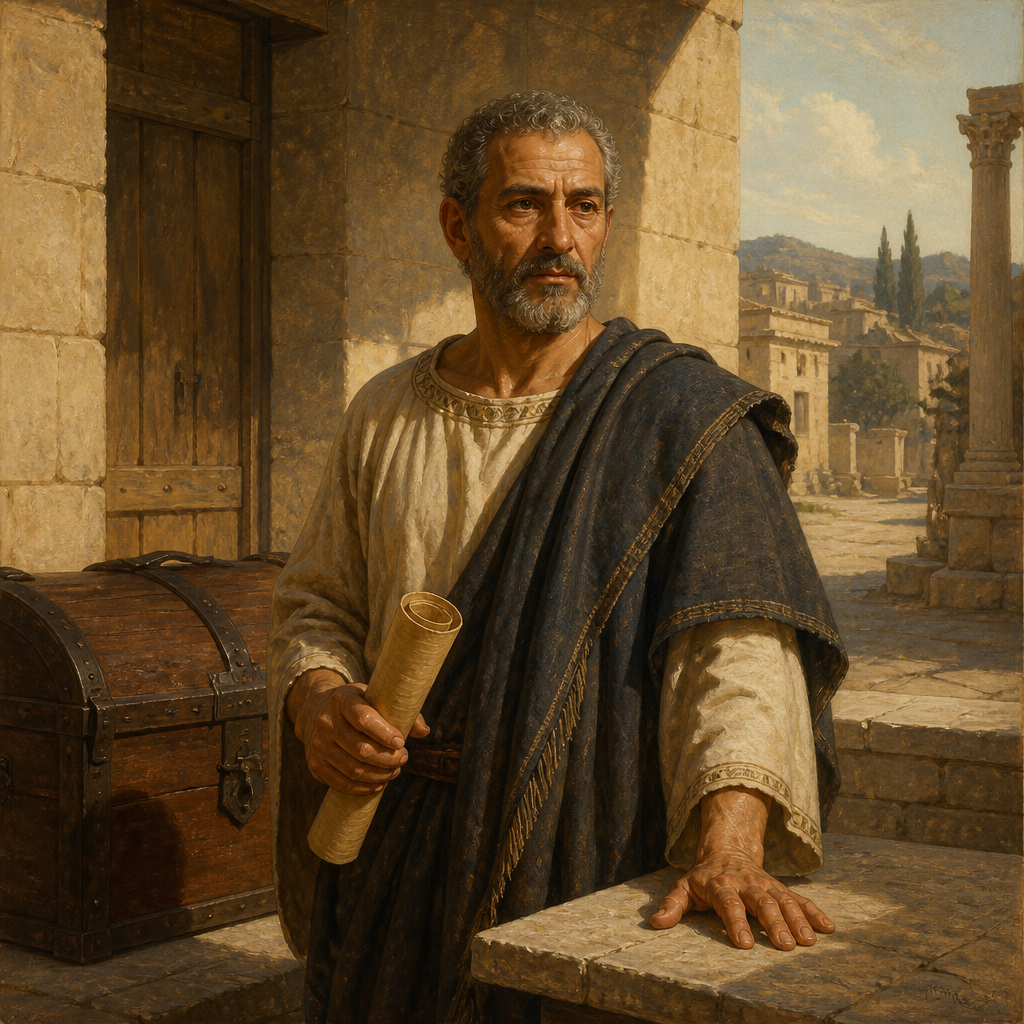
A 1st-century Christian leader from Corinth who, along with Stephanas and Fortunatus, represented the Corinthian church to the Apostle Paul in Ephesus.
Achaicus was a prominent member of the early Christian community in Corinth during the mid-1st century AD. He is mentioned specifically in the closing remarks of the Apostle Paul’s first epistle to the Corinthians. His name, which literally means 'belonging to Achaia,' suggests he may have been of Greek origin or perhaps a freedman associated with the Roman province of Achaia, of which Corinth was the capital city.
Along with two other men, Stephanas and Fortunatus, Achaicus traveled from Corinth to Ephesus to meet with Paul during his three-year ministry there. This delegation played a critical role in the communication between the struggling Corinthian church and the Apostle, providing Paul with first-hand accounts of the situation in the city and likely delivering the letter of inquiry that prompted many of the instructions found in 1 Corinthians.
Background and Family
The precise social standing of Achaicus is not explicitly detailed in the New Testament, but scholars draw several inferences from his name and associations. The name 'Achaicus' was common among slaves and freedmen within the Roman Empire, often denoting a connection to the geographic region of Achaia. Given that he traveled as part of a delegation alongside Stephanas—whose household Paul describes as the 'firstfruits of Achaia' (1 Corinthians 16:15)—it is highly probable that Achaicus was either a member of Stephanas’s large household or a trusted leader within the local congregation. The fact that he was able to undertake the journey from Corinth to Ephesus implies he possessed the means, time, and autonomy to serve the church at his own expense or via the support of the community.
Major Life Events
The primary historical record of Achaicus occurs in 1 Corinthians 16:17. During a period of significant turmoil in the Corinthian church—characterized by factionalism, moral lapses, and doctrinal confusion—Achaicus, Stephanas, and Fortunatus arrived in Ephesus. Their arrival provided Paul with what he described as a 'refreshing' of his spirit.
I am glad of the coming of Stephanas and Fortunatus and Achaicus: for that which was lacking on your part they have supplied. For they have refreshed my spirit and yours: therefore acknowledge ye them that are such. (1 Corinthians 16:17-18, KJV)
This visit was more than a social call; it was a diplomatic and spiritual bridge. The Corinthian church was plagued by divisions, with different groups claiming loyalty to Paul, Apollos, or Cephas. By sending a representative delegation that included Achaicus, the church maintained its link to apostolic authority. Achaicus and his companions likely brought the letter mentioned in 1 Corinthians 7:1, in which the Corinthians asked Paul specific questions about marriage, food sacrificed to idols, and spiritual gifts.
Relationship to Other Biblical Figures
Achaicus is intrinsically linked to the Apostle Paul and the two other delegates, Stephanas and Fortunatus. While Fortunatus and Achaicus are mentioned only once together, Stephanas is noted as the head of a household that Paul personally baptized (1 Corinthians 1:16). This places Achaicus in the inner circle of the early Achaian converts.
Paul’s exhortation to the church to 'acknowledge ye them that are such' suggests that Achaicus and his companions were not always given the respect their service deserved by the more rowdy factions in Corinth. Paul’s endorsement serves as a formal commendation, identifying Achaicus as a reliable witness and a faithful servant of the gospel. He acted as an intermediary, carrying Paul's stern but loving corrections back to the Greek mainland.
Spiritual Significance
The spiritual significance of Achaicus lies in his role as a 'refresher' of the ministry. Paul specifically notes that Achaicus supplied 'that which was lacking.' This lack was not necessarily financial, but rather the absence of the physical presence and personal affection of the Corinthian believers. In a ministry often defined by hardship, betrayal, and isolation, Achaicus represented the segment of the church that remained devoted to the apostolic mission.
Furthermore, Achaicus serves as a model for the support roles within the early church. While he was not a writer of scripture or a widely known apostle, his willingness to travel hazardous sea routes to facilitate communication was vital for the unity of the Body of Christ. He exemplifies the biblical principle that every member of the church, regardless of how 'minor' their mention in the text, plays a crucial role in the preservation of sound doctrine and the encouragement of leadership.
Spiritual Significance
Achaicus is significant as a representative of the early Gentile church who prioritized corporate unity and apostolic connection. His presence in Ephesus provided Paul with a tangible link to the Corinthian believers, allowing the Apostle to address specific congregational issues with both clarity and renewed energy. He represents the unsung laborers who facilitated the spread of the New Testament epistles.
Theologically, the mention of Achaicus underscores the Pauline theme of mutual refreshment within the body of Christ. His service emphasizes that 'the supply of the saints' includes emotional and spiritual support, which is essential for those in leadership positions. Achaicus stands as a historical witness to the collaborative nature of the first-century missionary movement.
Frequently Asked Questions
Where is Achaicus mentioned in the Bible?
Achaicus is mentioned in the New Testament in 1 Corinthians 16:17-18.
What does the name 'Achaicus' mean?
The name is Greek in origin and means 'belonging to Achaia,' the Roman province where Corinth was located.
Why did Achaicus go to see Paul in Ephesus?
He went as part of a three-man delegation to represent the Corinthian church, likely delivering a letter of questions and providing a first-hand report on the church's status.
Was Achaicus a leader in the church?
Yes; Paul instructs the Corinthians to 'acknowledge' men like Achaicus and to submit to their leadership, indicating he held a position of respect and authority.
Who traveled with Achaicus?
He traveled with Stephanas and Fortunatus.
Connected Figures
Paul the Apostle
Mentor and Apostolic leader
Stephanas
Fellow delegate and likely household leader
Fortunatus
Fellow delegate from the Corinthian church