Cornelius' Devout Soldier
An unnamed Roman soldier characterized by his personal piety who served as a trusted messenger between the centurion Cornelius and the apostle Peter.
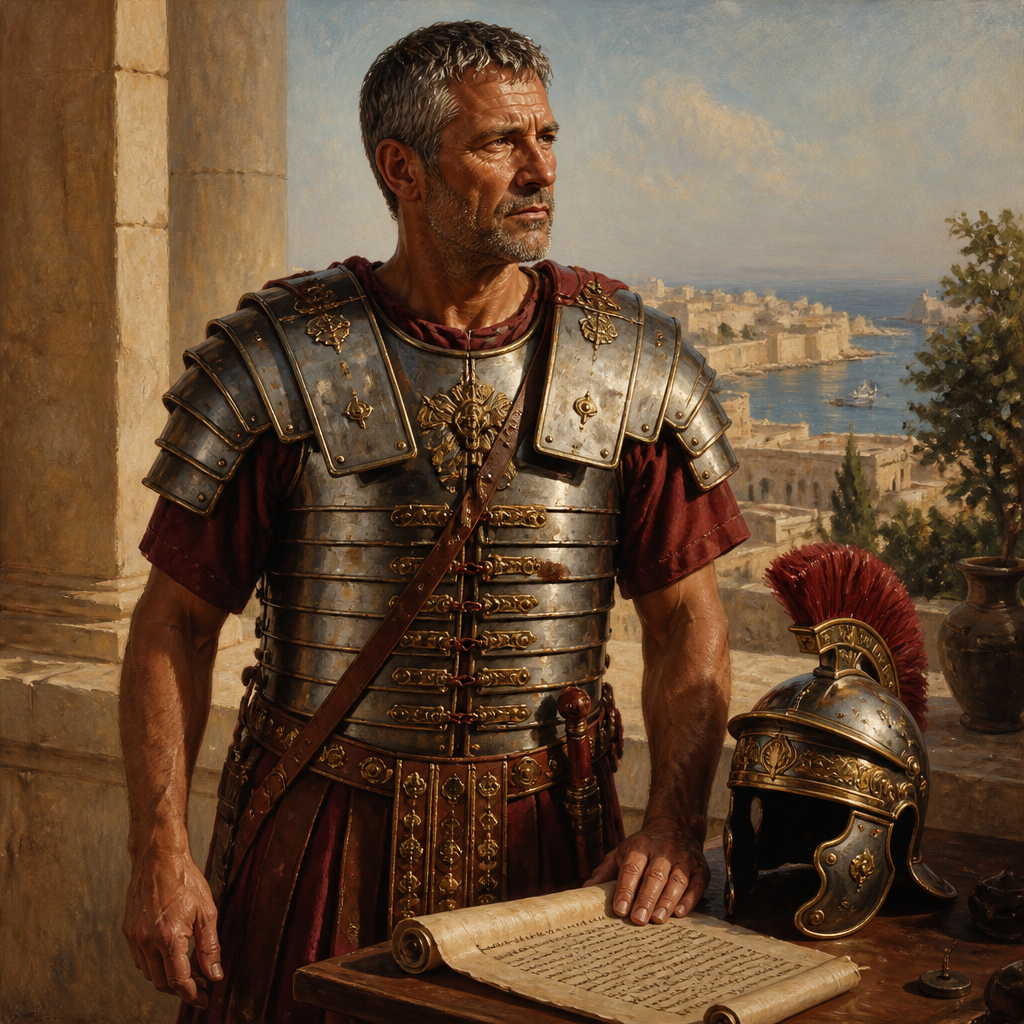
The unnamed figure known as the 'devout soldier' appears in the tenth chapter of the Book of Acts. He was a subordinate to Cornelius, a centurion of the Italian Regiment stationed in Caesarea Maritima. While the New Testament contains several accounts of Roman military personnel, this individual is unique for the specific descriptor 'devout' (Greek: eusebes), indicating a personal commitment to the God of Israel that mirrored his commander's faith.
His role, though brief in the narrative, was essential to the expansion of the early Church. He served as one of the three messengers sent by Cornelius to Joppa to retrieve the apostle Peter. This mission facilitated the first formal inclusion of Gentiles into the Christian community without the requirement of circumcision, a pivotal transition in the apostolic era during the mid-1st century AD.
Background and Family
The devout soldier lived during the Roman occupation of Judea in the 1st century AD. As a member of the 'Italian Regiment' (Acts 10:1), he was likely a professional soldier recruited from Italy or a Roman colony. While the Bible does not record his name, age, or lineage, it provides a rare glimpse into the spiritual life of the Roman rank-and-file. He was part of the household staff or immediate circle of Cornelius, the centurion.
The text implies that the religious atmosphere of Cornelius’ house was pervasive. Acts 10:2 notes that Cornelius was 'a devout man who feared God with all his household.' This suggests that the soldier's faith was not merely a professional duty but a shared conviction. As a 'God-fearer,' he would have been a Gentile who worshipped the God of Israel and followed Jewish moral ethical codes, though he had not undergone full conversion to Judaism through circumcision.
Major Life Events
The primary event involving the devout soldier occurred in Caesarea about 37–40 AD. After Cornelius received a vision of an angel instructing him to send for Simon Peter, he summoned two of his household servants and a 'devout soldier' from among his personal attendants (Acts 10:7).
The soldier’s selection for this task reveals the high level of trust Cornelius placed in him. The mission required traveling approximately 30 miles south along the coast to Joppa. Upon arrival, the soldier and his companions found Peter on a rooftop, recovering from his own vision of the sheet filled with clean and unclean animals.
'And while Peter was pondering the vision, the Spirit said to him, “Behold, three men are looking for you. Rise and go down and accompany them without hesitation, for I have sent them.”' (Acts 10:19-20)
The soldier acted as a witness to the divine orchestration of the meeting. He and the servants explained Cornelius’ vision to Peter, lodged with him overnight—a significant social crossing of Jewish-Gentile boundaries—and escorted Peter back to Caesarea the following day. He was present when the Holy Spirit fell upon the Gentiles, marking the 'Gentile Pentecost.'
Relationship to Other Biblical Figures
The soldier’s primary relationship is with Cornelius. He is described as one of those who 'waited on him continually' (Acts 10:7), suggesting he was an adjutant or a personal bodyguard. This proximity allowed him to be influenced by Cornelius’ righteousness and generosity.
His relationship with Peter is one of a catalyst. By respectfully approaching the apostle and conveying the centurion's message, he helped bridge the gap between the Jewish apostolic leadership and the Roman military world. He was among the first group of Gentiles to hear the Gospel directly from Peter's lips.
Spiritual Significance
Theologically, the devout soldier represents the concept that 'God is no respecter of persons.' His inclusion in the narrative serves several purposes in the Book of Acts:
- The Spread of Faith within the Military: He demonstrates that the Gospel found fertile soil among the Roman occupiers. His presence suggests that faith was not limited to the upper echelons (like centurions) but also flourished among common soldiers.
- Character over Title: By labeling him 'devout' (eusebes), Luke—the author of Acts—highlights his internal state rather than his military rank. This term is the same one used to describe the most pious Jews, signifying that the soldier’s devotion was recognized as genuine.
- The Role of the Messenger: He serves as an example of a faithful subordinate. His prompt obedience to Cornelius’ vision contributed to a turning point in redemptive history. Without the faithful delivery of the message, the historic meeting at Cornelius' house might not have occurred as it did.
In the broader context of the New Testament, this soldier stands as a testament to the fact that one’s occupation—even in a pagan army—did not preclude one from a sincere and recognized relationship with God.
Spiritual Significance
The devout soldier is significant as a representative of the first Gentile fruit of the Christian mission. His status as a 'God-fearer' within the Roman military highlights the breaking of ethnic and nationalistic barriers in the early Church. His presence in the house of Cornelius when the Holy Spirit fell signifies that the lowest-ranking members of a household were equally recipients of divine grace alongside their masters.
Furthermore, he illustrates the influence of a godly leader. Because Cornelius feared God, those under his command were also drawn toward the truth. The soldier’s role as an intermediary between the Roman world and the Apostle Peter underscores the providential nature of the Church's expansion, proving that God prepares both the messenger and the recipient of the Gospel.
Frequently Asked Questions
Was the devout soldier a Christian?
While he was a 'God-fearer' before meeting Peter, he was present when the Holy Spirit fell on Cornelius' household and was likely among those baptized in the name of Jesus Christ (Acts 10:44-48).
What does the word 'devout' mean in this context?
The Greek word 'eusebes' implies a person who is pious, reverent, and active in their religious duties toward God.
Why did Cornelius send a soldier instead of just servants?
The soldier likely provided protection for the journey from Caesarea to Joppa and served as a high-ranking witness to the sincerity of the centurion’s request.
What regiment did the soldier belong to?
He belonged to the 'Italian Regiment' (or Italian Band), which was a cohort of Roman auxiliary volunteer infantry recruited from Italy.
Did the soldier see the angel that appeared to Cornelius?
The Bible does not state he saw the angel; rather, it says Cornelius 'explained everything to them' (Acts 10:8) before sending them to Joppa.
Connected Figures
Cornelius
Commander and spiritual mentor
Peter the Apostle
Teacher to whom he was sent
Simon the Tanner
Host in Joppa where the soldier stayed