Cornelius
A Roman centurion based in Caesarea who became the first Gentile to receive the Holy Spirit and be baptized into the Christian faith.
Cornelius was a centurion of the Italian Regiment, a sub-division of the Roman military stationed in Caesarea Maritima. Despite his Roman background and allegiance to the Empire, the Book of Acts describes him as a God-fearing man who was dedicated to prayer and charity. His conversion marks a definitive turning point in the history of the early Church, as it signaled the inclusion of the Gentiles into the new covenant without the requirement of becoming Jewish proselytes.
His encounter with the Apostle Peter serves as the catalyst for the Church's expansion beyond its Jewish roots. Through a series of divine visions given to both Cornelius and Peter, the Holy Spirit broke down the cultural and religious walls that had previously separated Jews from the rest of the world. This event is widely regarded as the 'Gentile Pentecost,' confirming that the gospel of Jesus Christ was intended for all of humanity.
Background and Family
Cornelius lived in the cosmopolitan city of Caesarea, the administrative capital of the Roman province of Judea. As a centurion, he commanded a 'century' of approximately 80 to 100 soldiers within the Italian Regiment (Latin: Cohors II Italica Civium Romanorum). This unit's presence in Judea is historically consistent with Roman military records from the mid-1st century AD.
Though a Roman officer, Cornelius and his entire household were described as 'devout and God-fearing' (Acts 10:2). In the 1st-century context, 'God-fearers' (Phobeomenoi) were a specific class of Gentiles who were attracted to the monotheism and ethics of Judaism. They attended synagogue services and observed some Jewish customs, such as dietary laws or the hours of prayer, but they did not undergo circumcision or fully convert to Judaism. Cornelius was noted specifically for his generosity toward the Jewish people, often giving alms, which likely earned him a level of respect seldom afforded to Roman occupiers.
Major Life Events
The account of Cornelius begins with a vision occurring at the ninth hour of the day (3:00 PM), a traditional Jewish hour of prayer. An angel of God appeared to him, calling him by name and informing him that his prayers and gifts to the poor had 'come up as a memorial offering before God' (Acts 10:4). The angel instructed him to send men to Joppa to fetch Simon, also known as Peter, who was staying with a tanner named Simon.
Simultaneously, the Apostle Peter received a vision of a sheet descending from heaven filled with 'unclean' animals, with a divine command to 'kill and eat.' This vision challenged Peter’s strict adherence to Jewish purity laws. As Peter pondered the vision, the messengers from Cornelius arrived. Internalizing the message that 'what God has made clean, do not call common,' Peter agreed to travel to Caesarea—an act that would normally be considered a violation of Jewish social and religious protocol.
When Peter arrived at the house of Cornelius, he found a large gathering of the centurion’s relatives and close friends. As Peter began to preach the gospel of Jesus Christ, the Holy Spirit fell upon the entire audience. The Jewish believers who accompanied Peter were astonished to see that the gift of the Holy Spirit was poured out on Gentiles. Seeing this divine confirmation, Peter ordered that they be baptized in the name of Jesus Christ.
Relationship to Other Biblical Figures
Cornelius is primarily linked to the Apostle Peter. Their interaction represents the resolution of a significant tension within the early Christian movement: whether the Messiah’s message was exclusively for Israel. Peter’s willingness to enter a Gentile’s home and eat with him was a radical departure from tradition, later requiring him to defend his actions before the church leadership in Jerusalem (Acts 11).
Cornelius also stands as a counterpart to the Roman centurion in the Gospels (Matthew 8) whose faith Jesus praised. Both figures represent the 'worthy Gentile' whose heart was prepared to receive the kingdom. Within his own household, Cornelius exercised a strong spiritual influence, as evidenced by his family and at least one 'devout soldier' who served him and shared his vision of the true God.
Spiritual Significance
The story of Cornelius is central to the theology of universality in the New Testament. It functions as a bridge between the ministry of Peter to the Jews and the upcoming missionary journeys of Paul to the Gentiles. Theologically, the conversion of Cornelius demonstrates that salvation is by grace through faith rather than by adherence to the Mosaic Law.
The 'Gentile Pentecost' in Cornelius’s house proved that God does not show favoritism (Acts 10:34). By bestowing the Holy Spirit upon Cornelius before he was even baptized or circumcised, God provided an undeniable sign that the barrier of the 'middle wall of separation' (Ephesians 2:14) had been permanently removed. Cornelius remains a symbol of the seeker whose sincere quest for truth is met by a God who reaches across cultural and political divides.
Spiritual Significance
Cornelius is the pivotal figure through whom God opened the door of the gospel to the non-Jewish world. His conversion was the empirical evidence needed to convince the early Jewish-Christian community that God had granted 'repentance that leads to life' to the Gentiles as well as the Jews. This shift fundamentally changed the demographic and theological trajectory of Christianity from a Jewish sect to a global faith. Furthermore, his character as a God-fearing soldier challenges the dichotomy between military service and spiritual devotion, showing that a high-ranking officer of an occupying force could be found righteous before God.
Frequently Asked Questions
Was Cornelius the first Gentile to believe in Jesus?
While others like the Ethiopian Eunuch may have been baptized earlier, Cornelius is widely considered the first 'official' Gentile convert because his conversion was the first to be publicly validated by an Apostle and led to a change in Church policy regarding Gentile inclusion.
What is the 'Italian Regiment' mentioned in his story?
The Italian Regiment (or Cohors II Italica) was a Roman auxiliary unit made up of Roman citizens, likely from Italy, stationed in the province of Judea to maintain order.
Why was it a problem for Peter to visit Cornelius?
In first-century Jewish tradition, entering the home of a Gentile or eating with them was considered ritual defilement. Peter had to be convinced by a vision from God that no person should be called 'unclean' before he agreed to visit.
Did Cornelius have to be circumcised after his conversion?
No. The falling of the Holy Spirit upon him while he was still uncircumcised proved to the Apostles that circumcision was not a requirement for Gentile believers to receive God's grace.
What happened to Cornelius after his baptism?
The Bible does not provide further details on his life. However, Church tradition suggests he may have become a leader in the church at Caesarea, and some accounts claim he later became a bishop.
Connected Figures
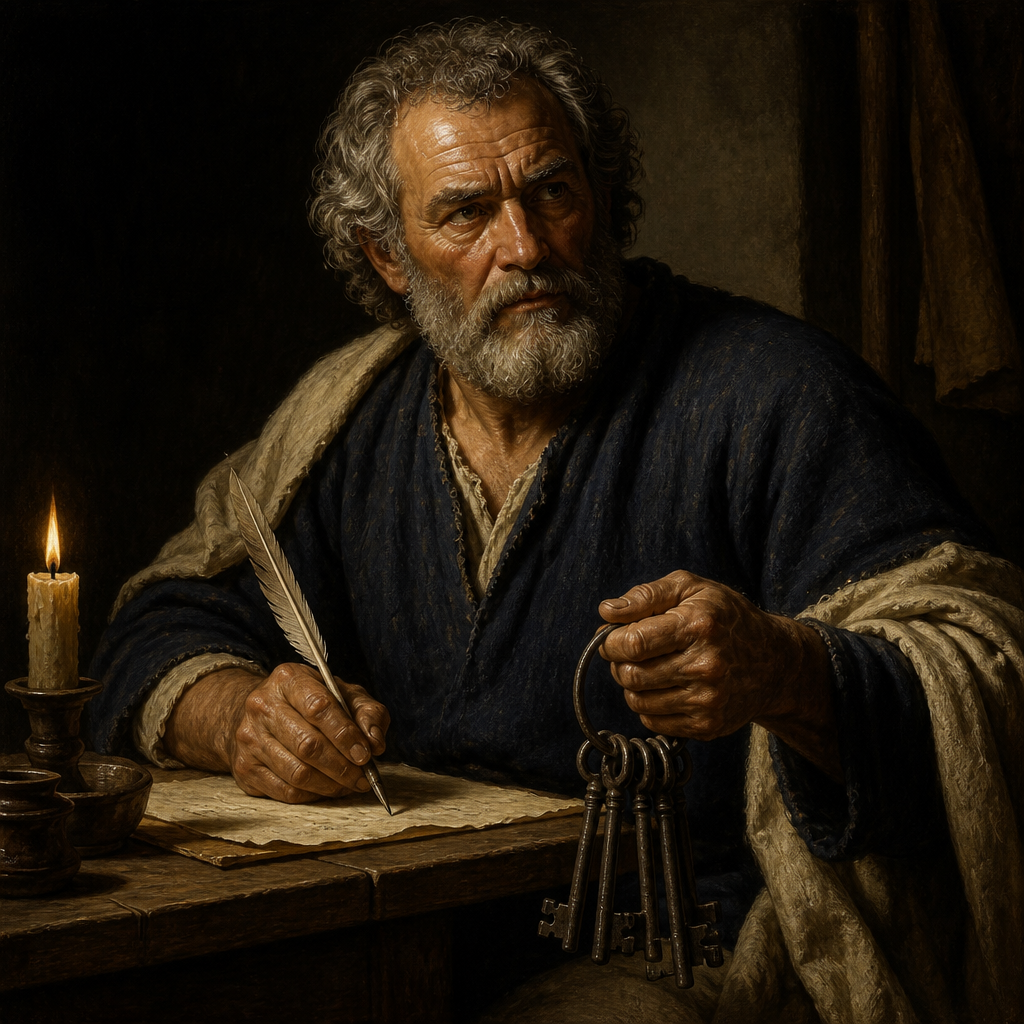
Peter
Apostle who preached to and baptized him
Simon the Tanner
Peter's host in Joppa when Cornelius's messengers arrived
Philip the Evangelist
Resident of Caesarea who likely interacted with the new converts