
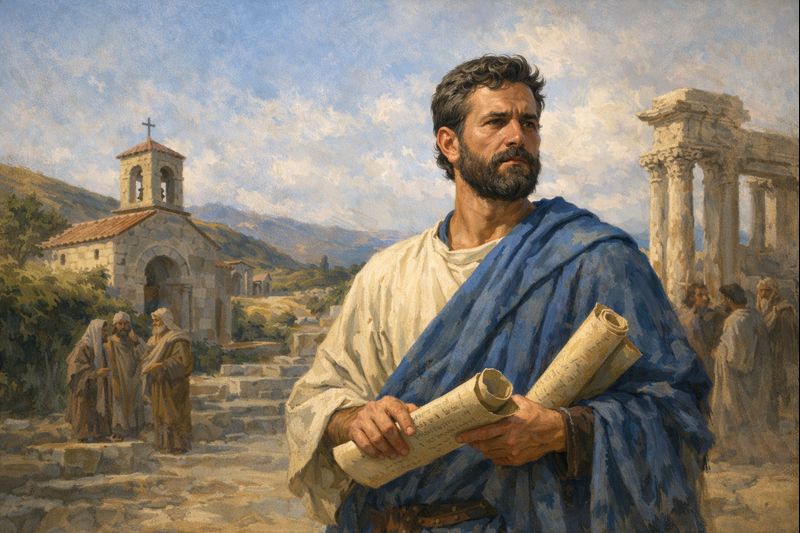
Titus was a trusted coworker of the apostle Paul and an important leader in the early Christian church. Although he is never mentioned in the Book of Acts, Titus appears prominently in Paul’s letters and plays a key role in the spread and organization of the gospel among Gentile believers.
A Gentile Convert and Proof of the Gospel’s Power
Titus was a Gentile (non-Jewish) believer, likely converted through Paul’s ministry. This made him especially significant in the early church, where questions about whether Gentile Christians needed to follow Jewish ceremonial laws—such as circumcision—were hotly debated.
Paul references Titus during the Jerusalem Council, explaining that Titus was not compelled to be circumcised, even though he was Greek. This stood as a powerful affirmation that salvation is by grace through faith, not by works of the law (Galatians 2:1–3). Titus himself became a living example of the gospel’s freedom.
A Faithful and Dependable Coworker
Paul clearly held Titus in very high regard. He calls him “my true child in a common faith” (Titus 1:4, ESV), language Paul uses only for his closest protégés. Titus often acted as Paul’s representative in difficult or sensitive situations.
One such instance involved the troubled church in Corinth. Paul sent Titus to Corinth to help address serious issues in the church, including division and moral failure. Titus handled the task faithfully and later brought Paul encouraging news of the Corinthians’ repentance and renewed obedience (2 Corinthians 7:6–7, 13–15). Paul’s relief and joy over Titus’s report show how deeply he trusted him.
Leader of the Church in Crete
Titus’s most well-known assignment was in Crete, where Paul left him to organize and strengthen the churches. Paul writes:
“This is why I left you in Crete, so that you might put what remained into order, and appoint elders in every town as I directed you.” (Titus 1:5, ESV)
The letter to Titus—one of the Pastoral Epistles—gives practical instructions on church leadership, sound doctrine, and godly living. Paul emphasizes that right belief must lead to right conduct, especially in a culture known for moral laxity.
Titus was responsible for appointing qualified elders, silencing false teachers, and encouraging believers to live lives that reflected the grace of God.
A Model of Good Works and Sound Doctrine
Throughout the letter to Titus, Paul stresses the connection between theology and everyday life. Believers are to be “zealous for good works” (Titus 2:14) and to live in a way that “adorns the doctrine of God our Savior” (Titus 2:10).
As the leader charged with teaching and modeling these truths, Titus himself would have needed to embody maturity, humility, and integrity. His life demonstrated that Christian leadership is not merely about authority, but about example.
Titus’s Legacy
Scripture does not record the end of Titus’s life, though later church tradition suggests he continued ministering faithfully for many years. What the Bible makes clear is that Titus was:
- A proof of God’s grace to Gentiles
- A trusted partner of the apostle Paul
- A capable leader in challenging ministry contexts
- A model of faith, obedience, and good works
Though he may not be as well-known as Peter or Paul, Titus played a crucial role in the foundation and health of the early church.
Why Titus Still Matters Today
Titus reminds believers that the gospel transforms people from every background and that healthy churches require both sound doctrine and godly living. His life challenges Christians—especially church leaders—to live faithfully, teach clearly, and trust God’s grace to produce real change.
In many ways, Titus stands as a quiet but powerful example of faithful service in God’s kingdom.